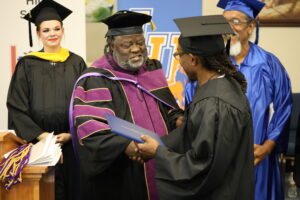
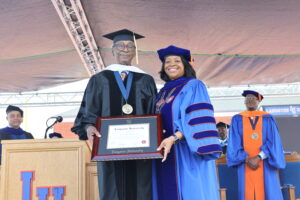
Prentice Ponds II fought back tears as he shook hands with Dr. Alonzo Peterson.
An inmate at Dick Conner Correctional Center (DCCC) in Hominy, Oklahoma, Ponds never thought he would have the opportunity to attend college. It was one of the many doors he assumed had been closed to him for good when he received a life sentence for a robbery conviction in 2017. But thanks to Langston University’s Second Chance Pell Program, Ponds graduated with his Bachelor of Business Administration degree on Aug. 14.
“It was just an experience that I thought I would never have,” Ponds said. “And I had the opportunity and a chance to take it. So I did, and I love it. You know, and I advocate for (this program) all the time.”
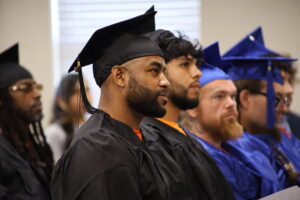
Ponds was one of nine inmates who graduated from Langston University and participated in a small graduation ceremony at the medium security chapel at the DCCC. Many of the inmates had friends and family who attended, along with several LU faculty and staff.
Nine inmates at Dick Conner Correctional Center graduated from Langston University in a small ceremony on Aug. 14, 2026.
The celebration included remarks from Dr. Ruben Herron, a professor in LU’s Department of Rehabilitation and Disability Studies, as the guest speaker; an honors student recognition for those on the Dean’s and President’s Honor Rolls; induction into the Delta Mu Delta Honor Society for qualifying students; and the formal conferral of degrees. The ceremony also included a recognition and diploma conferral for inmates who graduated from the Oklahoma Department of Corrections’ Lakeside High School.
Seven men graduated with their Bachelor of Business Administration, and two men graduated with their Bachelor of Science in Rehabilitation Services.
“It was truly a special day,” said Dr. Peterson, LU’s Vice President for Academic Affairs. “You could see what the moment meant not only to the graduates, but also to their families and loved ones, as well as our faculty and staff who have worked with these students along the way.”
The Second Chance Pell Program operates under LU’s Tulsa Campus. It was established in 2017 under the U.S. Department of Education’s Second Chance Pell Initiative, which restored Pell Grant eligibility for incarcerated individuals in 2015. Beginning with the 2026-27 school year, the Second Chance Pell Program will transition to a Prison Education Program.
Students in the program are able to choose between degrees in Business Administration or Rehabilitation Services. These degree programs were chosen because they are best suited to serve the graduates when they complete their sentences and re-enter the workforce.
Sylvester Stanley, a Rehabilitation Services graduate, said he loved the program because it helped him learn more about himself and has motivated him to keep pursuing education.
Sylvester Stanley earned his Bachelor of Science in Rehabilitation Studies. He wants to use his degree to help at risk youth in Tulsa when he is released.
“It helped me to kind of grow and change in here to where I know I’m locked up, but I’m not locked up,” Stanley said. “Because it’s a mindset thing. So, I take my mind and use it as a tool to help me better myself and the people around me. I’ve got this support system in the world, and I want to let them know that I’m not allowing prison to be the deciding factor of how I act or dictate my mood or my feelings.”
To qualify for graduation, the inmates must meet all the same degree requirements as regular LU students. For many, this takes longer than the standard four years because they may have to take a semester off to work or see to responsibilities within the court system. Ponds and Stanley remained dedicated to their studies, and they both earned honors for their work. Ponds was even able to graduate with a perfect 4.0 GPA.
Stanley said it was important to him to devote his time to his studies because he has goals for his life after DCCC. When he’s released, he wants to work with at risk youth in Tulsa to help prevent them from making the same mistakes he did. He hopes to have an opportunity to begin working on his master’s while still in jail so that he will be one step closer to becoming a licensed professional counselor when he leaves.
For Dr. Peterson, this is the true goal of the program. He doesn’t see it as simply a way for the inmates to earn degrees; it’s a way for them to take control of their futures.
“I am proud that Langston University is able to provide this opportunity,” Dr. Peterson said. “These men made a decision to use education to change the direction of their lives, and they worked hard to earn their degrees. When they return to their communities, they will do so as college graduates with an education they can use to create new opportunities for themselves and their families. And just as importantly, they are now proud alumni of Langston University.
“For me, this is what our work is really about: changing lives, creating opportunities and giving people hope for what comes next.”
Sherman Lewis knew to wake up when he heard the rooster crow.
The sun was just beginning to peer into the windows of the bedroom he shared with his four siblings. Mom was already stirring in the other room. Lewis dressed quickly and began attending to his morning chores. The chickens, cows, pigs and horses needed to be fed, and the cows needed to be milked. Regardless of how tired Lewis might be in the mornings, the animals had to be tended.
The small sharecropper farm Lewis lived on was six miles south of Beggs, Oklahoma, and about half a mile from Toland Primary School. After the animals were cared for, Lewis and his siblings walked to school.
The trek took Lewis through farmland and dirt roads before he came upon the small, two-room schoolhouse where he was educated from pre-primer (what we now call kindergarten) through the eighth grade.
Lewis is a 1964 graduate of Langston University.
After finishing the school day, Lewis would return home and help care for the crops. The grit of the sandy loam soil worked its way under his nails as he tended to the cotton, corn, hay, black-eyed peas or other specialty crops. The flat farmland gave him a perfect view of the sunset
Afterward, his mother would sit Lewis and his siblings down by the kerosene lamp so they could focus on their homework and study.
“My mother, although she only had an eighth-grade education, thoroughly believed in getting an education,” Lewis said. “She emphasized it to all the children. We had a set time to do (homework)… she always enforced that at this time, you’re going to study. Now, after you do that, then you can have some time to play.
“She would always say to me, ‘Promise me that we––’ and she would always say ‘we,’ me and her ‘––are going to college.’ She wanted me to be the first one in the family to get a college education. She kind of drilled that into me.”
That idea was drilled in Lewis not just with the words of his mother, but also with her discipline and perseverance. Lewis had no choice but to feed the animals and milk the cows every morning. He had no choice but to tend to the crops, and he had no choice but to study.
This regimen continued throughout Lewis’ childhood. Eventually, he moved from Tolson Primary School to Beggs Wheatley High School where he continued to work hard and study even harder. College was always the goal.
The discipline Lewis learned growing up on a farm helped him when he got to college.
Only Lewis and two of his four siblings graduated from high school.
Lewis kept his promise to his mom after graduating and enrolled at Langston University so “they” could go to college.
His disciplined upbringing on the farm prepared Lewis for life at LU. Now, instead of waking up early to feed the animals and milk the cows, he started his mornings in the university cafeteria, washing pots and pans and preparing breakfast. His walks to Toland and Beggs Wheatley High School became treks across campus to attend class, and he would return to the cafeteria for lunch and dinner to continue washing the dishes.
Lewis would finish with the dishes around 8 p.m. every day, return to his dorm and study. His old routine rooted in him so long ago.
“Having a very disciplined life growing up on the farm prepared me extremely well for college because I already had that work ethic and didn’t mind working,” Lewis said. “Success is when preparation meets opportunity. My upbringing prepared me for the opportunity to go to college.”
Despite all the hard work, life at Langston University is Lewis’ favorite memory.
Campus was even closer knit in the ‘60s than it is today. Many of the students were poor, and hardly any of them had a car. They mostly stayed on campus or visited downtown Langston, so campus events were essential to the social lives of Langston Lions. Dances at the Student Success Center kept them the most entertained.
The four years Lewis spent as a student at Dear Langston shaped the trajectory of his life.
But professors still had the highest expectations for their pupils. Lackadaisical students were not tolerated. Professors would call out students who were not doing their work in front of the class, and students would support each other by helping them study.
“You hear about Langston University being a family,” Lewis said. “Well, that’s been the case forever. Everybody was here to help each other.”
Lewis graduated from Langston University in 1964 with a degree in agricultural economics and a minor in mathematics, fulfilling his and his mom’s dream of becoming the first college graduate in his family.
Lewis couldn’t have known it at the time, but those four years he spent at Dear Langston would shape the trajectory of his personal and professional life for years to come.
“Having the opportunity to come to Langston University and get an education is responsible for what I’ve achieved over my lifetime,” Lewis said.
EARN
Soon after earning his degree, Lewis joined the United States Air Force.
His service time was spent at Clinton-Sherman Air Force Base in Clinton, Oklahoma, working in the accounting and finance office during the Vietnam War from 1964-1966.
“I often tell people that I made sure the soldiers got paid,” Lewis said.
Lewis entered the Air Force after college before beginning a career with the USDA.
Much like he did during his childhood and collegiate career, Lewis found comfort in the structure and routine of the miliary. Just like on the farm or on the campus of Langston University, he developed habits that kept him consistent and reliable throughout his career.
After two years of military service, Lewis began working for the United State Department of Agriculture (USDA) in what was then known as the Soil Conservation Service.
Lewis moved to Bristow, Oklahoma, to begin his training. Here, he worked directly with farmers and ranchers on conservation practices for a year before being promoted to a Soil Conservationist position in Lawton.
After three years in the position, the USDA approached Lewis with another promotion. This time, they wanted him to be a District Conservationist. The first Black District Conservationist in the country.
“The decision makers (in Oklahoma) and in Washington D.C. were trying to figure out if a Black District Conservationist could be successful working with white farmers and white employees,” Lewis said. “They decided to test it, and for some reason they selected me.
“Basically, what they were saying was, ‘If you succeed, we’ll select another (Black District Conservationist), but if you fail, we are not going to select another one.’”
Lewis didn’t have a choice but to be successful.
But to his surprise, Lewis didn’t run into the issues the “decision makers” were concerned about.
Lewis was a trailblazer in the USDA. He was the first Black person to hold several types of leadership roles in the USDA.
“They were seeing things that did not exist,” Lewis said. “As far as the employees and farmers were concerned, I had no problem. They just wanted someone to help them. They didn’t care.”
After two years of success as a District Conservationist, the USDA decided to give Lewis another opportunity. This time, to be the first Black Area Conservationist.
Lewis accepted the opportunity in 1974 and was sent out of Oklahoma to Spokane, Washington, where he was responsible for all of Eastern Washington.
Regardless of the role he was given, Lewis continued to break down barriers. He proved not only that he was capable, but that Black workers were capable of the same work white employees had been doing for decades.
Because Lewis had proven himself, the USDA decided to send him back to school for a little more education.
Lewis began attending Harvard University in 1976 and within a year earned his master’s degree in public administration from the John F. Kennedy School of Government, otherwise known as the Harvard Kennedy School.
After graduating, Lewis was sent to Boise, Idaho, as an Assistant State Conservationist. He was the first Black Assistant State Conservationist in the United States.
After over two years in the position, Lewis was made the first Black State Conservationist, sending him to Massachusetts, then Nebraska. He served in these roles until 1986, when Lewis was asked by the Deputy Secretary of Agriculture to move to Washington, D.C., to develop national policy for the advancement of civil rights within the USDA.
This made Lewis the Special Assistant to the Deputy Secretary of Agriculture.
Through this role, Lewis helped develop the 1890 National Scholars Program, place liaisons on all 1890 land-grant institutions and create the 1890 Centers of Excellence.
“I did that,” Lewis said. “I provided that leadership in putting those policies in place.”
During his time at the USDA, Lewis helped implement many programs to help farmers and Black people interested in agriculture.
These programs continue to benefit not just Langston University students, but students at HBCUs across the nation.
After a year as the Special Assistant to the Deputy Secretary of Agriculture, Lewis was reassigned back to the Soil Conservation Service as the Director of Conservation planning in Washington, D.C. After a year, he became the country’s first Black Assistant Chief of the Midwest in 1990. Two years later, Lewis was named the first Black Deputy Chief for Management and Strategic Planning.
During this time, Lewis began the National Organization of Professional Black Soil Conservation Employees. The goal of this organization is to assist Black employees with their training so they can move into middle and upper management positions. This organization is still active today. Lewis was also instrumental in changing the name of the Soil Conservation Service to the Natural Resource Conservation Service.
Lewis retired from the USDA as the Deputy Chief for Management and Strategic Planning in 1997.
Dr. Ernest Holloway, the 14th President of Langston University, convinced Lewis to retire early.
“Whenever Dr. Holloway was in D.C., he would always stop by my office,” Lewis said. “He would always say, ‘As soon as you’re able to retire, we need you to come back home and help us start a new program out there in outreach management.’
“I had not planned on retiring in 1997. I was only 56 years old. If he had not asked me to do so, I would have worked for another three, four or five years in Washington, D.C. I retired on a Friday morning in 1996, and the following Monday in 1997 I started to work (at Langston University).”
Drawing on decades of federal and state relationships, Lewis created the Center for Outreach Programs, securing grants and cooperative agreements with several agencies, eventually bringing in around $5 million a year. These funds not only sustained Dear Langston’s outreach work but also supported other university programs.
After Dr. Holloway’s retirement, Lewis became the Assistant Administrator for Extension, continuing to serve the Langston University community until 2006.
“I felt like I finally had something to offer Langston University,” Lewis said. “Langston University had been very good to me and helped me be what I was at the time and what I am today. So, I wanted to give something back to LU. It was one of the best decisions I ever made.”
RETURN
Within five years of graduating from Langston University, Lewis started giving back to the university every year.
It started small. At first, it was maybe $100 a year. But as his professional life grew, so too did his giving.
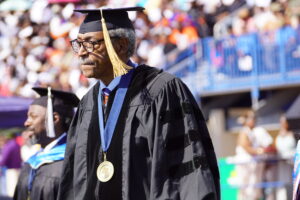
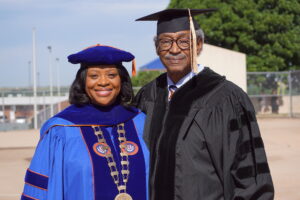
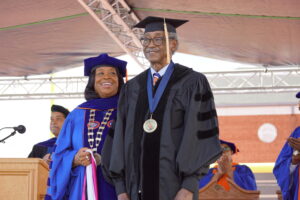
Lewis was honored at LU’s 126th Commencement Ceremony with an honorary doctorate of humane letters.
While working at Langston University, Sherman began a private business in Houston, Texas, with his son and daughter. When he retired from LU in 2006, Lewis began working in that business full-time. It began to flourish.
This allowed Lewis to start giving to the university in a major way, with his first large donation being made in 2015.
In 2018, Lewis and his family sold the business. This gave Lewis the time and means to really focus on his philanthropy. Now, he’s the largest individual donor in Langston University history.
“I’ve always wanted to be a philanthropist because I know the value of giving back,” Lewis said. “I’m so proud of that philanthropy. I think back to the founders of Langston University who were doing whatever they could to raise $5,000 (in the 1890s). Baking, selling blankets, whatever it took.
“They weren’t doing that for themselves. It’s about the future, about future kids and about their education. They were philanthropists, but they didn’t have a lot of money. They had a vision. That’s my philosophy, doing something now to help future generations.”
Lewis remembers hearing some smart person say the words “Learn. Earn. Return.” The phrase immediately resonated with him. Now, he lives by that motto.
Because of Lewis’ generosity, he became the namesake of the Sherman Lewis School of Agriculture and Applied Sciences in 2022, the first named school in LU history.
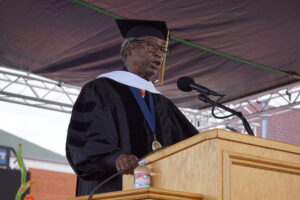
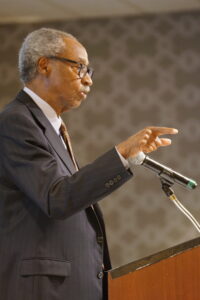
At this year’s Commencement Ceremony, Lewis served as the commencement speaker and was honored with the conferral of an honorary doctorate in humane letters.
“It’s an extreme honor,” Lewis said. “I’m the first in my family to ever receive a college education. If my mother and sisters and brother were here today to know I was receiving an honorary doctorate from Langston University, they would be so proud of that.
“I’m proud of it not for myself, but for my family. For my daughter and son. To show young people that anything is possible, but you must be willing to help others.”
But giving isn’t about the accolades and honors received.
To Lewis, It’s about the future of Langston University.
“You came to Langston University to learn,” Lewis said. “Now you’re ready to go out to earn money. Be willing to return some of those earnings to Langston University to educate someone else 100 years from now, the same way people in 1890 did for you.
“If more of us adopted that saying, Langston University would be strong for a long, long, long time.”
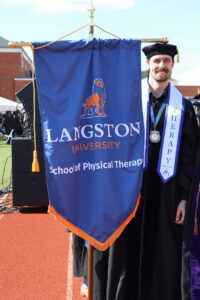
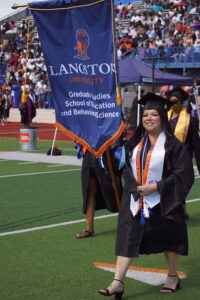
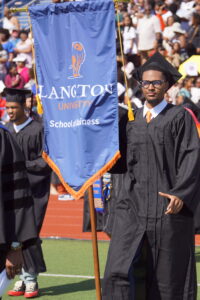
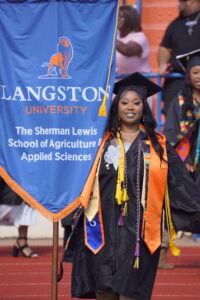
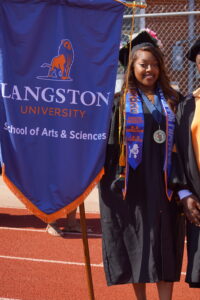
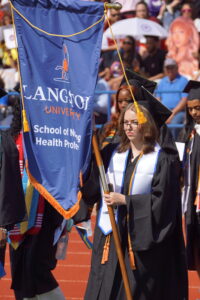
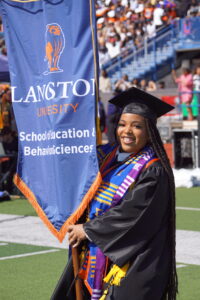
Langston University’s annual Commencement Ceremony is a joyous event filled with many meaningful traditions, and one of the most prized of these is the tradition of the School Flag Bearers. As the graduates process onto the field at the beginning of the ceremony, each academic school is led by their dean and one of their peers who carries the school flag. These coveted positions are awarded to the graduates with the highest grade point averages from each school. It is a recognition of their hard work and stellar academic performances throughout their time at Dear Langston. Meet the School Flag Bearers for the Class of 2026.
Jake Landes was the Flag Bearer for the School of Physical Therapy.
Jake Landes
Doctor of Physical Therapy, School of Physical Therapy
Jake Landes has always believed in helping others. He grew up in Tonkawa, Oklahoma, and his small town upbringing taught him the importance of community and service. So when he graduated from the University of Central Oklahoma in 2023 with his B.S. in General Studies, after earning his associate’s in biomedical sciences from Northern Oklahoma College in 2020, it made sense to choose a career that was all about helping people.
“I chose physical therapy because I wanted to have the ability to have a direct impact on people’s quality of life,” Landes said. “Physical therapy combines science and critical thinking, allowing me to use my mind to solve complex problems and my hands as tools to help restore function, movement and independence.”
With this goal in mind, Langston University seemed like the perfect fit for Landes. The smaller class sizes appealed to him, and the program’s affordability made it feasible to pursue his dream of being a physical therapist. Additionally, the university’s values aligned with his own.
“I decided to attend Langston University School of Physical Therapy because of their focus on servant leadership, and the opportunity to be a part of a program that values clinical excellence and serving the underserved,” Landes said.
Landes excelled right from the beginning. His first year, his classmates elected him Class President. In this role, he advocated on behalf of his classmates and organized community service projects. In class, his professors mentored him. They guided him as he developed his clinical reasoning and professionalism, and they instilled confidence in him.
Landes built strong relationships with his classmates. They had class outings, both class-related and just for fun, and they attended the APTA Combined Sections Meeting in Houston together where they had the opportunity to network, learn and grow professionally. He said some of his favorite memories from the program were the late-night study sessions he hosted with his friends, as well as tailgating during Homecoming.
After graduation, Landes plans to work as a travel physical therapist to continue developing his clinical skills in different settings and communities. Eventually, he plans to transition into an outpatient clinic with the hopes of owning his own clinic one day.
“Langston University School of Physical Therapy has prepared me academically, clinically and professionally,” Landes said. “This program pushed me to develop strong clinical reasoning, confidence in patient care, and leadership skills that I will continue to develop into my career. Being selected as Flag Bearer represents not only my journey, but the support of my family, classmates, faculty and everyone who helped me along the way.”
Ereca Camero
Ereca Camero was chosen as the Flag Bearer for Graduate Programs.
M.S. Rehabilitation Counseling, Graduate Programs
After graduating with her bachelor’s degree in psychology from Cameron University in 2021, Ereca Camero found her way into the field of tribal vocational rehabilitation services. In this line of work, she supports individuals with disabilities and mental health challenges in achieving their vocational goals. In 2024, she decided it was time to take the next step forward in her career.
That fall, she enrolled in Langston University’s Rehabilitation Counseling master’s program.
“I chose Rehabilitation Counseling because I am passionate about helping individuals overcome mental health challenges, disabilities and vocational barriers,” Camero said. “I wanted to develop the skills needed to support clients in achieving independence, stability and meaningful employment opportunities. And I chose Langston University because of its strong reputation for supporting diverse student populations and its commitment to academic excellence and community impact.”
Camero thrived at LU. Throughout her master’s program, she learned about applied counseling concepts through case studies and clinical practice scenarios which strengthened her understanding of client needs and evidence-based counseling approaches. The program’s faculty became her mentors, providing guidance, encouragement and valuable professional insight throughout her academic journey.
As she continued to perform well in her classes, Camero was invited to join Chi Sigma Iota Counseling Academic and Professional Honor Society International (CSI). The invitation was a recognition of her academic excellence and professional potential in the field of counseling, and she became a proud member of the Lambda Upsilon Chapter at Langston University.
After graduation, Camero plans to continue working in tribal vocational rehabilitation services while expanding her professional experience in counseling and advocacy.
“Langston University has thoroughly prepared me for my next steps by providing both academic knowledge and practical application in rehabilitation counseling,” Camero said. “The program has strengthened my confidence and readiness to continue to work in the field. Some of my favorite memories (from the program) include engaging in meaningful class discussions, collaborating with classmates on assignments and case studies, and growing both personally and professionally throughout the program. The relationships built with peers and faculty made the experience especially memorable.”
Kobe Law was the Flag Bearer for the School of Business.
Kobe Law
B.B.A. Management, School of Business
An Oklahoma City native, Kobe Law came to Langston University in Fall 2022 as a student athlete. He was a basketball player with interests in business and finance, and he knew Langston University was the perfect place for him to grow as an athlete and a young entrepreneur.
“I decided to attend Langston University because it offered a strong Black atmosphere, a supportive campus community and meaningful opportunities for leadership development,” Law said. “I began my journey at LU as a collegiate athlete on the basketball team through an athletic scholarship, which made Langston the right fit for both my academic and personal goals.”
Law majored in Business Administration–Management with a minor in finance. He chose those programs because he knew management would help him understand leadership and operations while finance would strengthen his ability to make strategic decisions and build long-term value.
During his time at LU, Law participated in several student organizations which he said helped him grow as a leader, communicator and more well-rounded person in professional settings. This included becoming the Co‑Founder and Director of Operations of the Langston University Collegiate Chapter of DECA, the Public Relations Chair for Gents, a member of Delta Mu Delta, a member of the National Society of Leadership and Success, a member of the Langston Chamber of Commerce and a student leader in the School of Business.
Law also participated in research as part of the Langston Community Plaza Feasibility Study, which aimed to integrate technology, business innovation and entertainment to create a vibrant community hub for families, entrepreneurs, students, visitors and professionals. Law presented his research in a pitch competition and won first place, receiving a $3,000 award and a three‑day trip to Washington, D.C., to attend the 2025 HBCU Entrepreneurship Empowerment Summit.
“My feasibility study evaluated the project’s potential by analyzing market demand, technical requirements, financial sustainability and operational feasibility,” Law said. “Through this project, I gained skills in first‑hand and second‑hand research, forecasting, project management and professional presentation.”
Law’s professors supported and encouraged him throughout his time at LU, and he considers Dean Daryl Green, Michael Hamilton and Dr. Charles Mambula to be his biggest mentors. After graduation, Law plans to become a project manager and pursue his MBA and a PMP License. Eventually, he wants to become a business consultant.
“Langston prepared me through rigorous coursework, mentorship and leadership experiences that strengthened my professionalism, discipline and strategic thinking,” Law said. “I’m proud to represent LU and excited to carry what I’ve learned here into the next chapter of my life.”
Delisha Carter
Delisha Carter was chosen as the Flag Bearer for the Sherman Lewis School of Agriculture and Applied Sciences.
B.S. Agribusiness, Sherman Lewis School of Agriculture and Applied Sciences
As a student at Landry Walker High School in New Orleans, Louisiana, Delisha Carter started her college search with the intent of studying accounting and finance. As she researched schools, LU stood out to her because it was Oklahoma’s only HBCU. Further research into the history of the institution, its campus life and its academic reputation convinced her to apply, and she was accepted with scholarships. She enrolled in Fall 2022, and Dear Langston quickly became a place she was happy to call home.
Carter got involved on campus right away. She has been a member of the Manners Club since 2022, serving as Vice President for the 2025–26 term. She has also served as the Public Relations Officer for the ABAC Club since 2024. Since Fall 2023, Carter has worked as a Resident Assistant, and she received the RA of the Year award, a Leadership Advocate Award and recognition for maintaining a 3.5 GPA within University Housing departments.
“Some of my favorite highlights at Langston have been the relationships I built with my friends, who have continuously motivated and supported me,” Carter said. “I also cherish the opportunities I’ve had to attend conferences and represent the university, as well as moments where I was able to lead and grow as a student leader.”
Carter made sure to take advantage of networking opportunities throughout her time in school, and she eventually met LU alumna Jateya Jackson. Jackson introduced Carter to the wide range of opportunities within the agriculture field, and Carter decided to change her major to Agribusiness with a minor in accounting.
“Since making that decision, I have not looked back,” Carter said. “I have grown to truly appreciate how diverse and impactful the field of agriculture is.”
After graduation, Carter plans to pursue a career in the corporate sector while working toward becoming a successful businesswoman. Her long-term goal is to own a real estate firm. Thanks to her professors, mentors and her advisor, Dr. Nyairo Newton, Carter is confident she’s prepared for what comes next.
“(Langston University) has shaped me into the woman I am today and has instilled in me the drive to continue striving for excellence,” Carter said. “I am thankful for the experiences, growth and opportunities that Langston has provided me. The long nights and early mornings have all led to this moment, and I am proud to carry the legacy forward.”
Samiya Robinson was the Flag Bearer for the School of Arts and Sciences.
Samiya Robinson
B.A. English and B.B.A Finance, School of Arts and Sciences
Originally from Kansas City, Missouri, Samiya Robinson has always been familiar with Langston University because it’s her great aunt’s alma mater. She understood the unique cultural and historical significance LU holds as Oklahoma’s HBCU, so she decided to apply and was accepted into the Edwin P. McCabe Honors Program. She came to LU in Fall 2021.
Though she originally chose LU because of her McCabe Honors scholarship, she soon fell in love with Dear Langston, and she is proud to be part of the same legacy as her great aunt.
Planning to pursue a career in business, Robinson chose to double major in English and Finance. She chose Finance because she hoped to develop her analytical and strategic thinking skills, and she chose English because she saw the growth and transformation the department has experienced in recent years and wanted to be part of it.
“The English Department pushed me to expand beyond technical skills and really develop my voice, especially in terms of creative expression and rhetoric,” Robinson said. “Together, these programs have allowed me to think both analytically and critically, blending business strategy with creativity and communication in a way that I believe is essential for leadership.”
Robinson also worked to become a leader outside the classroom. She joined the Iota Chapter of Sigma Gamma Rho Sorority, Inc., in Spring 2022, and she said the sorority has been central to her leadership development and college experience. She has served as her chapter’s Vice President, President and Parliamentarian. She has also served as both a National Pan Hellenic Council and chapter delegate.
Beyond Greek life, Robinson worked in the LU Writing Center as a tutor and she served as the Community and Public Relations Chair for the School of Business. She is a Overnight Assistant for Residential Life and Housing Services. She is also a member of the National Society of Leadership and Success, the National Council of Negro Women, the School of Business Student Advisory Board, Sigma Tau Delta English Honor Society, and Delta Mu Delta International Business Honor Society.
After graduation, Robinson will head to Minnesota as part of the 2026 NBA x HBCU Fellowship. She will spend the summer working in Community Engagement with the Minnesota Lynx and Timberwolves organizations.
“My experience here has shaped me in ways that go far beyond academics,” Robinson said. “More than anything, Langston has taught me growth both personally and socially. The 22-year-old I am today exists because my 17-year-old self made the decision to step outside of her comfort zone and choose a school just four hours from home as a place to grow into who I am.”
Kaitlyn Mitchell
Kaitlyn Mitchell was the Flag Bearer for the School of Nursing and Health Professions.
B.S. Nursing, School of Nursing and Health Professions
Kaitlyn Mitchell first discovered her passion for nursing as a student at Perry High School in Perry, Oklahoma. Her mother is a registered nurse, so she grew up with a lot of exposure to the field. When she got to high school, she decided she wanted to learn more. She took classes and became a Certified Nursing Assistant (CNA), and she continued working as a CNA until she graduated.
“I started working as a CNA in high school and fell in love with it,” Mitchell said. “I wanted to be able to do more for people, so I decided to become a nurse.”
Once Mitchell realized this was her calling, she started looking into nursing programs in Oklahoma. Her mother’s coworkers highly recommended Langston University, and it didn’t take Mitchell long to understand why.
She enrolled at LU in Fall 2022, and her professors made it clear early on that it would take a lot of hard work and dedication to earn her BSN. Mitchell was more than up for the challenge. She studied hard for her classes and made the most of her time in clinicals, and she excelled.
Outside of nursing, Mitchell was a member of the Edwin P. McCabe Honors Program, and she was also a member of the Langston University Quiz Bowl Team. She made friends and had fun, but school was her priority.
“Getting into the nursing program was a highlight (of my time at LU),” Mitchell said. “But also, I think nursing pinning and graduation will be my favorite memories since it highlights all my hard work paying off.”
After graduation, Mitchell plans to spend her first year focusing on being a newly graduated registered nurse and gaining experience. Later, she plans to continue her education to eventually become a nurse practitioner.
“I honestly feel like Dr. Hunter has done a good job preparing me for what comes next,” Mitchell said. “But I am absolutely glad it is over, and I made it to this point.”
Brooklyn Noiel was the Flag Bearer for the School of Education and Behavioral Sciences.
Brooklyn Noiel
B.A. Psychology and B.S. Corrections, School of Education and Behavioral Sciences
Originally from Oklahoma City, Brooklyn Noiel has always been a stellar student. She graduated in the top 10% of her class from Moore High School in 2022 before enrolling as a quad major–double bachelors in corrections and psychology and double associates in criminal justice and general studies–at Langston University that fall.
Noiel knew she wanted to be a lawyer, and she knew Langston University was the perfect place for her to earn her bachelor’s degree and prepare for law school.
“I decided to attend Langston University because it offers a strong sense of community, academic excellence and opportunities for personal growth,” Noiel said. “Attending Langston University allows me to grow academically, professionally and personally while being part of a legacy of excellence.”
From the beginning, Noiel was drawn to the supportive environment at LU. As Oklahoma’s HBCU, Langston University celebrates culture, develops leaders and empowers students to reach their highest potential. That’s exactly what Noiel wanted.
That supportive atmosphere helped Noiel excel in and out of the classroom.
She was an LU Ambassador, serving terms as the Historian and the Chief of Staff; a Resident Assistant; a member of Legal Lions, where she served as Treasurer; a member of Sigma Gamma Rho Sorority Incorporated, where she served as the Recording Secretary; and a member of the Scholar’s Club, where she was Secretary and Miss Scholars’ Club. She was also part of LU’s student chapters of the National Council of Negro Women and the National Association of Blacks in Criminal Justice. She sang in LU’s Concert Choir, serving as the Wardrobe Lead and President, and she participated in the Student Government Association Senate, where she served as an Associate Justice to the Chief Justice,
After graduation, Noiel will intern at MedPro Group as their Inclusion and Engagement Intern in Fort Wayne, Indiana. In addition to her internship, Noiel plans to study for the LSAT with hopes of attending law school in Fall 2027.
“I truly feel that Langston University has prepared me for what comes next,” Noiel said. “My time here has given me not only a strong academic foundation, but also the confidence, leadership skills and resilience needed to pursue my future goals. Through the support of faculty, staff and fellow students, I have grown personally and professionally, and I feel ready to take the next step toward law school and my career aspirations.”
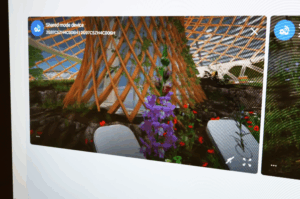
As she stepped into the Pollinator Sanctuary, Andria took a moment to assess her surroundings.
She stood in the middle of a circular path lined with bushes and flowers. Butterflies, bees and other flying insects flitted between the plants, buzzing contentedly and paying her no mind. Her eyes followed the route of a bumblebee as it circled a purple flower to her right and flew over her head, bringing her gaze up to admire the bright blue sky that shone through the crisscrossing wooden beams enclosing her and the insects inside a giant ring.
She returned her eyes to the front and saw six pedestals in front of her. Each held a flower and was labeled with a different pollinator. She stepped forward, reached out, and plucked a bright red and orange marigold from its pedestal. Immediately, a honeybee came and landed on the flower, allowing her to get a good, close look at it. She brought the flower eye-level, and a voice began speaking in her ear, telling her about the daily habits of honeybees.
“Usually, if I saw it in real life, I would get scared,” Andria said. “If I saw a bee, I would run. But since I knew it wasn’t real, I was kind of investigating it, seeing what was on the bug and stuff.”
The VR Pollinator Sanctuary helped students learn about pollination, the insects that pollinate, and how that process plays into everyday life.
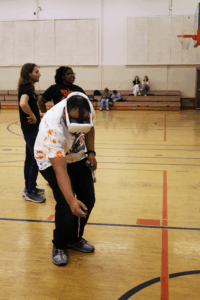
Observing different bees, butterflies and moths up close on the flowers was one of several activities Andria did through the Pollinator Sanctuary Virtual Reality Experience at Langston University on Thursday.
A rising junior at Stillwater High School, Andria is a camper at LU’s 2026 Math and Science Academy. The annual summer camp brings students from all over Oklahoma and surrounding states to the Langston Campus for two weeks to learn about STEM careers, life in college and strategies for taking the ACT. Activities like the Pollinator Sanctuary give the students opportunities to learn about STEM and agriculture in new and exciting ways, which is why Shar Carter is trying to make it more accessible.
Carter is an extension educator with LU’s Cooperative Outreach and Extension Programs (CEOP). She worked with Aaru Entertainment, a virtual reality company based in Tulsa, to bring the Pollinator Sanctuary to Langston for the Math and Science Academy. For two years, she has worked with Aaru to put on similar events around Tulsa with some of the other educational labs they offer, such as a virtual reality space simulation. This summer, she wants to do more.
“We can take them to places, whether that’s botanical gardens or museums, that they might never see in their lifetime,” Carter said. “There’s just so many applications that we can do, and what Dr. (Welsey) Whitaker, Dr. (Alonzo) Peterson and President (Ruth Ray) Jackson have allowed me to do is engage with other departments and adapt it to what they want to do.”
For the Math and Science Academy, Carter wanted it to showcase one of the many intersections of STEM and agriculture.
In the VR Pollinator Sanctuary, students could get a close look at insects and flowers and learn about the importance of pollination and pollinator conservation.
By donning the VR headset, students were transported from LU’s Multipurpose Gymnasium into a state-of-the-art insect sanctuary and observatory to learn about pollination, the insects that pollinate, and how that process plays into everyday life. They looked at bugs and flowers up close, walked through a grocery store with empty shelves where all the food requiring pollination should have been, and learned about pollinator conservation.
For many of the students, this was their first experience with virtual reality, and they were impressed.
“I was excited because I always wanted to try VR,” Andria said. “At first, it wasn’t like how I expected it to be, but it was still fun. It was cool looking around and seeing random things flying around. I think it’s a fun way to learn, especially since it’s kind of like a video game, and most people like video games.”
The experience stuck with the students as more than just a fun activity. Many said they learned things about bees they hadn’t known before, and the impact of seeing the empty grocery store shelves is something many said will stay with them.
Aaiyah, a rising junior at Wiley East High School in Dallas, said the experience was eye-opening.
“It’s showing you how all the pollinators are gonna be gone, and how we’re not really gonna have any food,” Aaiyah said. “Like, in year 2080, we’re really only gonna have bread and wine. It was just really sad because we need to work on it.”
Despite the somber feeling she had when she took off the headset, Aaiyah was still impressed by the VR experience.
“You see things, like articles and stuff like that,” Aaiyah said. “But this was like, you actually got to engage with it. To see the future and back and the difference, and to actually take it in.”
Carter and Aaru will host the next virtual reality STEM education lab on the Langston Campus on June 25 as part of the Sherman Lewis School of Agriculture and Applied Sciences’ HERC Field Day. Carter is working to schedule more around Oklahoma throughout the summer.
The Langston University Rehabilitation Counseling Program has been named one of the Top 10 rehabilitation counseling graduate programs and the Top HBCU program in the nation by U.S. News and World Report.
Langston University rose 8 points in the rankings from 2025 to be named the tenth best program in the United States. Previously tied with Winston-Salem University, LU now sits as the highest ranked Historically Black College or University (HBCU) on the list.
“We are incredibly proud to see our Rehabilitation Counseling program break into the Top 10 nationally,” said Dr. Corey Moore, the founding director of the program. “While the ranking is a high honor, the true reward is watching our graduates enter the workforce fully equipped to lead, and seeing our research translate into better outcomes for the communities we serve.”
Langston University was ranked above programs from the Illinois Institute of Technology, Northern Illinois University, University at Buffalo-SUNY and others.
This accomplishment comes as the program celebrates its 25th anniversary, and LU President Ruth Ray Jackson recently honored Dr. Moore with a Distinguished Service Award for his leadership as the founding chair of the Department of Rehabilitation and Disability Services.
Langston University’s rehabilitation counseling master’s program is available in Oklahoma City and Tulsa. Students benefit from small class settings that allow for more one-on-one interaction with the program’s distinguished faculty, and they have opportunities to participate in ground-breaking research at the department’s two federally funded Rehabilitation Research and Training Centers. Many of the students receive scholarships funded by the Office of Special Education and Rehabilitation Services/U.S. Department of Education, and all students participate in hands-on internships.
“We will use this momentum to further enhance the academic preparation of the next generation of rehabilitation and mental health professionals and to continue translating our high-impact solutions-oriented research initiatives funded by the National Institute on Disability, Independent Living, and Rehabilitation Research/Administration for Community Living,” Dr. Moore said.
For more information about the Rehabilitation Counseling Program, please visit langston.edu/rehab.
For many years, Dr. Ryan Johnson and the Langston University Department of Chemistry have worked diligently to create service-learning and confidence-building programs in STEM fields for high school students.
Dr. Johnson’s goal has always been to expand this work statewide, but he’s learned an important lesson during his endeavors.
“Externally funded programs are powerful but temporary,” Dr. Johnson said. “When grants end, students lose access to support.”
That’s why the Chemistry Department has shifted its focus to sustainability by embedding this work directly into Langston University’s curriculum, building permanent pipelines that connect LU students to Oklahoma communities.
The Thomas E. English Chemistry Leadership Initiative is a curriculum-embedded service learning program named after Langston University’s 12th president, who emphasized education for community engagement and service.
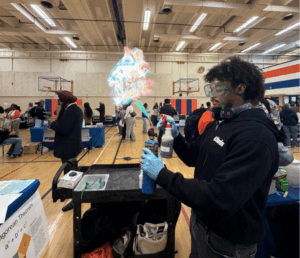
Langston University General Chemistry I students develop and deliver interactive chemistry demonstrations to local high school students, positioning themselves as experts and leaders. During the Fall 2025 semester, more than 25 LU students presented demonstrations at Frederick A. Douglass High School in Oklahoma City on Nov. 11 and 18.
For some of LU’s chemistry students, this was the first time they felt confident calling themselves “scientists.” That change in mindset doesn’t just help students pass chemistry; it shapes their entire STEM journey and career trajectory, according to Dr. Johnson.
General Chemistry I students designed demonstrations on topics like acids and bases, chemical reactions and states of matter. They practiced extensively, then taught 40-minute sessions to Douglass High School chemistry classes.
“This opportunity was encouraging for me because I got a glimpse of how well I can do in the education field as an instructor,” said Oliviya Greenhoward, a General Chemistry I student last semester. “I was so surprised, appreciative of and humbled by the experience.”
The department of chemistry is expanding the Thomas E. English Chemistry Leadership Initiative this semester and has submitted a research proposal to determine whether this type of teaching experience helps students build confidence in STEM fields.
“The goal is to create a replicable model that can scale across Oklahoma and beyond,” Dr. Johnson said. “A sustainable approach to STEM pipeline development that doesn’t depend on external funding cycles.”
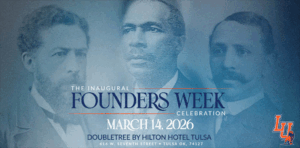
Langston University is set to celebrate 129 years since its founding with a week of ceremonies and celebrations in Langston and Tulsa. The events will include musical performances, the annual Founders Day Program and an Inaugural Founders Week Celebration Gala.
The Langston University Department of Music will present The Chamber Collective musical performance on Tuesday, March 10. This collection of small ensembles will feature both choral and instrumental performances. The event will be held in the I.W. Young Auditorium on the Langston Campus at 6:30 p.m.
The annual Founders Day Program will be held at the I.W. Young Auditorium on the Langston Campus at 11 a.m. on Thursday, March 12. The theme for this year’s program is “Honoring Our Past, Empowering Our Promise,” and the featured speaker will be Dr. Tiffany Crutcher, Founder and Executive Director of the Terence Crutcher Foundation.
Dr. Cruther is an alumna of Langston University, and she is a nationally recognized justice advocate, community leader and social impact advisor. As Founder and Executive Director of the Terence Crutcher Foundation, she leads transformative initiatives focused on public safety, criminal justice reform, economic mobility and community healing. She also serves as a Founding Board Member of Justice for Greenwood, Senior Advisor to Black Tech Street and Advisor to Roc Nation’s United Justice Coalition.
Langston University will end the week with the Inaugural Founders Week Celebration Gala in Tulsa on Saturday, March 14.
The Founders Week Celebration Gala, a black-tie optional event, will include a formal dinner, awards presentation and live music. There will also be a special presentation to commemorate the 25th anniversary of the Master’s in Rehabilitation Counseling program, which has since spurred the creation of a bachelor’s program, the formation of the Department of Rehabilitation and Disability Studies, the establishment of two federally funded Rehabilitation Research Training Centers, and the creation of a post-doctoral research program.
The Chamber Collective and annual Founders Day Program are free and open to the public. The Founders Week Celebration Gala is a ticketed event. Tickets can be purchased online at langston.edu/founders-week through Friday, March 6.
Computer science is often ranked among the best college degrees in the United States, and U.S. News & World Report cites diverse career opportunities as one of the many benefits. Among STEM majors, a degree in computer science prepares students to thrive in technology-driven careers. These positions are often in high demand with leading companies who are focused on innovation and growth.
For those interested in computer science, Langston University is an excellent place to earn your degree.
Since spring 2021, the Langston University Computer Science program has boasted a 100% job placement rate. LU’s computer science graduates have all received jobs in their chosen industry, often solidifying their new jobs prior to graduation. In the past five years, Langston University has also realized a 95.5% enrollment growth in computer science.
Reginald Archibald II, Emoree Coley and Jathaniel Wakefield are just three of Dear Langston’s successful computer science graduates. Their preparation in mastering programming, algorithm design, data structures and developing software applications has paid dividends. In 2024, they earned their Bachelor of Science degrees in computer science. Today, they are living their dream with goals of achieving even more.
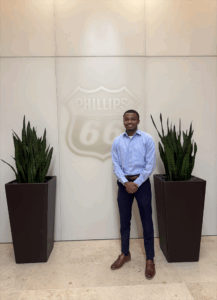
Reginald Archibald II accepted a job as an advisor and developer in commercial analytics for Phillips 66.
Reginald Archibald II
As an advisor and developer in commercial analytics for Phillips 66 in Houston, Texas, Reginald Archibald II is off to a great start. In this position, Archibald leverages his technical skills and tools in helping Phillips 66’s commercial business unit make more informed decisions to provide energy and improve lives.
Prior to graduation, he completed two summer internships as a software engineer with Boeing. Archibald also served as the lead computer scientist for NASA Rock On, where he contributed to the integration of a payload into a two-stage terrier Orion Rocket, and specialized in using a minicomputer to collect atmosphere data.
What Archibald appreciates most about his job is the “great work life balance” and the opportunity to network with fellow professionals.
The most challenging part of his job, Archibald said, is becoming comfortable with the uncomfortable.
”Just using problem-solving skills and networking that I learned from Langston helps me navigate through these real-world scenarios,” Archibald said. “We had conversations amongst peers and professors about scenarios and circumstances we may face in our careers and in the world. These deep conversations not only made me feel prepared in my technical skills and knowledge, but more importantly, my soft skills.”
Ralph Grayson, chair of the computer science department, was instrumental in Archibald’s choice of major. Grayson’s influence continued throughout Archibald’s matriculation, guiding him through internships, projects and coursework.
“I saw how passionate he was about his students’ success,” Archibald said. “He allowed me into his classes my freshman year as a business management major to observe and ask questions of the upperclassmen about their experiences. I was able to witness students who came before me and land amazing careers, and I told myself, that could be me if I buckle down and hit my studies hard.”
Archibald was awarded an Edwin P. McCabe Honors scholarship in addition to becoming an OK-LSAMP scholar. He was also chosen to attend the Thurgood Marshall College Fund Leadership Institute. His other achievements include being named the most outstanding computer science student and the Dr. In Hai Ro awardee for excellence in computer science, and becoming a member of Kappa Alpha Psi Fraternity, Inc.
Grateful for his faith, his family, and LU faculty and professors, Archibald encourages those seeking to pursue their computer science degree to choose Langston University.
“It’s more than a program,” Archibald said. “It is a family – from professors to the students. We uplift one another, hold each other accountable and recognize our peers’ successes.”
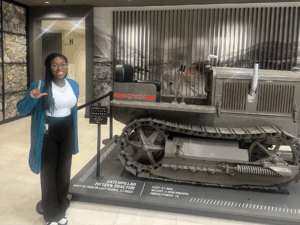
Emoree Coley accepted a job as an Information Technology Analyst with Caterpillar Financial Services Corporation after earning her bachelor’s in computer science at LU.
Emoree Coley
Emoree Coley grew up in Broken Bow, Oklahoma. Today, she is an Information Technology Analyst with Caterpillar Financial Services Corporation in Nashville, Tennessee. She is a part of the Cat Financials program, a two-and-a-half-year rotational program that will allow her to gain experience in different areas of the company before being placed with a permanent team.
Currently, Coley is working with the Cat Vantage Rewards team where she spends most of her time developing and working on tickets in the Salesforce platform. She has also been given the title of Co-Chair for the rotational program, which is a leadership role.
“I have the opportunity to organize events, support recruitment and intern efforts, and represent my fellow members to influence the evolution of the program,” Coley said.
Coley said she loves meeting new people, learning new things, and getting different experiences. The work is different than anything she’s done before, but she said her team makes it easy to figure things out, and she loves the work environment and company culture.
Coley transferred to Langston University from North Carolina Agricultural and Technical State University because of LU’s computer science program and the opportunities she knew she would have.
”(LU) just felt like the right fit for me, and it definitely was!” Coley said. “The classes covered a wide range of topics and taught me how to think critically and solve problems in different ways. The professors were always willing to help and pushed me to be my best.
“Even though what I’m working on now is new to me, the preparation I received at Langston University has made it easier to adjust and keep moving forward.”
Following in her father’s footsteps, Coley says she couldn’t ask for a better example to look up to. Growing up, she watched her father solve problems, build solutions and love his work. That passion made her want to pursue a career where she could feel the same way. He encouraged Coley to explore computers and technology from an early age. From there, her interest kept growing until she realized this was the path she wanted to follow.
She also credits her mom, grandmother, brother, boyfriend, closest friends and Grayson in helping her down this path.
During her LU journey, Coley achieved many awards and recognitions. Some of these accomplishments include being a USDA 1890 Scholar, a two-time Folds of Honor Scholarship recipient, making the Dean’s List every semester, and a triple scholar recipient (OK-LSAMP, TMCF, ITSMF).
Coley served as a member for several student organizations including Women of Purpose, the Computer Science Club, and LU NAACP. A spring 2025 initiate of the Apha Zeta Chapter of Alpha Kappa Alpha Sorority, Incorporated, she is also proud that as a transfer she completed her bachelor’s degree in three years, and received a full-time job offer before her final semester.
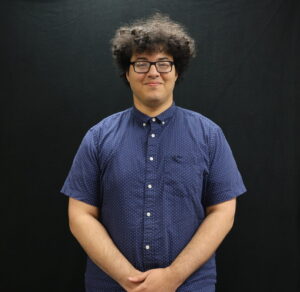
Jathaniel Wakefield secured a job at Paycom in Oklahoma City as a Level 2 Developer and received his first promotion a few months later.
Jathaniel Wakefield
As Oklahoma’s HBCU, Langston University has a legacy of generational enrollment. Jathaniel Wakefield and his family are part of that legacy. His parents, Misty and Jay, met on the Langston Campus while pursuing their education. Two decades later, their son followed in their footsteps.
“I am legacy,” Wakefield said. “On top of being a McCabe Scholar and not having to incur any debt for my education, it made for very persuasive reasons to attend.”
The younger Wakefield represented the family name well. Graduating summa cum laude, he quickly secured a job at Paycom in Oklahoma City as a Level 2 Developer and received his first promotion a few months later. Now as a Software Developer, Wakefield is responsible for the software development of new projects and applications. His duties involve testing and verifying functionality and then working with products to ensure their vision is properly applied.
Wakefield says the most enjoyable part of his job is the opportunity to solve complex problems by leveraging the tools and languages developed at Paycom, and to create a product that heavily impacts small and large businesses alike.”
His connection to Dear Langston allowed Wakefield to meet Grayson. He helped Wakefield understand what computer science is as well as how to apply basic concepts to real world scenarios and in industry use cases.
“(Grayson was) very influential and helped me by providing opportunities and challenges to grow and develop my understanding of computer science and how to apply it,” Wakefield said.
For those considering computer science, Wakefield recommends starting early and being responsible for your own development.
“When you start early, it gives you time to understand and work with complex topics like data structures and algorithms, which are used heavily throughout the industry to solve problems dealing with large amounts of data and information,” Wakefield said. “Being responsible helps your drive to continue learning. Computer science is not a career that allows you to quit learning as more and more things are discovered and leveraged to improve performance and understanding.”
Dry air fills Gloire Houmba Mayindou’s lungs as he runs, his worn shoes beating the concrete surface of the park’s basketball court.
The “Diablo Rouge,” Mayindou’s club team, practice on the outdoor court nearly every day in The Republic of the Congo, his home country. Dribble, stop, shoot, rebound, pass… the 5-on-5 drills of the day were as normal and intense as any other day.
The 11-year-old watches as a shot soars overhead, the ball bouncing wildly between the backboard and rim. Realizing the ball isn’t going in the basket, Mayindou jumps to secure the rebound. He suddenly feels hands, followed by a shoulder, hit him in the back as his feet leave the ground, causing them to swing out from under him. He lands shoulder first on the unforgiving concrete. A teammate falls on top of him.
The impact dislocates his right shoulder.
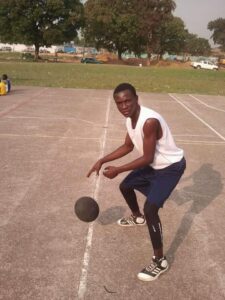
Young Gloire Houmba Mayindou poses for a photo in the Republic of the Congo.
“I couldn’t shower, couldn’t dress myself, couldn’t eat, couldn’t move,” Mayindou said. “So, dealing with that pain and then knowing that you cannot go to the hospital to get help, man, it’s mentally challenging.”
Access to healthcare, much less physical therapy, is limited in the Republic of the Congo. Even if you can get to a hospital or other healthcare provider, services are so expensive that most people don’t even consider it an option when they are hurt.
This experience, along with his observations of how many people are living with chronic pain without the assistance they need, drove Mayindou to come to the United States and eventually Langston University to earn his doctorate in physical therapy.
Now Mayindou, a first-year physical therapy student, can not only learn his trade in a program that boasts a 92% National Physical Therapy Exam pass rate and a 100% job placement rate, but he can soon get hands-on experience much more quickly than the average physical therapy student when Langston University completes construction on a physical therapy clinic being built right on the Langston Campus.
Construction has already begun on this Physical Therapy Clinic, which is being funded through Title III grants.
Dr. Elicia Pollard, Dean of the School of Physical Therapy, said this clinic will not only have an impact on students at LU, but on the community as well.
“There’s no physical therapy clinic here (in Langston),” Dr. Pollard said. “If locals want services, they’ll either drive or do without. So, we are going to fill that need there. We are going to be offering this clinic to people who are uninsured or under insured or low-income families. We are going to eliminate potential barriers such as transportation and cost.”
The closest clinics to the town of Langston are in Guthrie, which forces those who seek assistance to drive upward of 20 minutes for care.
The clinic is not designed like a typical medical facility with a labyrinth of halls and little rooms. The Langston University Physical Therapy Clinic will have an open concept with only a few rooms with doors for private needs. This allows for the area to be reconfigured for different patient populations and research needs.
Dr. Anthony Sylvester, Director of Clinical Services at Langston University, has been instrumental in the development and design of this clinic since its inception. As a two-time Langston University graduate with experience running small, rural health clinics in addition to 25 years of experience as a clinical instructor, he understands the importance of ensuring the space is being used to its fullest potential to optimize client and student outcomes.
Because of his experiences, Dr. Sylvester understands how unique this clinic is to Langston University.
“This isn’t typical of other physical therapy schools,” Dr. Sylvester said. “I think we’re going to be pretty unique in reference to what most schools, a lot of PT schools, will have. We’ll have that daily experience here. Students will see a patient they’ve worked with progress through their care.”
The Physical Therapy Clinic will also offer opportunities for students to participate in research, different forms of patient care, community events and much more.
This level of experience is why students like Mayindou come to Langston University to study physical therapy.
“The first time I learned that they were building a clinic, everyone, at least all my classmates, we are all so excited,” Mayindou said. “That’s kind of a dream come true. In our field, there’s nothing better than experience. To work with a patient one-on-one is a different thing.
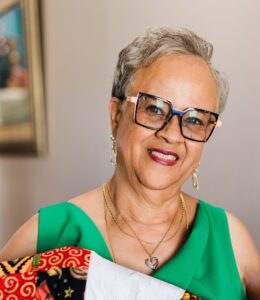
Beverly Huggins Kirk, a Langston University alumna, master quilter, educator and cultural historian, found her public voice later in life; now she urges seniors across America not to wait for certainty before stepping into purpose.
“Uncertainty has a way of making people pause, but I’ve learned that waiting for the ‘right time’ can quietly become a decision to stay silent,” Kirk said. “My message to seniors is simple: Today is the time to act.”
In 2026, with leadership priorities, economic pressures, and growing concern about aging, loneliness and relevance, many seniors have reassessed their place in a rapidly changing world. After decades in corporate America, Kirk discovered her creativity and calling had intensified.
At a stage where many have been encouraged to slow down, she leaned forward, transforming quilting into a powerful medium for faith, healing, history and legacy.
“Life didn’t become quieter for me at 72,” Kirk said. “It became clearer.”
That reassessment became a turning point.
Kirk is an LUSB alumna and the founder of Scissor Tales Guild, Oklahoma’s first African American quilt guild.
Kirk is the founder of Scissor Tales Guild–Oklahoma’s first African American quilt guild–and the creator of “A Maker of Quilts,” a limited-edition, 26-page, full-color booklet that weaves together quilt photography, personal reflection and cultural storytelling. Her quilts address themes that resonate deeply today, such as resilience across generations, healing after loss and grief, and faith in uncertain seasons.
“America is like a quilt,” Kirk wrote in the booklet’s opening pages. “Many patches. Many stories. Held together by something stronger than we can see.”
Although innovation, leadership and creativity can often be associated with youth, Kirk represents a growing but often overlooked truth: some voices are meant to rise later. Her message aligns with that of the mission of Langston University’s School of Business—to elevate purpose-driven leadership across the lifespan.
“Beverly Kirk embodies what so many seniors need to see right now,” said Dr. Daryl Green, dean of LUSB. “In a time when uncertainty can paralyze people, she chose expression over fear. Her work reminds us that our later chapters can be our most influential.”
Kirk’s work speaks to a generation navigating transition in an era defined by disruption, reminding people they can reinvent, reengage and lead at any age.