




Learn, Earn, Return: The Legacy of Sherman Lewis

(This story was originally published in ‘E Roar | Vol. 3 Issue 4 on June 12, 2026)
by Jet Turner
LEARN
Sherman Lewis knew to wake up when he heard the rooster crow.
The sun was just beginning to peer into the windows of the bedroom he shared with his four siblings. Mom was already stirring in the other room. Lewis dressed quickly and began attending to his morning chores. The chickens, cows, pigs and horses needed to be fed, and the cows needed to be milked. Regardless of how tired Lewis might be in the mornings, the animals had to be tended.
The small sharecropper farm Lewis lived on was six miles south of Beggs, Oklahoma, and about half a mile from Toland Primary School. After the animals were cared for, Lewis and his siblings walked to school.
The trek took Lewis through farmland and dirt roads before he came upon the small, two-room schoolhouse where he was educated from pre-primer (what we now call kindergarten) through the eighth grade.
After finishing the school day, Lewis would return home and help care for the crops. The grit of the sandy loam soil worked its way under his nails as he tended to the cotton, corn, hay, black-eyed peas or other specialty crops. The flat farmland gave him a perfect view of the sunset
Afterward, his mother would sit Lewis and his siblings down by the kerosene lamp so they could focus on their homework and study.
“My mother, although she only had an eighth-grade education, thoroughly believed in getting an education,” Lewis said. “She emphasized it to all the children. We had a set time to do (homework)… she always enforced that at this time, you’re going to study. Now, after you do that, then you can have some time to play.
“She would always say to me, ‘Promise me that we––’ and she would always say ‘we,’ me and her ‘––are going to college.’ She wanted me to be the first one in the family to get a college education. She kind of drilled that into me.”
That idea was drilled in Lewis not just with the words of his mother, but also with her discipline and perseverance. Lewis had no choice but to feed the animals and milk the cows every morning. He had no choice but to tend to the crops, and he had no choice but to study.
This regimen continued throughout Lewis’ childhood. Eventually, he moved from Tolson Primary School to Beggs Wheatley High School where he continued to work hard and study even harder. College was always the goal.
Only Lewis and two of his four siblings graduated from high school.
Lewis kept his promise to his mom after graduating and enrolled at Langston University so “they” could go to college.
His disciplined upbringing on the farm prepared Lewis for life at LU. Now, instead of waking up early to feed the animals and milk the cows, he started his mornings in the university cafeteria, washing pots and pans and preparing breakfast. His walks to Toland and Beggs Wheatley High School became treks across campus to attend class, and he would return to the cafeteria for lunch and dinner to continue washing the dishes.
Lewis would finish with the dishes around 8 p.m. every day, return to his dorm and study. His old routine rooted in him so long ago.
“Having a very disciplined life growing up on the farm prepared me extremely well for college because I already had that work ethic and didn’t mind working,” Lewis said. “Success is when preparation meets opportunity. My upbringing prepared me for the opportunity to go to college.”
Despite all the hard work, life at Langston University is Lewis’ favorite memory.
Campus was even closer knit in the ‘60s than it is today. Many of the students were poor, and hardly any of them had a car. They mostly stayed on campus or visited downtown Langston, so campus events were essential to the social lives of Langston Lions. Dances at the Student Success Center kept them the most entertained.
But professors still had the highest expectations for their pupils. Lackadaisical students were not tolerated. Professors would call out students who were not doing their work in front of the class, and students would support each other by helping them study.
“You hear about Langston University being a family,” Lewis said. “Well, that’s been the case forever. Everybody was here to help each other.”
Lewis graduated from Langston University in 1964 with a degree in agricultural economics and a minor in mathematics, fulfilling his and his mom’s dream of becoming the first college graduate in his family.
Lewis couldn’t have known it at the time, but those four years he spent at Dear Langston would shape the trajectory of his personal and professional life for years to come.
“Having the opportunity to come to Langston University and get an education is responsible for what I’ve achieved over my lifetime,” Lewis said.
EARN
Soon after earning his degree, Lewis joined the United States Air Force.
His service time was spent at Clinton-Sherman Air Force Base in Clinton, Oklahoma, working in the accounting and finance office during the Vietnam War from 1964-1966.
“I often tell people that I made sure the soldiers got paid,” Lewis said.
Much like he did during his childhood and collegiate career, Lewis found comfort in the structure and routine of the miliary. Just like on the farm or on the campus of Langston University, he developed habits that kept him consistent and reliable throughout his career.
After two years of military service, Lewis began working for the United State Department of Agriculture (USDA) in what was then known as the Soil Conservation Service.
Lewis moved to Bristow, Oklahoma, to begin his training. Here, he worked directly with farmers and ranchers on conservation practices for a year before being promoted to a Soil Conservationist position in Lawton.
After three years in the position, the USDA approached Lewis with another promotion. This time, they wanted him to be a District Conservationist. The first Black District Conservationist in the country.
“The decision makers (in Oklahoma) and in Washington D.C. were trying to figure out if a Black District Conservationist could be successful working with white farmers and white employees,” Lewis said. “They decided to test it, and for some reason they selected me.
“Basically, what they were saying was, ‘If you succeed, we’ll select another (Black District Conservationist), but if you fail, we are not going to select another one.’”
Lewis didn’t have a choice but to be successful.
But to his surprise, Lewis didn’t run into the issues the “decision makers” were concerned about.
“They were seeing things that did not exist,” Lewis said. “As far as the employees and farmers were concerned, I had no problem. They just wanted someone to help them. They didn’t care.”
After two years of success as a District Conservationist, the USDA decided to give Lewis another opportunity. This time, to be the first Black Area Conservationist.
Lewis accepted the opportunity in 1974 and was sent out of Oklahoma to Spokane, Washington, where he was responsible for all of Eastern Washington.
Regardless of the role he was given, Lewis continued to break down barriers. He proved not only that he was capable, but that Black workers were capable of the same work white employees had been doing for decades.
Because Lewis had proven himself, the USDA decided to send him back to school for a little more education.
Lewis began attending Harvard University in 1976 and within a year earned his master’s degree in public administration from the John F. Kennedy School of Government, otherwise known as the Harvard Kennedy School.
After graduating, Lewis was sent to Boise, Idaho, as an Assistant State Conservationist. He was the first Black Assistant State Conservationist in the United States.
After over two years in the position, Lewis was made the first Black State Conservationist, sending him to Massachusetts, then Nebraska. He served in these roles until 1986, when Lewis was asked by the Deputy Secretary of Agriculture to move to Washington, D.C., to develop national policy for the advancement of civil rights within the USDA.
This made Lewis the Special Assistant to the Deputy Secretary of Agriculture.
Through this role, Lewis helped develop the 1890 National Scholars Program, place liaisons on all 1890 land-grant institutions and create the 1890 Centers of Excellence.
“I did that,” Lewis said. “I provided that leadership in putting those policies in place.”
These programs continue to benefit not just Langston University students, but students at HBCUs across the nation.
After a year as the Special Assistant to the Deputy Secretary of Agriculture, Lewis was reassigned back to the Soil Conservation Service as the Director of Conservation planning in Washington, D.C. After a year, he became the country’s first Black Assistant Chief of the Midwest in 1990. Two years later, Lewis was named the first Black Deputy Chief for Management and Strategic Planning.
During this time, Lewis began the National Organization of Professional Black Soil Conservation Employees. The goal of this organization is to assist Black employees with their training so they can move into middle and upper management positions. This organization is still active today. Lewis was also instrumental in changing the name of the Soil Conservation Service to the Natural Resource Conservation Service.
Lewis retired from the USDA as the Deputy Chief for Management and Strategic Planning in 1997.
Dr. Ernest Holloway, the 14th President of Langston University, convinced Lewis to retire early.
“Whenever Dr. Holloway was in D.C., he would always stop by my office,” Lewis said. “He would always say, ‘As soon as you’re able to retire, we need you to come back home and help us start a new program out there in outreach management.’
“I had not planned on retiring in 1997. I was only 56 years old. If he had not asked me to do so, I would have worked for another three, four or five years in Washington, D.C. I retired on a Friday morning in 1996, and the following Monday in 1997 I started to work (at Langston University).”
Drawing on decades of federal and state relationships, Lewis created the Center for Outreach Programs, securing grants and cooperative agreements with several agencies, eventually bringing in around $5 million a year. These funds not only sustained Dear Langston’s outreach work but also supported other university programs.
After Dr. Holloway’s retirement, Lewis became the Assistant Administrator for Extension, continuing to serve the Langston University community until 2006.
“I felt like I finally had something to offer Langston University,” Lewis said. “Langston University had been very good to me and helped me be what I was at the time and what I am today. So, I wanted to give something back to LU. It was one of the best decisions I ever made.”
RETURN
Within five years of graduating from Langston University, Lewis started giving back to the university every year.
It started small. At first, it was maybe $100 a year. But as his professional life grew, so too did his giving.
While working at Langston University, Sherman began a private business in Houston, Texas, with his son and daughter. When he retired from LU in 2006, Lewis began working in that business full-time. It began to flourish.
This allowed Lewis to start giving to the university in a major way, with his first large donation being made in 2015.
In 2018, Lewis and his family sold the business. This gave Lewis the time and means to really focus on his philanthropy. Now, he’s the largest individual donor in Langston University history.
“I’ve always wanted to be a philanthropist because I know the value of giving back,” Lewis said. “I’m so proud of that philanthropy. I think back to the founders of Langston University who were doing whatever they could to raise $5,000 (in the 1890s). Baking, selling blankets, whatever it took.
“They weren’t doing that for themselves. It’s about the future, about future kids and about their education. They were philanthropists, but they didn’t have a lot of money. They had a vision. That’s my philosophy, doing something now to help future generations.”
Lewis remembers hearing some smart person say the words “Learn. Earn. Return.” The phrase immediately resonated with him. Now, he lives by that motto.
Because of Lewis’ generosity, he became the namesake of the Sherman Lewis School of Agriculture and Applied Sciences in 2022, the first named school in LU history.
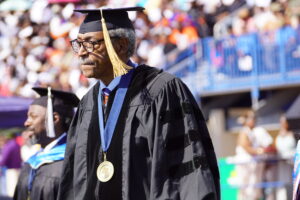
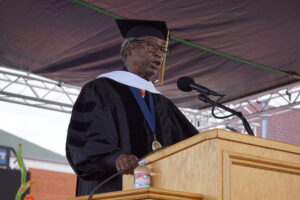
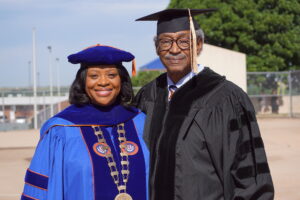
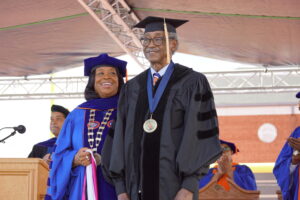
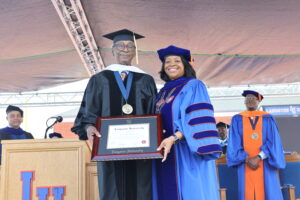
At this year’s Commencement Ceremony, Lewis served as the commencement speaker and was honored with the conferral of an honorary doctorate in humane letters.
“It’s an extreme honor,” Lewis said. “I’m the first in my family to ever receive a college education. If my mother and sisters and brother were here today to know I was receiving an honorary doctorate from Langston University, they would be so proud of that.
“I’m proud of it not for myself, but for my family. For my daughter and son. To show young people that anything is possible, but you must be willing to help others.”
But giving isn’t about the accolades and honors received.
To Lewis, It’s about the future of Langston University.
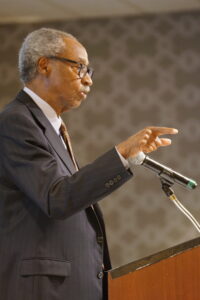
“You came to Langston University to learn,” Lewis said. “Now you’re ready to go out to earn money. Be willing to return some of those earnings to Langston University to educate someone else 100 years from now, the same way people in 1890 did for you.
“If more of us adopted that saying, Langston University would be strong for a long, long, long time.”