




LU Cooperative Extension and Outreach hosts virtual reality STEM education labs

by Ellie Melero
As she stepped into the Pollinator Sanctuary, Andria took a moment to assess her surroundings.
She stood in the middle of a circular path lined with bushes and flowers. Butterflies, bees and other flying insects flitted between the plants, buzzing contentedly and paying her no mind. Her eyes followed the route of a bumblebee as it circled a purple flower to her right and flew over her head, bringing her gaze up to admire the bright blue sky that shone through the crisscrossing wooden beams enclosing her and the insects inside a giant ring.
She returned her eyes to the front and saw six pedestals in front of her. Each held a flower and was labeled with a different pollinator. She stepped forward, reached out, and plucked a bright red and orange marigold from its pedestal. Immediately, a honeybee came and landed on the flower, allowing her to get a good, close look at it. She brought the flower eye-level, and a voice began speaking in her ear, telling her about the daily habits of honeybees.
“Usually, if I saw it in real life, I would get scared,” Andria said. “If I saw a bee, I would run. But since I knew it wasn’t real, I was kind of investigating it, seeing what was on the bug and stuff.”
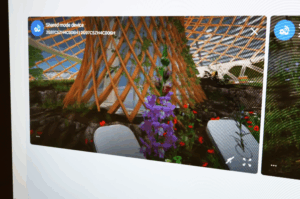
Observing different bees, butterflies and moths up close on the flowers was one of several activities Andria did through the Pollinator Sanctuary Virtual Reality Experience at Langston University on Thursday.
A rising junior at Stillwater High School, Andria is a camper at LU’s 2026 Math and Science Academy. The annual summer camp brings students from all over Oklahoma and surrounding states to the Langston Campus for two weeks to learn about STEM careers, life in college and strategies for taking the ACT. Activities like the Pollinator Sanctuary give the students opportunities to learn about STEM and agriculture in new and exciting ways, which is why Shar Carter is trying to make it more accessible.
Carter is an extension educator with LU’s Cooperative Outreach and Extension Programs (CEOP). She worked with Aaru Entertainment, a virtual reality company based in Tulsa, to bring the Pollinator Sanctuary to Langston for the Math and Science Academy. For two years, she has worked with Aaru to put on similar events around Tulsa with some of the other educational labs they offer, such as a virtual reality space simulation. This summer, she wants to do more.
“We can take them to places, whether that’s botanical gardens or museums, that they might never see in their lifetime,” Carter said. “There’s just so many applications that we can do, and what Dr. (Welsey) Whitaker, Dr. (Alonzo) Peterson and President (Ruth Ray) Jackson have allowed me to do is engage with other departments and adapt it to what they want to do.”
For the Math and Science Academy, Carter wanted it to showcase one of the many intersections of STEM and agriculture.
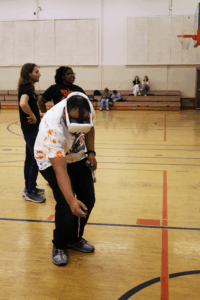
By donning the VR headset, students were transported from LU’s Multipurpose Gymnasium into a state-of-the-art insect sanctuary and observatory to learn about pollination, the insects that pollinate, and how that process plays into everyday life. They looked at bugs and flowers up close, walked through a grocery store with empty shelves where all the food requiring pollination should have been, and learned about pollinator conservation.
For many of the students, this was their first experience with virtual reality, and they were impressed.
“I was excited because I always wanted to try VR,” Andria said. “At first, it wasn’t like how I expected it to be, but it was still fun. It was cool looking around and seeing random things flying around. I think it’s a fun way to learn, especially since it’s kind of like a video game, and most people like video games.”
The experience stuck with the students as more than just a fun activity. Many said they learned things about bees they hadn’t known before, and the impact of seeing the empty grocery store shelves is something many said will stay with them.
Aaiyah, a rising junior at Wiley East High School in Dallas, said the experience was eye-opening.
“It’s showing you how all the pollinators are gonna be gone, and how we’re not really gonna have any food,” Aaiyah said. “Like, in year 2080, we’re really only gonna have bread and wine. It was just really sad because we need to work on it.”
Despite the somber feeling she had when she took off the headset, Aaiyah was still impressed by the VR experience.
“You see things, like articles and stuff like that,” Aaiyah said. “But this was like, you actually got to engage with it. To see the future and back and the difference, and to actually take it in.”
Carter and Aaru will host the next virtual reality STEM education lab on the Langston Campus on June 25 as part of the Sherman Lewis School of Agriculture and Applied Sciences’ HERC Field Day. Carter is working to schedule more around Oklahoma throughout the summer.