By Jet Turner, Assistant Director of Communications
Langston University held its 25th Annual Research Day on April 18, 2025. Research Day includes various disciplines, majors and students. Whether you are a biology or chemistry student, psychology student or even a computer science student, you are welcome to participate in Research Day.
Research Day aims to help students understand the practical applications of their learning. It shows students how their knowledge can serve society and provides an opportunity to demonstrate their problem solving and articulation skills. It also allows students to build their resumes, prepare for internships and graduate school applications, among many other skills.
“It’s the value added,” said Dr. John K. Coleman, Interim Dean of the College of Arts and Sciences. “Once you get a culture where students (are presenting their research), you look at the student and you just see the product. Now they are starting to learn why they’re learning these theories and why they learn these concepts, and then what you can actually do with it and how you can help society. You’re here to learn, but you leave to serve. So how do you use what you’re learning? This is the part that teaches you how you use what you’re learning to serve society.”
Dr. Lindsay Davis, associate professor of chemistry, participated in the 13th Research Day when she was a student at LU.
Despite her fear and hesitation to present her research, she was well prepared and supported.
“Ultimately, Research Day gave me the confidence that I needed to pursue graduate school and to make these presentations a norm for me,” Dr. Davis said. “I was so scared of public speaking, and now it’s easy.
“So, Research Day definitely helps with their communication skills. But most importantly, I think it allows them to be a scientist, to communicate through research and to really achieve their goals.”
This year over 20 students participated in Research Day.
Josiah Grayson – Selection of Undergraduate Degree Major Among College Students
Senior, Computer Science Major
Josiah Grayson’s research explored the psychological and social factors influencing how college students, especially those at Historically Black Colleges and Universities (HBCUs), choose their academic majors.
Grayson’s studies revealed personal interest is the most important factor when a prospective student selects a major, which contradicts his hypothesis that financial considerations would be at the forefront of their decision-making process.
Grayson highlights that student interests are often “shaped by what they have been exposed to,” meaning individuals are more likely to pursue careers and majors they have seen modeled in their communities. For Black students specifically, this means decisions are “shaped by survival, legacy and representation.”
“Institutional culture and climate impacts persistence,” Grayson said. “What goes on at the university and then specifically in the department, how they teach the information, how they work with the students. Is there tutoring? These things highly impact whether or not somebody is actually going to finish their degree.”
Financial status, according to Grayson, still plays a significant role in a student’s decision in what major they select, even if it isn’t the primary driving force. Grayson notes that students from a lower socioeconomic status tend to be more risk-averse, often choosing a “more stable” career path, while students from higher socioeconomic backgrounds have more flexibility to pursue less conventional majors, if they so choose.
Kimbree Layton – Studying the Relationship Between Mental Health, Emotional Well-Being and Academic Well-Being Among College Athletes
Senior, Psychology Major
Kimbree Layton conducted a comprehensive study examining the relationship between mental health, emotional well-being and academic well-being among collegiate athletes at Langston University. Her research focused specifically on anxiety, depression and stress levels among student athletes.
The study employed a multi-scale survey approach, utilizing four different psychological assessment tools. Layton was able to collect data from 15 of Langston University’s student athletes, all of whom were female.
Findings revealed that Langston University student athletes generally demonstrated positive mental health indicators, showing no significant signs of depression, anxiety or stress.
“(The student athletes) think highly of professional help and seeking it when it is necessary,” Layton said.
Layton’s research highlighted several critical factors influencing student athlete mental health, including “the importance of their relationships” with coaches, professors and family. Modern student athletes must overcome a tough emotional landscape, and many challenge the stigma that they should always be “very mentally tough” and not show emotions.
While the study provides valuable insights, Layton recognized limitations in her research, including the small sample size and the use of somewhat dated psychological assessment scales. She recommended future research should “examine what relationships between scales and demographics” exist and potentially explore the impact of teammates on mental health, a dimension not fully explored in this current study.
Reginald M. Archibald II – Artificial Intelligence Biases in Healthcare
Senior, Computer Science Major
Reginald Archibald II explored the critical issue of artificial intelligence (AI) bias in healthcare, highlighting how AI models can perpetuate systemic inequalities.
Archibald’s research uncovered six types of bias in healthcare AI models: implicit, selection, measurement, confounding, temporal and algorithm bias.
An example pointed to in this research is the dermatology AI tool developed by Stanford University, which was trained predominantly on images of lighter-skinned individuals. This could have a significant negative impact on patients who have a darker skin complexation.
“When you go in and they’re trying to detect for skin cancer, oftentimes they’re not able to find it, and they might (misdiagnose) you,” Archibald said.
Several other real-world scenarios demonstrate the potential harm of biased AI. During the COVID-19 pandemic, pulse oximeters were found to miss conditions in Black patients three times more often than in other races. Another study revealed an AI algorithm that based healthcare decisions on costs that systematically undervalued Black patients’ health needs.
To address these critical issues, Archibald proposes multiple solutions. These include conducting bias audits before AI deployment, training healthcare professionals on AI decision-making processes and incorporating synthetic data to improve representation.
He emphasizes the importance of diversity in AI development, stating that diverse team members can provide “ethical background knowledge about their race, their gender, their age group and their economic status.”
Every year on Mother’s Day, Dr. Emily Patterson Harris gets a call from one of her former students.
When that student was younger, he attended and dropped out of two colleges, but Dr. Harris wasn’t having it.
“It took me two years to talk him into coming to Langston University and giving it another try,” Dr. Harris said. “And he did. We had some rough times in there, but he finished, and he calls me on Mother’s Day.”
Not all of her student interactions have been as friendly.
Once, while walking down the stairs at the LU-Tulsa campus, a student stopped Dr. Harris to talk. She knew the student sometimes struggled to balance his schoolwork with his responsibilities as a father, but she also knew he was capable of it.
“He stopped me, and he said, ‘Well, I want you to know that I’m going to graduate, if for no other reason than to get you off of my back,’” Dr. Harris said. She responded with an upbeat, “OK!”
That student did graduate, and he went on to earn his master’s degree, too. She still sees him and talks with him occasionally.
Dr. Harris has countless stories like these because she’s been working with students for over 40 years. She has worked tirelessly to develop well-defined and relevant programs that will help students get jobs after graduation, and she has also worked to make sure students make it to graduation. From working with them in the classroom to advising those who left to figure out how to come back, Dr. Harris doesn’t give up on her students. She cares about them, and she knows that for many, earning their degree will change their life.
Education is Transformative
Dr. Harris has always believed in the power of education, and she understands better than most that the transformative effects of earning a degree can be felt for generations. Her own family is a prime example. Her maternal grandmother, Emily Alford, only had an 8th grade education, but she was determined to send her children to college. They came to Langston University.
Violet Alford, Dr. Harris’ mother, graduated from Langston University with a B.S. in Business in 1950.
Dr. Harris’ mother, Violet, graduated from Langston University in 1950 with a B.S. in Business. Her father, Lee V. Patterson, Sr., graduated from LU that same year with a B.S. in Industrial Arts. They both had successful teaching careers in Oklahoma, and they made sure their children understood education was important. The message was echoed by Dr. Harris’ aunts and uncles as she and her cousins prepared to go to college, and they eventually passed the message along to their children, too.
Today, the younger generations of the family understand that education is transformative, and Dr. Harris’ son Erick said they all expect to go on to earn the highest-level degrees available for their chosen professions. Four generations after Emily Alford, the average degree in the family is a masters.
“I go back to that initial decision that my grandmother made that a college education was important,” Dr. Harris said. “That one decision has impacted generations of my family.”
It has also, in turn, allowed Dr. Harris to impact thousands of others.
Dr. Harris graduated from her father’s alma mater, Booker T. Washington High School in Tulsa, Oklahoma, but she did not follow in her parents’ footsteps to attend Langston University. Instead, she chose to attend Central State University in Wilberforce, Ohio, and her experiences there reinforced her beliefs about the power of HBCUs. She went on to earn her Master of Library and Information Studies from the State University of New York at Buffalo before moving to Texas to serve as a librarian at Houston Community College.
After a three-year stint in Houston, Dr. Harris came home to Oklahoma. Thanks to the efforts of Dr. Roosevelt Mack, she officially joined the Lion Pride as a librarian at the LU-Tulsa campus in 1981.
Building Something
Langston University’s Tulsa campus opened in 1979. It was the first public institution to offer graduate and upper level higher education courses in Tulsa.
The Langston University-Tulsa campus had been established just two years prior when Dr. Harris joined the staff.
It was the first public institution to offer upper-level higher education classes in Tulsa, and in 1982, it worked together with Oklahoma State University (OSU), the University of Oklahoma (OU) and Northeastern State University (NSU) to form the University Center at Tulsa. Still a firm believer in the importance of education, Dr. Harris was excited to be a part of bringing access to higher education to her hometown.
Serving as a librarian for all academic programs gave Dr. Harris an opportunity to work closely with the students in Tulsa, and she found she enjoyed getting to know them while helping them access the materials they needed for their classes. She was good at her job, and she was soon asked to move to the Langston campus to serve as the Acting Director of the G. Lamar Harrison Library while the school looked for a permanent director.
When she returned to LU-Tulsa a year later, she knew she was ready to take on more responsibility.
She transitioned from the library to a position as an academic counselor. It was around this time that Dr. Wessylyne A. Simpson, Dr. Harris’ aunt who was then the Dean of the School of Education and Behavioral Sciences (SOEBS), was working to expand the program offerings at the Tulsa campus. Dr. Harris worked with Dr. Simpson, SOEBS faculty and Diana Sharp to bring the Teacher Education program to Tulsa.
“We worked on paperwork and made sure we had all the bylaws and everything set up before we could start recruiting students,” said Sharp, who still works at LU-Tulsa as an administrative assistant. “We all put our heads together and started the program here, and it’s taken off ever since.”
Diana Sharp (right) has worked with Dr. Harris since she joined the LU-Tulsa staff in 1983.
Sharp liked working with Dr. Harris right from the start. Her first impression of Dr. Harris in 1983 was of a peppy, happy-go-lucky person who was very easy to talk with. Forty years later, Sharp said that’s still how she’d describe her.
This was the first of many projects Sharp and Dr. Harris would work on together over the years, and Sharp said she appreciated Dr. Harris’ positive attitude and her willingness to try several approaches until they found one that would work. She also appreciated that Dr. Harris knew how to leave work at work, allowing them to form a personal friendship in addition to a professional one.
Thanks to their hard work, they were able to bring the Teacher Education program to LU-Tulsa in 1985. The program was housed on the seventh floor of the building they shared with OSU at 440 S. Houston St., and Dr. Harris took on the role of Associate Director for Teacher Education at LU-Tulsa.
For 12 years, she supervised the teacher education program at the Tulsa campus. She loved working with students and continued to serve as an advisor. In 1986, she also began teaching as an assistant professor in SOEBS, focusing mostly on psychology and education courses.
She went back to school and earned her Ed.D. in Higher Education Administration from OSU in 1989, and she said she is eternally grateful to the late Dr. Mack for his continual support throughout this time as she juggled work and doctoral coursework. She also wanted to thank Dr. Ernest L. Holloway, LU’s longest-serving president, and Dr. C. Gary Crooms.
“There’ve been powerful leaders, master teachers and mentors that encouraged me and were great at their chosen fields,” Dr. Harris said. “The late Dr. Holloway continually focused on challenges as opportunities. Dr. Crooms taught me to look at those challenges from multiple perspectives.”
Dr. Harris finished her doctorate, completed additional coursework in Behavioral Sciences and became certified to teach Social Studies, Language Arts and Library Media. She took her mentors’ lessons as well as everything she’d learned from her own classroom experiences as both a teacher and student to try to continually improve her own classes.
“What I loved about teaching is just the fact that there’s always more information,” Dr. Harris said. “And I’m a librarian, so I love looking for information. You can never get tired of finding new things or new ways of doing things, and sometimes your students will send you off in a different direction.”
Students First
Dr. Harris (far right) served as the Associate Vice President for the LU-Tulsa Campus for almost 12 years.
Dr. Harris was dedicated to her work, and that’s something to which her family can attest. Her two sons spent a lot of their free time at the LU-Tulsa campus and witnessed how hard their mother worked for the students there.
One day, an 8-year-old Erick approached Dr. Virginia Schoats, the campus site director, and told her as much.
“My mom was always working hard,” Erick said. “I had just found out what the word ‘promotion’ meant, and once I realized that I said, ‘Oh, well she deserves one of those.’ And because (Dr. Schoats) was her boss I thought, ‘She’s the one that can give it to her.’”
Not long after, Dr. Schoats did recommend Dr. Harris for a promotion.
In 1997, she became the Associate Vice President for LU-Tulsa, the person who ran the campus. She also served as the Institutional Representative for Langston University to the University Center at Tulsa, advocating for the needs of LU students and faculty while working to improve access to higher education for all Tulsans.
Though her duties and responsibilities changed, her goal stayed the same: to guide students to degree completion.
At this time, the average age of the students at LU-Tulsa was about 34. Dr. Harris recognized early on that their needs would be different than the needs of students at the Langston campus, so she tried to keep their work and familial responsibilities in mind. She, the faculty and staff in Tulsa tried to make it as feasible as possible for students to take classes, offering everything from a bookstore to a registrar’s office on campus so students wouldn’t have to make the drive to the Langston campus.
“We had it set up making sure that once they got out from work, we had every avenue for (students) to be able to take courses so that they would still be able to graduate,” Sharp said. “We made sure the students were happy and taken care of, no matter how many different hats we had to wear.”
Dr. Harris’ motto was to meet students where they were and never take anything personally, and she gave that advice to her student teachers as well as her faculty.
She understood that students, the same as everyone, had challenges in their lives outside of class and were sometimes prone to take that out on their teachers. But she also knew she had to look past that in order to assist them, and she was determined to help them.
“We’re all works in progress,” Dr. Harris said. “I emphasize that we each have our own individual paths.”
Dr. Harris has always done everything in her power to help students make it to graduation.
Students drop out of college for all sorts of reasons. Sometimes they don’t feel they have time to go to class. Sometimes they can’t afford it. Sometimes they just don’t want to do it anymore. If a student dropped out of LU-Tulsa, Dr. Harris wanted to know why.
She would contact them to follow up on why they chose to leave school. Then she would encourage them and brainstorm solutions.
“She would make those calls, and once she got them here, she would do all the rest of it,” Sharp said. “She was making sure that students were taken care of and just trying to get them to realize that, you know, ‘You’re so close. Don’t lose this.’”
Many students returned to school thanks to Dr. Harris’ efforts, and many other students stayed in school for the same reasons.
Dr. Harris recalled that once, an alumnus whom she hadn’t seen in years walked up to her and abruptly told her that he used to hate her. Unflappable as always, she simply responded, “Oh, you did?” He said he really did.
He told her he used to complain about all the work she made them do in her classes. He didn’t appreciate all the readings, essays and other homework she assigned, and it made him resent her during his time as a student.
“And then he said, ‘I just wanted to tell you that I earned my masters,’” Dr. Harris said. “And he told me the program he’d gone through, and he said, ‘If it hadn’t been for you, I would not have made it through that program. And I just wanted to come back and share that with you.’
“That’s the beauty, I think, about Langston University, no matter the campus. There is just a history of balancing those two things of nurturing a student but also having great expectations for those students. ‘LU graduates around the globe serve as leaders, innovators and engaged citizens,’ to quote our vision statement.”
A Lasting Legacy
Dr. Ruth Ray Jackson said Dr. Harris embodies the Alpha Kappa Alpha Sorority, Inc., motto: Service to All Mankind.
In 2008, Dr. Harris became the “Gear Up” Program Director and Coordinator for the Department of Psychology at LU-Tulsa. She worked closely with Tulsa Public Schools to design and deliver programs meant to encourage college attendance and completion at Tulsa-area middle and high schools while continuing her work as a professor and the leader of the psychology program in Tulsa.
In 2018, she was appointed Chair of the Department of Psychology for all LU campuses, and in 2019 she became Dean of the School of Education and Behavioral Sciences. She has also served, when the need arose, as Acting Dean of University Libraries. Throughout it all, she has continued her efforts to help students learn and make it to graduation.
“Dr. Harris has done a phenomenal job,” President Ruth Ray Jackson said. “Even in her role as Dean, she continues to advise students and to meet with transfer students. Of course, she’s now in a position where she’s solving problems and listening to complaints and concerns from both students and faculty, but she’s consistently energized and ready to meet somebody and help them get to where they want to go.”
Dr. Harris has become known for the positive energy she brings to projects and her willingness to try several routes until she finds the one that will work. Dr. Jackson called her a creative problem solver, and she’s had a lot of experience doing it.
During her 44 years at Langston University, Dr. Harris has tackled lots of challenges, from redesigning curricula to helping develop completely new ones. Though she has almost 40 years of teaching experience, she continued trying out different teaching strategies up until she taught her last class in 2024 because she knew there was always room for improvement. She knows Langston University inside and out, and she has made a lasting impact.
“My mother is one of the most encouraging people that I’ve ever known,” Erick said. “She supports you, but there’s a nice edge to her that will push you and encourage you to keep moving forward. And that’s what she’s done at Langston University.”
Throughout her career, Dr. Harris has been the model of a servant-leader, both in her personal and professional life.
Her youngest son, Christopher, said he’s grateful to have grown up with Dr. Harris as a role model because she inspires him to try to be a leader in his own industry, noting that he often models his own behavior after her in professional settings. He also recognized that his mother’s career at LU has always gone beyond her job descriptions.
“You recognize the sacrifice almost after the fact,” Christopher said. “She could have had positions and titles that would’ve paid more at other institutions and in other states, but not everything is about financial gain.
“It’s having us grow up around our grandparents, and from a career perspective, it’s saying that you can have a positive impact on people’s lives and be that role model of what leadership looks like.”
She is a longtime member of Alpha Kappa Alpha Sorority, Inc., and Dr. Jackson, a fellow AKA, said Dr. Harris embodies their sorority’s motto: Service to All Mankind.
Dr. Harris said it’s not hard to find ways to serve because they will usually find you. Now, after four decades of service to Dear Langston, she is finally ready to retire. Her last day will be June 30, though she jokes it will really be “the 12th of never.”
“I’m sure I will (miss teaching),” Dr. Harris said. “But I’m sure that I can find all kinds of creative things to do.
“I say, ‘Don’t look back. You’re not going in that direction.’”
Dr. Harris will retire from Langston University after 44 years of service on June 30.
By Jet Turner, Assistant Director of Communications
Brianna Campbell had not felt well in weeks.
An apple here, a smoothie there; that was all she could muster to eat. Not feeling well has been common to Campbell since she was diagnosed with Type 1 Diabetes at 13 years old, but something this time felt a little “off.”
Campbell, who was 19 years old at the time, was in the process of switching from her pediatric endocrinologist to an adult endocrinologist and was having difficulties getting the supplies she needed for her diabetes. Her blood sugar was high for several days and she had no idea.
With midterms coming up, she didn’t really have time to think about it.
Campbell had not attended class in-person for about two weeks, as professors were hosting remote classes due to the spread of COVID-19. Hardly leaving her dorm, how she felt wasn’t really a concern to her at the time.
She woke up on Sept. 20, 2023, less than ready to take her English midterm.
“I woke up not feeling good at all,” Campbell said. “I was out of breath, breathing very, very hard trying to get dressed and get down the stairs to get to my car.”
She parked in front of Jones Hall on Langston University’s campus. Just getting out of the vehicle and walking into the building was exhausting.
Campbell sat at a desk and, as soon as the professor passed the exams out, she hurried to the bathroom to throw up.
“That’s probably not a good sign, but I have to take this midterm,” Campbell said.
She found her way back to class, but not long after sweating over the exam she had to go back to the restroom. Stumbling down the hallway this time, she just made it to the bathroom door before passing out.
Not long afterward, a friend of Campbell’s found her. She was already waking up but didn’t have enough strength to stand. Campbell’s friend went to find her professor, and the professor called 911.
Paramedics arrived and took Campbell to the hospital. Her professor followed to ensure she was OK. They alerted her roommate, who called Campbell’s parents and let them know what was happening.
Campbell was admitted to the emergency room, and the tests began.
She was immediately tested for COVID-19, which came back positive. Her blood sugar level was also around 600 milligrams per deciliter (mg/dL), about six times higher than the norm. Most surprising, they found her hemoglobin levels to be at a 4, when the normal range is about 12-15 for adult women. A blood transfusion was needed.
“I signed my own consent form for a blood transfusion at 19 years old,” Campbell said. “I sign it, then turn to my professor and ask, ‘What is a blood transfusion?’”
About the same time as she was admitted into the hospital, Campbell’s parents arrived.
Brianna Campbell and her family.
The next several hours were a blur of CT scans and blood work as doctors worked to get to the root of what was making Campbell so sick. That night she stayed in the hospital for monitoring.
She awoke early the next morning, and soon a doctor was in to give the prognosis. Campbell called her parents on the phone so they could receive the news at the same time.
“They think it’s leukemia,” Campbell said.
She was transferred to Oklahoma Children’s Hospital in Oklahoma City that morning. The next day, Campbell had a bone marrow biopsy to determine if she had leukemia. After the procedure, she slept the rest of the day.
The next day the doctors came back and said leukemia was off the table. They now thought it was myelodysplastic syndrome.
According to Mayo Clinic, ” Myelodysplastic syndromes are a group of disorders caused by blood cells that are poorly formed or don’t work properly. Myelodysplastic syndromes result from something amiss in the spongy material inside your bones where blood cells are made (bone marrow).”
A bone marrow transplant is the only potential cure for myelodysplastic syndrome. During the transplant, a high dose of chemotherapy drugs is used to clean out defective red blood cells from the bone marrow.
After the transplant you have a brand-new immune system, and your body needs time to not only adjust to it, but to isolate so you don’t get sick.
This was what potentially awaited Campbell as she left the hospital six days later to head back to Keller, Texas. Campbell, with the help of her parents, decided to withdraw from Langston University because there was no telling how long this process would take.
On Oct. 20, 2023, one month after she passed out during her midterm, she got the results.
It turned out Campbell didn’t have myelodysplastic syndrome, or anything nearly as serious. Campbell has pernicious anemia, a rare B12 vitamin deficiency where her body cannot absorb the vitamin through food, which can be easily treated with supplements, shots, a diet change and other simple measures depending on the severity.
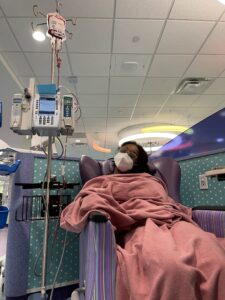
Brianna Campbell received medical treatment.
Campbell and her parents were relieved.
“Looking back on it, I really don’t like that they told me all of these things I might have before the tests were official,” Campbell said.
Because of what she went through, Campbell decided to change her major and pursue a degree in nursing. Campbell began taking online classes at the University of Texas at Arlington to not fall behind, but she quickly became frustrated with the pace of her education. She was progressing slower than she wanted and missed the social aspect of college she had come to love at Langston University.
Campbell began considering her options. Should she go back to Langston University? Enroll in another college in-person? Or should she continue online? Her parents were hoping that, whatever decision she made, Campbell would remain close to home after all she went through.
Campbell was returning to Langston University often in the months following her pernicious anemia diagnosis to see her friends.
“I was just really missing Langston at this point,” Campbell said. “I would come (to Langston University) for days on end, and they would go to class, and I’d be like, ‘I wish I had classes to go to.’”
Langston University President Ruth Ray Jackson had been in contact with Campbell and her family during this whole process, even visiting Campbell in the hospital. Dr. Jackson and Campbell’s mother had remained in contact, and Campbell began emailing and texting Dr. Jackson about possibly returning to Dear Langston.
Dr. Jackson helped Campbell find the proper offices and people to begin the re-enrollment process.
Brianna Campbell and her family enjoy homecoming with Dr. Ruth Ray Jackson.
Campbell eventually told her parents she wanted to go back to Langston University as a student.
“When they asked why, I told them that I never believed Langston University was a steppingstone,” Campbell said. “I don’t believe it was ever a wrong choice. I think that it is the first decision that I made as an adult to go to this university. I decided to move out of state, I decided to come to this university. I decided to go to an HBCU, and it’s a decision that never felt wrong to me. I want to honor that decision from my younger self, that first decision I made as an adult.”
Campbell returned to Langston University in the Fall of 2024. Now a sophomore, she’s made it a point to get the most out of her experience the second time around.
She is excelling in her nursing classes and hopes to be helping people just like her as soon as possible. Additionally, Campbell competed in the Alpha Pi Chapter of Kappa Alpha Psi Fraternity Inc. 2024-2025 Miss Krimson and Kream pageant that returning semester, winning the title of Miss Alpha Pi.
“I think having to leave and come back, you are able to appreciate Langston more,” Campbell said. “I think I’ve done 10 times more things than I would have done if I had just gone through normally. When I came back, I wanted to get out there, meet people, join things.
“You don’t realize what you have until you lose it.”
The Lady Lions knew they were about to make history.
With 20 seconds left in the fourth quarter, they led the University of Science and Arts of Oklahoma Drovers 63-49. They just needed to run the clock out.
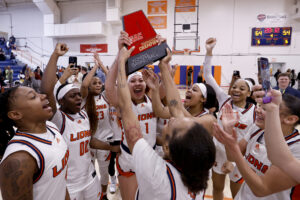
The entire bench was on their feet, and The Den was alive with excited anticipation. The cheering had already started, and the moment the clock ticked 0, the Lady Lions rushed onto the court and embraced their teammates.
For the first time in program history, they were the Sooner Athletic Conference Regular Season Champions. They were also the first Historically Black College or University to earn the title for SAC women’s basketball.
“It felt awesome,” said senior forward Ruth Sodipe. “Especially since it was senior night, it was the last home game of the season, so it was really awesome getting to do it in front of the fans and being able to celebrate and be happy with the girls.”
The team savored the moment in the minutes following the game, celebrating with each other and their families before heading down to the locker room. Then it was back to business.
A week later, the Lady Lions swept the SAC Tournament for another SAC Championship, also a program and HBCU first. Then they played in the NAIA National Tournament, making it all the way to Sioux City, Iowa, to play in the Round of 16.
The team played with such fierce determination and noticeable cohesiveness all season that one would think this was the culmination of four years playing together under Head Coach Chris Vincent. In reality, this was most of the Lady Lions’ first year at Langston University and Coach Vincent’s first year at the helm.
In his first year with the Lady Lions, Head Coach Chris Vincent led the team to two conference championships and a national tournament Round of 16 appearance.
Building an Elite Culture
Just three months after a last-minute national championship loss as assistant coach of the LU men’s team, Chris Vincent was hungry for another shot at a ring. He took over as head coach for the Lady Lions on June 15, and with only four girls returning from the previous season, he had six weeks to hire support staff and recruit players. Time was of the essence, but this was a step that couldn’t be rushed.
He needed to find coaches and players who would buy into Langston University’s “Be Elite” mindset, and that started with holding himself to an Elite standard as a recruiter. He spent hours scouring the transfer portal before hitting the road, traveling to several states to meet with players. He worked at all hours of the day and night, calling and messaging players while reviewing resumes for assistants.
“Those six weeks were exciting, but they were also very stressful,” Vincent said. “You know, just being by myself and trying to do it all. There was a lot of hours on the phone, a lot of isolated conversations in my office.”
Despite the ticking clock, Vincent made time to get to know each of the players he was asking to join his team and gave them an opportunity to get to know him as well. The future Lady Lions could already tell a difference between this program and others they had been a part of.
Sodipe was ready to join the team after Vincent flew to El Paso, Texas, and took the time to work out with her and talk about her goals. Diamond Richardson was set on Dear Langston after hearing Vincent speak so highly of the school then visiting the campus herself. Mikayla Woods committed to LU two days before school started after a long phone call with Vincent where they talked extensively about what she could accomplish with the team. Jordan Brown came because of the connection she felt with Vincent.
Jordan Brown committed to Langston University because of the coach-player connection she felt with Vincent.
“He saw my little highlight tape and reached out to me, and we really had a connection,” Brown said. “I never really had that coach-player connection at my last school like that, so it was really big on me to get that this year. So I talked with him, I came on a visit and I really thought he was genuine.”
Those initial conversations and connections attracted a lot of Vincent’s recruits to LU. It was clear he was passionate about basketball and determined to build a championship team, but it was also clear he cared about his players off the court. The same way Dear Langston considers the entire Lion Pride to be a family, Vincent wanted his team to be one, too. The Lady Lions were on board with that.
In August, Vincent brought in Ashley Bruner as assistant coach and E’Donis Harris as a graduate assistant. With a full staff and roster, he called the first team meeting of the year.
For Vincent, that first meeting was crucial to set the tone for the year. It was an opportunity for the players to get to know the coaches better, and it was a chance for them to begin to get to know one another, too.
They talked about each of their past experiences at other schools and in various programs. They opened up about injuries and everything they had been through, good and bad. As the meeting went on, they began to build trust with one another.
“We had to open up to one another, and I feel like that was big because in other programs, you kind of do that later on in the season,” Richardson said. “I feel like building that foundation, building that culture and identity from the jump rather than later was very important.”
Winning the Day
The Lady Lions strove to “Be Elite” and “Win the Day” during games, practice and off the court.
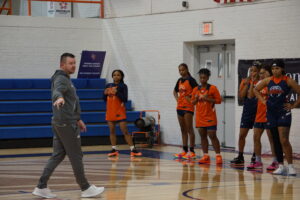
After that meeting, the Lady Lions got to work. Every day, they lifted weights, went to class and practiced in the evening. Even when Vincent gave them a day off to rest and recuperate, many of them still found their way to the gym, taking pride in calling themselves “Gym Rats.”
When their season opener arrived at the end of October, they trounced the Wiley University Wildcats 91-28. They swept their non-conference games but began their conference play with a 71-78 loss against Wayland Baptist University. It didn’t matter; they kept working.
One of Vincent’s catchphrases for the team was “Win the Day.” He told the players to take it day by day, one game at a time. Don’t let a bad game or bad practice stay with you; move on to the next day. When there’s a good game or practice, sit with it a moment and enjoy it, but then move on to the next day. He reminded them their goal was not to win any single game, but to win a championship.
“If you can set yourself up to try to reach that goal of excellence, of being elite, it’s just going to make you such a better player and a better person,” Vincent said. “That’s kind of what our culture is, and that’s something that we really stress. And they’ve really bought into it.”
The Lady Lions strove to Be Elite and Win the Day, and they held themselves and one another accountable to that standard.
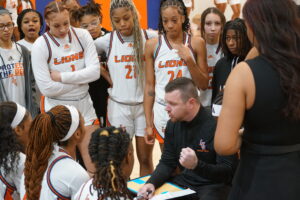
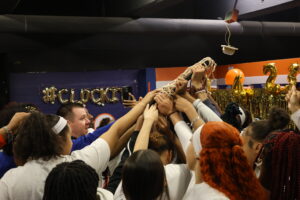
In practice, when one person made a mistake, their teammates would give them pointers and encouragement to fix it. The coaches were patient but firm, and the player herself would drill it until she got it right. In the locker room at halftime, they didn’t wait for the coaches to come in and tell them what they needed to work on; they told each other. After wins, they celebrated in the locker room before pivoting to focus on their next game.
As the season went on, they continued to grow closer as a team, players and coaches alike. It showed in how they played.
Lady Lions Superfan Renee James (right) cheered the team on all season as they continued to improve and grow closer together.
Renee James, an LU alumna and decades-long Lady Lions Basketball fan, said it was evident from her seat in the stands how close the team had grown and how much they trusted one another. Sometimes they would start a game slow, but then they’d regroup, talk to one another and the pieces would fall into place.
“They are so awesome,” James said. “They want to be together, and they work so well together. I love watching them play. I love their energy. They make watching women’s basketball fun!”
After their loss to Wayland, the Lady Lions went on a 19-game win streak, which included a rematch with Wayland at home. They lost to Texas Wesleyan University on the road but bounced back with a 64-61 win against the Rams two weeks later. They were 22-2 in conference play for the regular season.
The Lady Lions knew their team was special from the beginning. Winning the SAC Regular Season Championship and SAC Tournament Championship just confirmed for everyone else what they already knew.
When asked what set their team apart from the others, Sodipe said it was their competitiveness. Brown said it was their persistence. Richardson said it was their commitment to playing together. Woods said it was their winning culture.
“We’re very unselfish, and we’re really versatile,” Woods said. “We have a lot of different pieces, and I just feel like our chemistry is great, even off the court. We’re cool off the court and have a great time off the court, and I feel like that helps us on the court.”
Mikayla Woods was named a Women’s Basketball Coaches Association NAIA All-American and an NAIA Second Team All-American, the first NAIA All-American selection for the Lady Lions since 2022.
Heads Held High
Though their season did not end in a national championship, it did end in success. The Lady Lions ended their season 31-3, tying the record for most single season wins in program history. Several players earned accolades throughout the year, including Woods who was named a Women’s Basketball Coaches Association NAIA All-American and an NAIA Second Team All-American, the first NAIA All-American selection for the Lady Lions since 2022.
After the team’s hard fought Round of 16 loss in Iowa, there was a more somber atmosphere in the locker room than there had been all season. Many fought to hold back tears and others let them flow, not just upset about the end of their national championship pursuit but also about the end of their time playing together.
Coach Vincent looked around the room at the young women who had become a family this season, and he told them to hold their heads high. They had played hard. They had accomplished so much. They had made history.
“I want you all to know, I wouldn’t trade any of you for anything else,” Vincent told them. “I’ve come to not only love coaching you but also loving you as people. I want you to remember, this family is something no one can take from you. Keep your head up.
“I love you guys, all right.”
The Lady Lions made history as the first team in program history to win both the SAC Regular Season Championship and SAC Tournament Championship.
There are over 70 registered student organizations at Langston University offering students chances to find communities with like-minded interests and, for those willing to seek them, opportunities for leadership. From Greek Life to the English Club, there is always a need for campus leaders, and the Office of Student Life works hard to provide mentorship and learning opportunities to develop these students’ leadership skills.
Dr. A. Dominique Williams, the assistant dean for the Office of Student Life, tries to connect students not only with each other but also with resources that can help them be successful. For her, honing students’ leadership abilities is an important part of preparing them for their future careers, and she emphasizes that anyone willing to put in the work can become a leader, regardless of race or gender.
“Even though it’s 2025, there are still a lot of places in corporate America, non-profits, multiple different industries where Black women and women of color are not given leadership roles,” Dr. Williams said. “So, it’s really important to show our students, ‘You can be a leader. You absolutely can be in these rooms and be at these tables, and this is how you can lead in these spaces.’”
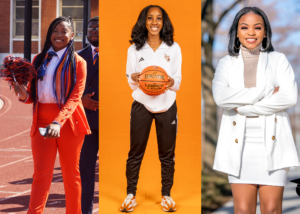
Lady Lions all over campus prove every day that women can be leaders. Let’s meet a few of the young women leading at Dear Langston.
Elise Thompson – SGA Vice President
Elise Thompson has always been civically engaged.
An Oklahoma City native, Thompson didn’t always feel like she fit in at the Dove Science Academy where she went to school, so from a young age, she sought out different avenues to try to find her place. She ended up joining youth leadership programs, which is how she first met Anastasia Pittman, a former state senator and state representative and a Langston University alumna.
Pittman’s work for Oklahoma’s 99th District inspired Thompson, and Pittman became her mentor. Working with Pittman and learning about government helped Thompson realize that was what she wanted to do when she grew up: serve her community as the State Representative for the 99th District. That’s the goal she’s still working toward.
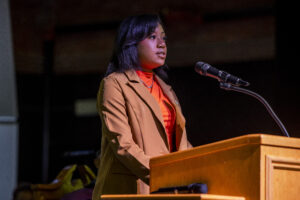
Elise Thompson addresses the student body during the Opening Convocation Ceremony in August.
After high school, Thompson came to Langston University as a McCabe Scholar studying accounting and immediately joined the LU Student Government Association (SGA). She ran for freshman class president and tied the race before losing by three votes in the runoff election. Instead of discouraging her from pursuing future leadership positions, the loss motivated her to work on herself and develop her skills for next time.
“That was a turning point for me,” Thompson said. “That just made me want to work harder. I saw the people who did have those positions and used them as inspiration. Even though I didn’t win, I made sure that I stayed around so I could learn.”
Thompson continued to join student organizations on and off campus, and she took advantage of leadership and development opportunities whenever they presented themselves.
She joined the Oklahoma Student Government Association (OSGA), and in Fall 2024, OSGA passed three bills she proposed, which have now been passed on to the Oklahoma State Regents for Higher Education (OSRHE). She joined the NAACP and attended their national convention in New Jersey her sophomore year. As an LU Student Ambassador, she helped plan and put on Lion Camp, and she has served as the Civic Engagement Chair for Women of Purpose for three years.
As an SGA senator, Thompson helped lobby Langston University administration to raise the fall bursar balance cap for spring enrollment from $200 to $1,000, allowing many students to continue their studies without having to take a semester off. As the SGA Vice President, Thompson helped register over 200 LU students to vote in the 2024 presidential election, and she attended OSRHE’s Student Advisory Council. She is currently helping plan Alternative Spring Break, which is a student community service trip to Washington D.C.
“I can see that my work is not done in vain,” Thompson said. “I actually do have an impact on people, on my community.”
Her hard work has earned her opportunities outside of LU, too. She was invited to attend the Oklahoma City Police Department Youth Leadership Academy where she was able to build a working relationship with Police Chief Ron Bacy, and she received a George and Donna Nigh Public Service Scholarship to represent Langston University at the Nigh Institute. Additionally, she has been an intern for Rep. Ajay Pittman for the past 6 years.
Thompson is aware she still has a lot of room to grow as a leader, but she’s proud of how far she’s come and how much she’s been able to accomplish during her time at Dear Langston. She is constantly learning from those around her, and she’s doing it all so she can one day use all she’s learned to help improve her community in east Oklahoma City.
“I want to help my community be able to thrive,” Thompson said. “Even if it’s something small, knowing that I’m able to help someone really just fills my heart, and that’s what keeps me going.”
Nadia Mooreland – Co-Founder of LU Athletics Social Media Team
Nadia Mooreland lives her life by Habakkuk 2:2: “Write it down, make it plain.”
Nadia Mooreland helped found the Langston University Athletics Social Media Team in 2023.
For Mooreland, the first step to achieving a goal is to write it down. The second step is to put in the work. Her hard work and dedication have transformed the Langston University Department of Athletics’ approach to social media.
Mooreland transferred to Langston University as a broadcast journalism major in Fall 2022 after running track at Oklahoma Baptist University for three years and taking a gap year to focus on her mental health. Growing up in Cushing, Oklahoma, without many Black peers or role models, Mooreland felt an immediate sense of belonging when she arrived on the Langston University campus, and that motivated her to seek out ways to get involved.
She pondered how she could combine her interests in sports and social media with her desire to find a way to give back to the university, and then she came across the LUBoys TikTok account. The page, run by her fellow broadcast journalism students as part of a class project, was filled with interviews and highlight reels of the LU football team.
“I was thinking to myself, ‘Man, it would be cool if we could do this but for all the sports programs,’” Mooreland said.
The idea stayed in the back of her mind until one Fried Chicken Wednesday that spring when her sister introduced her to Quinzaria Tatum. Tatum had a similar interest in revamping Athletics’ social media, and Mooreland knew she had found someone to help bring her idea to life. They met up again a few weeks later, and Mooreland brought a notebook filled with ideas to use social media to bring attention to LU athletes. To her delight, Tatum had done the same.
The two worked together to conduct a SWOT analysis of LU Athletics’ social media presence and then create a strategic plan and campaign proposal. They set up a meeting with Athletic Director Donnita Rogers and Assistant Athletic Director Fachaitte Kinslow where they pitched their plan for a social media team. They then gave their presentation to Sports Information Director Kyle Taylor, then again to the coaches of all Langston sports, and finally to the Office of Public Relations. In Fall 2023, Mooreland and Tatum officially founded the LU Athletics Social Media Team.
For the past two years they have co-led the 15-person social media team, creating content and managing the Instagram and Facebook accounts for all eight sports teams. The team has received lots of positive feedback from LU students and alumni, and coaches now use the content they create for recruitment. LU Athletics’ online exposure and engagement has increased exponentially; one of their football videos has over 600,000 views and earned dozens of ‘follows’ from high school football players.
“Langston University doesn’t get a lot of good press, but I like to call it the Hidden Gem of Oklahoma,” Mooreland said. “If you look inside that Hidden Gem, you see the talented, motivated, hardworking and passionate future leaders of America just killing the game at Langston University. And we just wanted to show exposure to our HBCU, one post at a time.”
Part of Mooreland’s original vision included increasing Athletics’ media and community engagement, and she has been spearheading the team’s media relations and brand storytelling. She organizes media days for every sport and team promotes theme nights for home games, and this year she started conducting post-game press conferences and half-time reports for men’s and women’s basketball.
Mooreland has learned and grown a lot from leading the social media team, but she is now facing her biggest challenge yet: letting go. As she prepares to graduate this July, she is mentoring and training the underclassmen on the social media team to take over for next year.
“It’s kind of hard starting a legacy but then coming to the realization, ‘Dang, I have to leave it,’” Mooreland said. “We have to give it to the younger people so they can put their own twist on it, and they can continue the legacy.”
Cambrie Cannon is the Constitution Revision Chair for the LU Student Ambassadors, the Civic Voice Chair in the SGA Senate and the Public Relations Chair for the Legal Lions.
Cambrie Cannon – LU Student Ambassadors
For Cambrie Cannon, confidence is key in leadership.
A junior double majoring in corrections and broadcast journalism, Cannon has learned a lot about leadership since high school. Growing up in Oklahoma City, she always had examples of strong leaders thanks to the many military service members in her family, including her father who served in the Army National Guard, Army and Army Reserves. As she neared her high school graduation, she knew she wanted to serve her country, but she also knew she wanted to pursue a higher education.
Luckily for her, it didn’t have to be one or the other.
Cannon enlisted in the Oklahoma National Guard after graduation and attended basic training that summer. In the fall, she accepted a Regent Scholarship to attend Langston University.
“I find myself following in my dad’s footsteps,” Cannon said. “He also served and he also attended Langston.”
At first, Cannon felt odd being an active-duty service member in school, but she was quickly able to find community among her fellow Lions. As she became more comfortable, she started getting more involved on campus. She became an LU Student Ambassador, joined the Student Government Association and became an active member of the Legal Lions, a club for pre-law students. As she got more involved, she began to take on leadership roles within these student organizations.
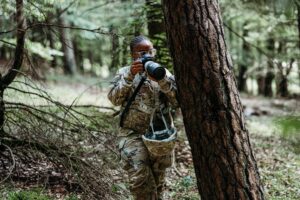
Cannon is the Constitution Revision Chair for the LU Student Ambassadors, the Civic Voice Chair in the SGA Senate and the Public Relations Chair for the Legal Lions. In the National Guard, she has earned the rank of Specialist and works in Public Affairs.
“These positions are really shaping me as a leader, and I’m definitely going to carry these skills and traits on when I go to law school,” Cannon said. “The skills that Langston is teaching me now are going to make me a better leader. I feel like the skills that you develop here, they’re skills that you can’t get anywhere else.”
Cannon knows the lessons she has learned in both the military and as a student have been building off each other, enabling her to better serve in each of her respective positions. Her experience in the military has given her the confidence to trust herself and her abilities, while her experiences at Dear Langston have given her the confidence to be creative in her problem solving, use her resources and interact with authority figures.
When Cannon finishes her degree, she plans to go to law school, though she is unsure whether she would like to go into criminal or family law or pursue a career as a Judge Advocate General’s Corps (JAG) officer. Whichever path she chooses, she knows she’s prepared.
“Langston is giving me that confidence as a woman and as a minority to go after these positions,” Cannon said. “I’m not scared to apply for promotion boards, I’m not scared to communicate with my higher ups. I’m used to Langston pushing me to take on these positions. So when it comes having the confidence to go after something that I want, Langston has given me the confidence to do that.”
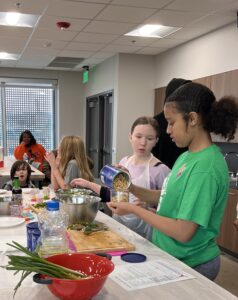
Yellow squash, zucchini, bell peppers and parmesan cheese. These are ingredients used to make a simple but nutritious squash skillet like the ones 4-H students made in the Junior Master Gardeners program at Langston University.
Junior Master Gardeners, or JMG, is an international program and curriculum that teaches kids about growing their own food to support healthy lifestyles. Kids learn about everything from the best times of year to plant seeds for different fruits and vegetables to the proper knife skills needed to prepare the veggies for cooking.
The curriculum is filled with hands-on activities and opportunities to try new foods, making it popular among the members of the Roaring Adventures 4-H Club in Langston, Oklahoma.
“I think that’s what was so important about 4-H is that that’s what they promote,” said Donnesha Williams, the 4-H educator in charge of the Roaring Adventures Club. “It’s positive youth development through hands-on learning, through hands-on engagements.”
4-H, the largest youth development program in the United States, is operated by Cooperative Extension at public land grant institutions across the country, including at Langston University. The Sherman Lewis School of Agriculture and Applied Sciences operates three 4-H clubs in Oklahoma, providing opportunities for kids from elementary through high school to engage with their communities and learn life skills.
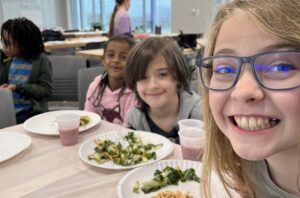
The Roaring Adventures 4-H Club teaches its members prepare a green bean dish during their Junior Master Gardeners program.
LU’s largest 4-H club is Roaring Adventures, which has 25 members ranging from ages 5 to 14. Many of its members are part of Coyle Public Schools, which operate virtually on Friday mornings, so the club meets every Friday afternoon at the Horticulture Education and Research Center (HERC) on LU’s Langston campus. There the kids participate in a variety of fun and educational activities, like JMG.
Because Roaring Adventures is based in Langston, Oklahoma, Williams takes advantage of as many of the university’s resources for her programming as she can. In addition to working with the HERC for JMG, she works with other departments to host activities like drone demonstrations and a Goat, Sheep and Haire Day. Another valuable resource for Williams are the LU students.
About 20 LU students from various organizations and majors volunteer to help Williams with the Roaring Adventures Club each semester. After completing their volunteer certification training, the college students help the 4-H-ers with activities ranging from making ice cream in mason jars to preparing for the annual fishing derby in the fall.
“We lean on (our college students) so much, and luckily, they love it,” Williams said. “They’re very hands-on. They adore the kids and the kids adore them.”
Down the highway, Amir Rashidi is in charge of the Eastern Pasture Community Club in Spencer, Oklahoma. The club has 15 members, mostly around 12 to 13 years old, and like the kids in Roaring Adventures, they participate in community events and do lots of hands-on educational activities.
Because it’s located much further from the Langston campus, the Eastern Pasture Club doesn’t have access to some of the resources Roaring Adventures does, like the HERC. So Rashidi works with local community partners like the Minnis Lakeview Recreation Center to put on programming for the kids, such as their recent canning workshop. A piece of programming Rashidi is especially passionate about is his horses.
Rashidi puts on demonstrations for his 4-H-ers where he teaches them about proper grooming and care for the horses.
A rodeo participant since childhood, Rashidi likes to incorporate his horses into lessons and activities for the Eastern Pasture Club. He puts on demonstrations where he teaches the kids about proper grooming and care for the horses, such as how to clean their hooves and what to feed them. He said it felt natural to include the horses in his club’s programming because of 4-H’s agricultural ties, and the kids love getting to see and pet the animals.
“Some kids, they’re not blessed with the opportunity to have interactions with horses,” Rashidi said. “So, I’m just trying to give these children more of this positive interaction just because they might not ever come in contact with a horse again. I’m trying to give them an experience so that they can have a positive outlook that one day they can possibly be a young cowboy or cowgirl.”
Roaring Adventures and Eastern Pasture are always welcoming new members to their clubs, and Williams encouraged any students or parents interested in 4-H to reach out for more information. In the future, LU Extension hopes to open more clubs around Oklahoma to continue to bring these opportunities to more children.
By Jet Turner, Assistant Director of Communications
Dr. John Coleman received a call from the fourteenth president of Langston University, Dr. Ernest Holloway, in 1993. Holloway’s gregariousness led their conversation all over the place, but his message was clear: the students at Dear Langston needed additional support.
Coleman left his position as an assistant professor at Hudson Community College in New Jersey after that summer and journeyed back to his home state of Oklahoma. He only planned to stay for a couple of years, but his dedication to helping students be their best kept him on Langston University’s campus. After 32 years of service and mentorship, Coleman will retire at the conclusion of the 2024-2025 academic year.
His career as the Chair of the Department of Chemistry at LU has been dedicated to teaching science, technology, engineering and mathematics (STEM) subjects and equally to seeing that students learn to excel in academics and life. His influence can be seen all over the University and, more importantly, in its students.
Beginnings
Coleman grew up around educational excellence in Boley, Oklahoma.
Today, the historically Black town might seem unassuming, but when Coleman was growing up in the 1940s and ’50s, the town was described by Booker T. Washington as the “finest Black town in the world.” Many of the individuals Coleman grew up around had their doctoral degrees or some other form of higher education, including his parents.
Boley’s significance in education parallels no other Black town in the nation, historian Currie Ballard said in a 2017 article by The Oklahoma Eagle.
This meant Coleman was always surrounded by excellent teachers. One of whom was Holloway, his future president, who taught chemistry at Boley Junior High in the 1950s.
“Holloway knew what was happening in Boley and how we got prepared,” Coleman said. “You always have someone who is going to help you. You didn’t have to rely on just your resources at home.”
Community is where Boley found its strength, and Coleman carried that lesson with him throughout his academic career.
Coleman always expected to go to college, and Langston University was a natural choice.
Coleman began his freshman year at Langston University during the 1961-1962 academic year.
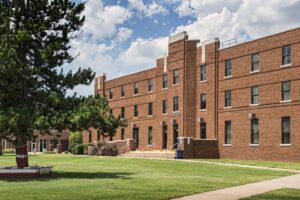
He began his freshman term during the 1961-1962 academic year. Buildings like Sanford Hall and Moore Hall still stood proudly where they are today, although their functionality was different from their modern day uses.
During his time at LU, he served as the freshman class president and was a brother of Alpha Phi Alpha Fraternity, Inc. Even though LU had been around for almost 75 years by the time Coleman graduated in 1965 with his bachelor of science in chemistry and mathematics, students still had to march at the Oklahoma State Capitol every year to fight for the university to remain open. Coleman was an active participant in these efforts.
Just as obtaining his undergraduate degree was expected for Coleman, working toward an advanced degree was a natural next step. He began his PhD in Theoretical Physical Chemistry at the University of Oklahoma in 1972.
OU was still integrating, and undergraduate Black students especially were facing discrimination at the hands of some students and employees. Coleman became a graduate advisor to the Alpha Phi Alpha chapter on campus during this time.
“There were cannons pointed south and all kinds of things going on,” Coleman said. “But we did a lot of things with students to try to help students feel more comfortable. We did a lot of tutoring. We did a lot of whatever, trying to make the students come in and be successful.”
Growing up in a Black town and attending a Historically Black University helped Coleman understand the importance of community. At every opportunity, Coleman shared that community with others.
Coleman graduated from Langston University in 1965.
He earned his PhD in 1976 and concluded his postdoctoral studies at OU in 1978.
Coleman was briefly a researcher at Halliburton Company before traveling east to become an assistant professor at several local institutions. First at Bergen County Community College in Paramus, New Jersey; then at City University of New York, and finally at Hudson Community College, where he received that call from Holloway.
Returning Home
Upon returning to Langston University, Coleman immediately got to work.
Coleman’s years of experience teaching STEM courses provided insights into the problems that frequently impede student learning. He encountered students’ wide-spread practice of what he calls “plug ‘n play.” Plug ’n play is when students use a solved “example” problem as a model and plug in variables from the new problem to find a solution. This bypasses the need to learn and apply core concepts.
Coleman developed and adopted instructional strategies embedded in a process he calls Competency Performance Recording for Learning (CPR-L). His CPR-L teaching and learning process has had a positive impact on student academic performance for his over 30-year career at Langston University and is the basis for how he approaches educating his students.
Dr. Alonzo Peterson, Vice President for Academic Affairs, witnesses Coleman’s commitment to Langston University’s students almost daily. Coleman can often be found on campus until 9 p.m. or later, depending on how many students still need help.
“He’s by far one of the smartest people I know,” Peterson said. “His ideas are very, very innovative. He spends a lot of time with students, hours and hours.
“One of the things I recognize from his tutoring processes is that he doesn’t give students answers. Students may ask, ‘how do you do this?’ and he responds, ‘well, how do you think we do it?’ And then he will go back and talk through the problem for them to solve it, not him. Some people are dispensers of knowledge, he is a facilitator of knowledge.”
In 2003, Coleman received a grant from the National Science Foundation which started Langston’s Integrated Network College (LINC) for STEM program. This program provided scholarships for students in STEM fields and required them to participate in research on campus and across the country. They would then present that research at conferences.
The goal of the LINC program was to produce more minority students in STEM fields who would then earn their doctoral degrees. This program was exceedingly successful.
LINC boasted a 92% graduation rate, with 60% of those students going on to earn graduate degrees. Many of these were earned at major universities that include Vanderbilt, University of Kansas, University of Texas, Baylor University, Johns Hopkins and more.
The students’ participation in summer research internships at institutions that include Johns Hopkins, University of Texas, Stanford, Cal Tech, University of California at Berkley, University of Oklahoma and more. Their research work generated over 300 Abstracts. Their participation in competitive research presentation events throughout the U.S. earned over 50 top awards.
These STEM professionals now hold prominent positions in both industry and education, including achieving success as entrepreneurs.
According to RTI International, of the STEM PhDs awarded in the U.S. in 2021, 5% went to Black scientists, even though the U.S. population is 12% Black, showing the disparity in the field.
Coleman was also encouraging students to stick with the STEM field, even if they did not think it would be for them.
Dr. Ryan Johnson, a former chemistry major and now professor at Langston University, was one of these students.
When Johnson began attending LU in the early 2010s, he was not interested in attending college, much less becoming a chemist. Even though he showed up to Dear Langston as an undeclared major, a mistake in the system had him listed as a chemistry major.
Wanting to change his major, Johnson was told to speak with Coleman before deciding.
That one conversation changed his life.
“He convinced me to stay,” Johnson said. “He told me I was doing well in my other STEM classes, and I was on track to take Chem I anyway. I took it the following semester and ended up staying with chemistry. Kind of weird, right? How those little conversations can change the trajectory of your life.”
As part of the LINC program, students had to at least apply for graduate schools as their undergraduate degrees concluded. Johnson had no intention of earning his doctorate, but another conversation with Coleman convinced him to apply to Louisiana State University, one of the leading producers of doctoral-prepared Black chemists in the nation.
Coleman was a member of Alpha Phi Alpha Fraternity, Inc. during his time at Langston University.
Innovation was another one of Coleman’s missions in the classroom.
Coleman was an early adopter of integrating technology into the classroom at Langston University, something that stood out to Dr. Byron Quinn when he was being taught by Coleman at Langston University.
“Even back in the early ’90s, at the beginning, he was at the forefront of this,” Quinn said. “He was working with really the first iteration, first generation, of tablets and PCs in the classroom, so that students could write and do homework on them and digitally turn them in.”
But Coleman’s impact is much farther reaching than the borders of Langston University’s campus.
About a year after his return to teaching at LU, Coleman set out to build strong science and math foundations when he received a grant to establishthe Langston University Summer Math and Science Academy.
It was here, when she was 14 years old, Dr. Lindsay Davis met a Black chemist for the first time in her life.
She hated chemistry.
“It was the hardest thing ever,” Davis said. “But Dr. Coleman had such an eloquent way of communicating chemistry. And so, by the end of that camp, I knew I wanted to be a chemist.”
She attended the Math and Science Academy many more summers after that. Her familiarity with the campus, its scholarship opportunities and its faculty led Davis to enroll at Langston University.
She took her first class with Coleman, Organic Chemistry, her sophomore year. It is still the most difficult course she has ever taken.
More than a third of black STEM PhD holders earn their undergraduate degrees at HBCUs according to American Institutes for Research.
But Coleman’s student-centric approach helped her through the class. She took three more classes with him throughout her time at LU and, after graduating, like so many of his students, was convinced by Coleman to pursue her doctoral degree.
“That took a lot of convincing, and there were a few mechanisms that helped me to go off and produce my PhD,” Davis said. “But Dr. Coleman being the first chemist I ever met inspired me to get a PhD.
“When you are able to see the representation in front of you, I think it either consciously or subconsciously inspires you.”
Because of Coleman’s influence, in 2021 Davis went on to become the first Black chemist to graduate with their PhD from the University of Texas at Arlington.
Legacy
Johnson, Quinn and Davis are just a handful of the students Coleman not only encouraged to go and earn their doctoral degrees, but to come back and teach at Langston University.
Quinn is currently the Chair of the Biology Department at Langston University, working closely with Coleman each day and utilizing the lessons he learned in using technology in the classroom to instruct his students and conduct world-renowned research.
Johnson just returned to Langston University as a professor in the chemistry department and is now providing the same mentorship, guidance and expectations Coleman gave to him as a student.
Coleman was voted “Most Intellectual” in 1965 alongside Louvenia Stidham.
Davis is not only a professor in the chemistry department but also leads the Math and Science Academy at Langston University, bringing her journey full circle. Now, she gets to be the same inspiration to the students who attend each summer that Coleman was to her as a teenager. She may even be the first Black chemist some of them meet.
“I hope I even have (a legacy),” Coleman laughed.
But his legacy is unmistakable. Coleman has built his own community of educational excellence at Langston University, in the STEM field and across the world.
His mission has been to ensure Dear Langston’s students have the support they need to lay the foundation for a brighter future. Now, Coleman gets to wrap up his career as the Interim Dean of the College of Arts and Sciences, where he is still buildingprograms and methods that will lay firm foundations and help educate students for the long term.
Langston University President Dr. Ruth Ray Jackson, who formerly served as the Vice President for Academic Affairs, has seen the impact of Coleman’s time at LU. She said regardless of his position, he has intentionally remained engaged with his students, ensuring they are well-prepared when they leave Langston University.
“I think that his lasting legacy really is his quest for knowledge, not just for himself, but for his students.