
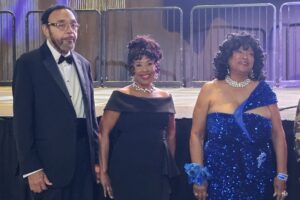
Tag: Dr. John K. Coleman

Langston University employees, alumnae honored at 14th annual Oklahoma African American Educators Hall of Fame

Release Provided By

Langston University employees and alumnae were honored at the Fourteenth Annual Ceremony and Banquet of the Oklahoma African American Educators Hall of Fame on Friday, Sept. 26.

The honorees included recent Langston University retiree Dr. John K. Coleman, alumna Mrs. Carolyn Gay Harris, alumna Dr. Jolly Henderson Meadows, and former Langston University professor Dr, Melvin B. Tolson, who was honored posthumously.

Dr. John K. Coleman

Dr. Coleman attended LU from 1961-65, graduating with honors and earning a Bachelor of Science degree in Chemistry and Mathematics. He continued his education at the University of Oklahoma, where he earned his Ph.D. in Theoretical Physical Chemistry in 1976 and completed post-doctoral studies in 1978. After some time away, Dr. Coleman returned to Langston University in 1993 at the request of the late President Ernest Holloway to serve as the Chair of the Department of Chemistry and Physical Sciences.

Over the past three decades, Dr. Coleman not only served as chair of the Department of Chemistry, but his impact also extended beyond academic metrics. For generations of Langston University students, he has been a mentor, advocate and example – a leader who never stopped believing in the transformative power of education. Many of his former students are now faculty members at Langston University in the Chemistry or Biology Departments, shaping new generations in the same spirit he so faithfully modeled.

Dr. Coleman was appointed the interim dean of the School of Arts and Sciences in 2023, and he retired at the conclusion of the 2024-2025 school year.

Mrs. Carolyn Gay Harris

Mrs. Harris joined Langston University as a majorette in the Marching Pride, which was known at the time as the Langston Lions Band. Her time at Langston University was marked by academic achievement as she earned her Bachelor of Arts degree, laying a foundation for her future career in education. Pursuing further academic excellence, she completed a Master of Education degree at the University of Central Oklahoma in 1974.

Mrs. Harris began her professional journey at Spencer High School in Spencer, Oklahoma, where she taught for five years. Her commitment to shaping young minds extended to middle school classrooms for six years, and thereafter to administrative roles as both elementary and middle school principal for another six years. Her dedication and expertise culminated in her leadership as an elementary school principal for a remarkable 16 years. These decades of service reflect a career that spanned a total of 33 years, during which she touched the lives of countless students, faculty members and families.

Dr. Jolly Henderson Meadows

Dr. Meadows earned her Bachelor of Science degree in Elementary Education in 1974 from Langston University, followed by a Master of Education degree in Reading from Northeastern State University in 1979. She obtained a Master of Education degree in Leadership from Northeastern in 1986 and her Doctor of Education degree in Educational Leadership from Oklahoma State University in 1997.

Dr. Meadows began her 51-year career in education at Liberty Elementary in Sapulpa, Oklahoma. She joined Tulsa Public Schools in 1975 when she accepted a teaching position at Riley Elementary School, and she was appointed assistant principal at Patrick Henry Elementary School in 1986. After two years she was appointed principal – a position she held for 23 years. In 2006, Tulsa Public Schools took notice of the impressive academic growth Patrick Henry Elementary School showed under Dr. Meadows’ tenure and assigned her to Monroe Middle School. She was transferred to Gilcrest Middle School in 2007.

As an administrator, Dr. Meadows was known for utilizing innovative and reliable programs with proven outcomes to achieve academic gains. She employed a collaborative approach to empower teachers to become leaders, to disaggregate test data and to research supplemental instructional materials. She retired from Tulsa Public Schools in 2009 and worked as an adjunct professor of urban education in the undergraduate and graduate programs at Langston University–Tulsa. She accepted a full-time position as an Assistant Professor in the Department of Education at the University of Tulsa.

Dr. Meadows is also the vice president of the Langston University National Alumni Association-Tulsa Chapter (2021-present).

Dr. Melvin D. Tolson

Dr. Tolson taught English and speech at Wiley College in Marshall, Texas, for nearly two decades. In addition to teaching English, he established an award-winning debate team, the Wiley Forensic Society, which became a pioneer in interracial collegiate debates. Beginning in 1930, the team debated against law students from the University of Michigan in Chicago. In 1931, the team participated in the first known interracial collegiate debate in the South against Oklahoma City University. This is the story that inspired the film “The Great Debaters,” starring Denzel Washington.

Dr. Tolson took a sabbatical from teaching in 1930 to study for a master’s degree at Columbia University in New York City. His thesis project, “The Harlem Group of Negro Writers,” was based on his extensive interviews with members of the Harlem Renaissance, which inspired him to write “A Gallery of Harlem Portraits,” his first major work.

In 1947, Dr. Tolson relocated to Langston University, where he taught English, drama, and was a dramatist and director of the Dust Bowl Theater. Students described Tolson as eccentric, driven, fearless and radical. It was not unusual for him to stand on top of a desk and jump off to engage and challenge students during lectures. While at Langston University, Dr. Tolson was elected to multiple terms as mayor of Langston City.

Dr. Tolson’s career in education at the collegiate level spanned 43 years. He died in Dallas, Texas, on Aug. 29, 1966, and is buried in Guthrie, Oklahoma. His award was accepted by Dr. Cindy Ross, Chair of the LU Department of English and Foreign Languages in the School of Arts and Sciences.
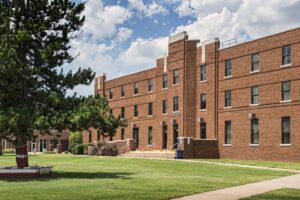
Sanderson Hall on Langston Campus

From Theory to Practice: Langston University Celebrates 25th Annual Research Day

Release Provided By

(This story was originally published in ‘E Roar | Vol. 2 Issue 4 in June 2025)

By Jet Turner, Assistant Director of Communications

Langston University held its 25th Annual Research Day on April 18, 2025. Research Day includes various disciplines, majors and students. Whether you are a biology or chemistry student, psychology student or even a computer science student, you are welcome to participate in Research Day.

Research Day aims to help students understand the practical applications of their learning. It shows students how their knowledge can serve society and provides an opportunity to demonstrate their problem solving and articulation skills. It also allows students to build their resumes, prepare for internships and graduate school applications, among many other skills.

“It’s the value added,” said Dr. John K. Coleman, Interim Dean of the College of Arts and Sciences. “Once you get a culture where students (are presenting their research), you look at the student and you just see the product. Now they are starting to learn why they’re learning these theories and why they learn these concepts, and then what you can actually do with it and how you can help society. You’re here to learn, but you leave to serve. So how do you use what you’re learning? This is the part that teaches you how you use what you’re learning to serve society.”

Dr. Lindsay Davis, associate professor of chemistry, participated in the 13th Research Day when she was a student at LU.

Despite her fear and hesitation to present her research, she was well prepared and supported.

“Ultimately, Research Day gave me the confidence that I needed to pursue graduate school and to make these presentations a norm for me,” Dr. Davis said. “I was so scared of public speaking, and now it’s easy.

“So, Research Day definitely helps with their communication skills. But most importantly, I think it allows them to be a scientist, to communicate through research and to really achieve their goals.

This year over 20 students participated in Research Day. 


Josiah Grayson – Selection of Undergraduate Degree Major Among College Students

Senior, Computer Science Major

Josiah Grayson’s research explored the psychological and social factors influencing how college students, especially those at Historically Black Colleges and Universities (HBCUs), choose their academic majors.

Grayson’s studies revealed personal interest is the most important factor when a prospective student selects a major, which contradicts his hypothesis that financial considerations would be at the forefront of their decision-making process.

Grayson highlights that student interests are often “shaped by what they have been exposed to,” meaning individuals are more likely to pursue careers and majors they have seen modeled in their communities. For Black students specifically, this means decisions are “shaped by survival, legacy and representation.”

“Institutional culture and climate impacts persistence,” Grayson said. “What goes on at the university and then specifically in the department, how they teach the information, how they work with the students. Is there tutoring? These things highly impact whether or not somebody is actually going to finish their degree.”

Financial status, according to Grayson, still plays a significant role in a student’s decision in what major they select, even if it isn’t the primary driving force. Grayson notes that students from a lower socioeconomic status tend to be more risk-averse, often choosing a “more stable” career path, while students from higher socioeconomic backgrounds have more flexibility to pursue less conventional majors, if they so choose.


Kimbree Layton – Studying the Relationship Between Mental Health, Emotional Well-Being and Academic Well-Being Among College Athletes

Senior, Psychology Major

Kimbree Layton conducted a comprehensive study examining the relationship between mental health, emotional well-being and academic well-being among collegiate athletes at Langston University. Her research focused specifically on anxiety, depression and stress levels among student athletes.

The study employed a multi-scale survey approach, utilizing four different psychological assessment tools. Layton was able to collect data from 15 of Langston University’s student athletes, all of whom were female.

Findings revealed that Langston University student athletes generally demonstrated positive mental health indicators, showing no significant signs of depression, anxiety or stress.

“(The student athletes) think highly of professional help and seeking it when it is necessary,” Layton said.

Layton’s research highlighted several critical factors influencing student athlete mental health, including “the importance of their relationships” with coaches, professors and family. Modern student athletes must overcome a tough emotional landscape, and many challenge the stigma that they should always be “very mentally tough” and not show emotions.

While the study provides valuable insights, Layton recognized limitations in her research, including the small sample size and the use of somewhat dated psychological assessment scales. She recommended future research should “examine what relationships between scales and demographics” exist and potentially explore the impact of teammates on mental health, a dimension not fully explored in this current study.


Reginald M. Archibald II – Artificial Intelligence Biases in Healthcare

Senior, Computer Science Major

Reginald Archibald II explored the critical issue of artificial intelligence (AI) bias in healthcare, highlighting how AI models can perpetuate systemic inequalities.

Archibald’s research uncovered six types of bias in healthcare AI models: implicit, selection, measurement, confounding, temporal and algorithm bias.

An example pointed to in this research is the dermatology AI tool developed by Stanford University, which was trained predominantly on images of lighter-skinned individuals. This could have a significant negative impact on patients who have a darker skin complexation.

“When you go in and they’re trying to detect for skin cancer, oftentimes they’re not able to find it, and they might (misdiagnose) you,” Archibald said.

Several other real-world scenarios demonstrate the potential harm of biased AI. During the COVID-19 pandemic, pulse oximeters were found to miss conditions in Black patients three times more often than in other races. Another study revealed an AI algorithm that based healthcare decisions on costs that systematically undervalued Black patients’ health needs.

To address these critical issues, Archibald proposes multiple solutions. These include conducting bias audits before AI deployment, training healthcare professionals on AI decision-making processes and incorporating synthetic data to improve representation.

He emphasizes the importance of diversity in AI development, stating that diverse team members can provide “ethical background knowledge about their race, their gender, their age group and their economic status.”