Tag: cooperative extension

employee from aaru helping a student put on the V R headset

LU Cooperative Extension and Outreach hosts virtual reality STEM education labs

Release Provided By

by Ellie Melero

As she stepped into the Pollinator Sanctuary, Andria took a moment to assess her surroundings.

She stood in the middle of a circular path lined with bushes and flowers. Butterflies, bees and other flying insects flitted between the plants, buzzing contentedly and paying her no mind. Her eyes followed the route of a bumblebee as it circled a purple flower to her right and flew over her head, bringing her gaze up to admire the bright blue sky that shone through the crisscrossing wooden beams enclosing her and the insects inside a giant ring.

She returned her eyes to the front and saw six pedestals in front of her. Each held a flower and was labeled with a different pollinator. She stepped forward, reached out, and plucked a bright red and orange marigold from its pedestal. Immediately, a honeybee came and landed on the flower, allowing her to get a good, close look at it. She brought the flower eye-level, and a voice began speaking in her ear, telling her about the daily habits of honeybees.

“Usually, if I saw it in real life, I would get scared,” Andria said. “If I saw a bee, I would run. But since I knew it wasn’t real, I was kind of investigating it, seeing what was on the bug and stuff.”
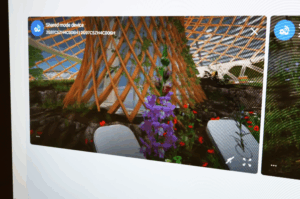
Pollinator Sanctuary virtual reality experience displayed on a TV screen
The VR Pollinator Sanctuary helped students learn about pollination, the insects that pollinate, and how that process plays into everyday life.

Observing different bees, butterflies and moths up close on the flowers was one of several activities Andria did through the Pollinator Sanctuary Virtual Reality Experience at Langston University on Thursday.

A rising junior at Stillwater High School, Andria is a camper at LU’s 2026 Math and Science Academy. The annual summer camp brings students from all over Oklahoma and surrounding states to the Langston Campus for two weeks to learn about STEM careers, life in college and strategies for taking the ACT. Activities like the Pollinator Sanctuary give the students opportunities to learn about STEM and agriculture in new and exciting ways, which is why Shar Carter is trying to make it more accessible.

Carter is an extension educator with LU’s Cooperative Outreach and Extension Programs (CEOP). She worked with Aaru Entertainment, a virtual reality company based in Tulsa, to bring the Pollinator Sanctuary to Langston for the Math and Science Academy. For two years, she has worked with Aaru to put on similar events around Tulsa with some of the other educational labs they offer, such as a virtual reality space simulation. This summer, she wants to do more.

“We can take them to places, whether that’s botanical gardens or museums, that they might never see in their lifetime,” Carter said. “There’s just so many applications that we can do, and what Dr. (Welsey) Whitaker, Dr. (Alonzo) Peterson and President (Ruth Ray) Jackson have allowed me to do is engage with other departments and adapt it to what they want to do.”

For the Math and Science Academy, Carter wanted it to showcase one of the many intersections of STEM and agriculture.
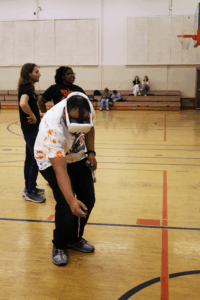
a student moves around while wearing a V R headset
In the VR Pollinator Sanctuary, students could get a close look at insects and flowers and learn about the importance of pollination and pollinator conservation.

By donning the VR headset, students were transported from LU’s Multipurpose Gymnasium into a state-of-the-art insect sanctuary and observatory to learn about pollination, the insects that pollinate, and how that process plays into everyday life. They looked at bugs and flowers up close, walked through a grocery store with empty shelves where all the food requiring pollination should have been, and learned about pollinator conservation.

For many of the students, this was their first experience with virtual reality, and they were impressed.

“I was excited because I always wanted to try VR,” Andria said. “At first, it wasn’t like how I expected it to be, but it was still fun. It was cool looking around and seeing random things flying around. I think it’s a fun way to learn, especially since it’s kind of like a video game, and most people like video games.”

The experience stuck with the students as more than just a fun activity. Many said they learned things about bees they hadn’t known before, and the impact of seeing the empty grocery store shelves is something many said will stay with them.

Aaiyah, a rising junior at Wiley East High School in Dallas, said the experience was eye-opening.

“It’s showing you how all the pollinators are gonna be gone, and how we’re not really gonna have any food,” Aaiyah said. “Like, in year 2080, we’re really only gonna have bread and wine. It was just really sad because we need to work on it.”

Despite the somber feeling she had when she took off the headset, Aaiyah was still impressed by the VR experience.

“You see things, like articles and stuff like that,” Aaiyah said. “But this was like, you actually got to engage with it. To see the future and back and the difference, and to actually take it in.”

Carter and Aaru will host the next virtual reality STEM education lab on the Langston Campus on June 25 as part of the Sherman Lewis School of Agriculture and Applied Sciences’ HERC Field Day. Carter is working to schedule more around Oklahoma throughout the summer.
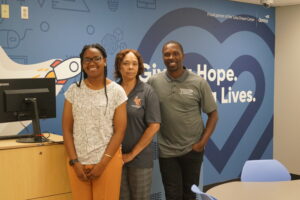
group poses in front of TDC mural

Keep Dreaming: Langston University Cooperative Extension partners with Tulsa Dream Center to bring STEM opportunities to Tulsa children

Release Provided By

(This story was originally published in ‘E Roar | Volume 2 Issue 5 on Sept. 12, 2025)

by Ellie Melero

It was a bright and clear Tuesday morning, and Tulsa was just starting to heat up under Oklahoma’s unforgiving summer sun. In the north part of the city, cars drove with their windows down and people walked on sunbaked concrete sidewalks as they made their way to the Tulsa Dream Center.

Despite the early hour, the north campus of the Tulsa Dream Center (TDC) was already a hive of activity. The lobby was filled with people hoping to take advantage of one of the many services TDC provides the community. Across the parking lot, volunteers were getting ready for the twice-weekly grocery giveaway. On the second floor of the Center, there were classrooms full of eager children waiting to see what activity they were about to do with Langston University.

For six weeks in June and July, the Department of Family and Consumer Sciences (FCS)–a part of LU’s Cooperative Extension and Outreach Programs through the Sherman Lewis School of Agriculture and Applied Sciences–hosted interactive STEM workshops for the TDC’s Dream Academy Summer Camp. The activities ranged from sewing classes to basic coding lessons, and they were always a highlight of the week for the kids.

“The kids, they loved it,” said Pastor Tim Newton, the executive director of TDC. “They’re experiencing things and seeing things that they otherwise wouldn’t have known even existed.”

LU Extension has worked with TDC a handful of times over the past three years, but both groups have wanted to expand the partnership for a while. This year, they took the first step forward by collaborating on TDC’s spring and summer day camps, and the partnership will continue growing as LU Extension grows its footprint in Tulsa.

It all started with STEM Field Day.

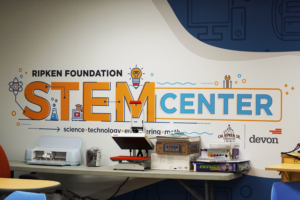
a mural inside the Tulsa Dream Center's STEM Center
The activities LU Cooperative Extension puts on are helping TDC kids build foundational knowledge in STEM and teaching them important life skills.

For several years, Extension Educator Shar Carter has organized a STEM Field Day in Tulsa at a local butterfly farm. She works with the statewide FCS team and collaborates with other LU departments, local schools and outside organizations to put on free, fun and engaging educational activities for the kids, such as demonstrations from Langston University’s Drone Technology and Precision Agriculture program.

In 2022, STEM Field Day fell on Monroe Middle School’s fall break, so Carter had an opening for 100 students to attend the event. She reached out to TDC to see if they would be interested, and Pastor Tim wasted no time gathering kids to fill the open spots.

“He was like, ‘I can get you kids,’” Carter said. “And from then on, we’ve been working with the Dream Center. They are just a feeder for so many schools in Tulsa that it just made sense.”

TDC is one of the largest providers of after school childcare in Tulsa, and it serves between 700–1,000 kids daily. The average household income for these families is $27,000 per year. Because of its reach, Carter knew working with TDC would be a strategic partnership for LU Extension.

This spring, Carter approached Dr. Tiffany Williams, the program leader for Family and Consumer Sciences, about an opportunity to grow their existing relationship with TDC. Dr. Williams was immediately on board.

“The needs of the youth as well as the adults who attend TDC closely align with the outreach mission of our cooperative extension program,” Dr. Williams said. “Shar recognized this and developed a partnership with TDC to implement the Children, Youth and Families at Risk program. She thought that would be a great way to really start this partnership between Langston and TDC, and she spearheaded developing that partnership.”

Pastor Tim had invited FCS to be a part of TDC’s spring break day camp in March, so Carter and Dr. Williams decided to do a week-long culinary camp for the kids. They worked with a professional chef to develop the program, and every day they taught the kids how to prepare healthy and delicious meals. They even sent the kids home with leftovers to share with their families.

As is her forte, Carter had fun explaining to the kids how everything from the fractions they used to measure ingredients to the chemical reactions as the food cooked tied back to STEM. For Dr. Williams, the camp was about educating the kids about healthy eating and motivating them to share the knowledge with their families. For Pastor Tim, it was about getting the kids excited to learn.

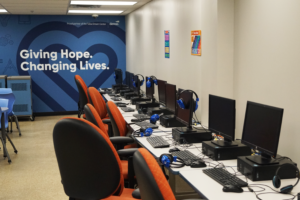
A row of computers inside the Tulsa Dream Center's STEM center
TDC is one of the largest providers of after school childcare in Tulsa, and it serves between 700–1,000 kids daily. Because of its reach, Carter knew working with TDC would be a strategic partnership for LU Extension.

The culinary camp was such a success that Pastor Tim asked them to come back for the Dream Academy Summer Camp. FCS takes a wholistic approach to education, focusing on teaching people of all ages important life skills, so Dr. Williams and Carter got the other extension departments involved. They did different activities every week, and Carter said the kids didn’t even realize how much they were learning.

“I tie everything that we do back to math, critical thinking and reading comprehension,” Carter said. “I think youth learn better if they’re having fun.”

One of Pastor Tim’s primary goals for TDC’s educational programs is to expand the kids’ minds, and he says the activities they do with LU go a long way toward achieving that goal. Not only does LU Extension make learning fun, but it also exposes them to new things they would probably never interact with otherwise.

In addition to helping them build foundational knowledge in areas like agriculture and food science, Pastor Tim said LU Extension is inspiring the students to pursue new interests. He anticipates there will be a long-term economic impact from this partnership as the children grow up and become more motivated, confident and prepared to pursue a higher education.

“As those kids get exposed to those things, they’ll be able to leave here, earn a good education, earn wages, and be able to come back into this community,” Pastor Tim said. “It will change the trajectory of this community, and really, that’s the goal.

Since the spring, the collaborations between LU and TDC have been steadily increasing. Thanks to the cooperative efforts of the statewide FCS team under Dr. Williams’ leadership, Community Resource Development’s Joshua Davis, LU Extension’s leadership team and Pastor Tim, LU and TDC have completed several community projects and begun work planning more

Over the summer, they planted a community garden at TDC’s north campus, which will serve not only as an educational tool for future Dream Academy programming but also to address food insecurity issues in an area considered a food desert.

Dr. Williams has created a nutrition education initiative to teach TDC’s constituents about healthy eating, and she recently launched a nutrition education website that is a prototype for an app.

Carter is working to start a quilting club for community members of all ages, and she hopes to offer more fiber arts programming as the resources become available.

LU Cooperative Extension and Outreach hired a new 4-H educator, Marquisha Thomas, to bring LU’s 4-H and Youth Development programs to TDC.

These are just some of what the group has accomplished through this partnership, and they are continually exploring new ways to collaborate for the good of the community. As Langston University’s Cooperative Extension works to expand its programs around Tulsa, Carter, Dr. Williams and Pastor Tim are excited to see what the future holds.

Langston University Cooperative Extension and Outreach Program makes plans to expand services to 48 Oklahoma counties in 2026

Release Provided By

LANGSTON, Okla.––Thanks to the efforts of the Oklahoma Legislature to fully match Langston University’s Evans-Allen federal funding, the LU Cooperative Extension and Outreach Program (CEOP) is preparing to expand its services to two new counties while increasing its program offerings in counties it already serves.
With the additions of Woodward and Johnston Counties, CEOP will offer extension programs in 48 of the 77 counties in Oklahoma. CEOP’s programs offer vital services to these communities, providing resources in areas ranging from family and youth development to a wide range of food and agricultural support. Dr. Roger Merkel, Associate Extension Administrator for CEOP, said that by expanding its services, CEOP seeks to fulfill its mission of advancing the well-being of Oklahomans and fostering resilient, thriving communities across the state.
“The Cooperative Extension and Outreach Program of the Sherman Lewis School of Agriculture and Applied Sciences is committed to serving the citizens of Oklahoma by promoting improved quality of life, enhancing agricultural and business productivity, and fostering community development,” Dr. Merkel said. “Central to the mission of Extension is the cultivation of meaningful human connections. Extension educators prioritize the establishment of respectful, supportive relationships that yield measurable, positive outcomes in the communities they serve.”
The Oklahoma Department of Agriculture, Food and Forestry (ODAFF) fully matched Langston University’s Evans-Allen federal funding for the first time in FY 2025, and ODAFF made strides to maintain the full match for FY 2026 by increasing CEOP’s state funding. Thanks to this full funding match, CEOP is strategically expanding its services throughout Oklahoma through investments in essential resources such as personnel, transportation, technology, program supplies, professional development opportunities and other forms of operational support.
With enhanced resources, the program intends to both broaden existing initiatives and implement new, impactful activities. Anticipated outcomes include:
This expansion effort is one of the ways in which Langston University aims to broaden its impact in Oklahoma through its land-grant mission.
“Langston University is grateful for its enhanced funding,” said Dr. Wesley Whittaker, Dean of the Sherman Lewis School of Agriculture and Applied Sciences. “Consumers, producers and industry professionals recognize that funding for agricultural extension and research in Oklahoma creates value on many levels. It helps to develop new revenue streams for farmers and ranchers, expand value-added products, encourage diversified agricultural practices and strengthen the competitiveness of Oklahoma agriculture.
“Our dedicated team is energized and ready to do all that is necessary to ensure impactful outcomes from our work.”