
Tag: computer science

Professor Ralph Grayson instructs computer science student Reginald Archibald

Programmed for Success: Langston University’s Computer Science Program boasts 100% job placement rate for graduates, 95% enrollment growth

Release Provided By

(This story was originally published in ‘E Roar Digital Magazine | Vol. 3 Issue 1)

by Heleen Sheets

Computer science is often ranked among the best college degrees in the United States, and U.S. News & World Report cites diverse career opportunities as one of the many benefits. Among STEM majors, a degree in computer science prepares students to thrive in technology-driven careers. These positions are often in high demand with leading companies who are focused on innovation and growth.

For those interested in computer science, Langston University is an excellent place to earn your degree.

Since spring 2021, the Langston University Computer Science program has boasted a 100% job placement rate. LU’s computer science graduates have all received jobs in their chosen industry, often solidifying their new jobs prior to graduation. In the past five years, Langston University has also realized a 95.5% enrollment growth in computer science.

Reginald Archibald II, Emoree Coley and Jathaniel Wakefield are just three of Dear Langston’s successful computer science graduates. Their preparation in mastering programming, algorithm design, data structures and developing software applications has paid dividends. In 2024, they earned their Bachelor of Science degrees in computer science. Today, they are living their dream with goals of achieving even more.
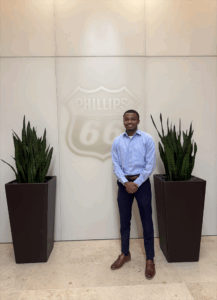
Reginald Archibald II poses next to a Phillips 66 sign.
Reginald Archibald II accepted a job as an advisor and developer in commercial analytics for Phillips 66.
Reginald Archibald II

As an advisor and developer in commercial analytics for Phillips 66 in Houston, Texas, Reginald Archibald II is off to a great start. In this position, Archibald leverages his technical skills and tools in helping Phillips 66’s commercial business unit make more informed decisions to provide energy and improve lives.

Prior to graduation, he completed two summer internships as a software engineer with Boeing. Archibald also served as the lead computer scientist for NASA Rock On, where he contributed to the integration of a payload into a two-stage terrier Orion Rocket, and specialized in using a minicomputer to collect atmosphere data.

What Archibald appreciates most about his job is the “great work life balance” and the opportunity to network with fellow professionals.

The most challenging part of his job, Archibald said, is becoming comfortable with the uncomfortable.

”Just using problem-solving skills and networking that I learned from Langston helps me navigate through these real-world scenarios,” Archibald said. “We had conversations amongst peers and professors about scenarios and circumstances we may face in our careers and in the world. These deep conversations not only made me feel prepared in my technical skills and knowledge, but more importantly, my soft skills.”

Ralph Grayson, chair of the computer science department, was instrumental in Archibald’s choice of major. Grayson’s influence continued throughout Archibald’s matriculation, guiding him through internships, projects and coursework.

“I saw how passionate he was about his students’ success,” Archibald said. “He allowed me into his classes my freshman year as a business management major to observe and ask questions of the upperclassmen about their experiences. I was able to witness students who came before me and land amazing careers, and I told myself, that could be me if I buckle down and hit my studies hard.”

Archibald was awarded an Edwin P. McCabe Honors scholarship in addition to becoming an OK-LSAMP scholar. He was also chosen to attend the Thurgood Marshall College Fund Leadership Institute. His other achievements include being named the most outstanding computer science student and the Dr. In Hai Ro awardee for excellence in computer science, and becoming a member of Kappa Alpha Psi Fraternity, Inc.

Grateful for his faith, his family, and LU faculty and professors, Archibald encourages those seeking to pursue their computer science degree to choose Langston University.

“It’s more than a program,” Archibald said. “It is a family – from professors to the students. We uplift one another, hold each other accountable and recognize our peers’ successes.”
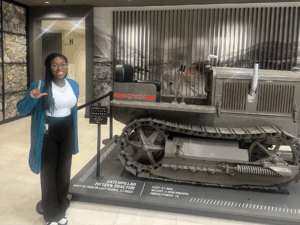
Emoree Coley poses next to an engine
Emoree Coley accepted a job as an Information Technology Analyst with Caterpillar Financial Services Corporation after earning her bachelor’s in computer science at LU.
Emoree Coley

Emoree Coley grew up in Broken Bow, Oklahoma. Today, she is an Information Technology Analyst with Caterpillar Financial Services Corporation in Nashville, Tennessee. She is a part of the Cat Financials program, a two-and-a-half-year rotational program that will allow her to gain experience in different areas of the company before being placed with a permanent team.

Currently, Coley is working with the Cat Vantage Rewards team where she spends most of her time developing and working on tickets in the Salesforce platform. She has also been given the title of Co-Chair for the rotational program, which is a leadership role.

“I have the opportunity to organize events, support recruitment and intern efforts, and represent my fellow members to influence the evolution of the program,” Coley said.

Coley said she loves meeting new people, learning new things, and getting different experiences. The work is different than anything she’s done before, but she said her team makes it easy to figure things out, and she loves the work environment and company culture.

Coley transferred to Langston University from North Carolina Agricultural and Technical State University because of LU’s computer science program and the opportunities she knew she would have.

”(LU) just felt like the right fit for me, and it definitely was!” Coley said. “The classes covered a wide range of topics and taught me how to think critically and solve problems in different ways. The professors were always willing to help and pushed me to be my best.

“Even though what I’m working on now is new to me, the preparation I received at Langston University has made it easier to adjust and keep moving forward.”

Following in her father’s footsteps, Coley says she couldn’t ask for a better example to look up to. Growing up, she watched her father solve problems, build solutions and love his work. That passion made her want to pursue a career where she could feel the same way. He encouraged Coley to explore computers and technology from an early age. From there, her interest kept growing until she realized this was the path she wanted to follow.

She also credits her mom, grandmother, brother, boyfriend, closest friends and Grayson in helping her down this path.

During her LU journey, Coley achieved many awards and recognitions. Some of these accomplishments include being a USDA 1890 Scholar, a two-time Folds of Honor Scholarship recipient, making the Dean’s List every semester, and a triple scholar recipient (OK-LSAMP, TMCF, ITSMF).

Coley served as a member for several student organizations including Women of Purpose, the Computer Science Club, and LU NAACP. A spring 2025 initiate of the Apha Zeta Chapter of Alpha Kappa Alpha Sorority, Incorporated, she is also proud that as a transfer she completed her bachelor’s degree in three years, and received a full-time job offer before her final semester.

Jathaniel Wakefield headshot
Jathaniel Wakefield secured a job at Paycom in Oklahoma City as a Level 2 Developer and received his first promotion a few months later.
Jathaniel Wakefield

As Oklahoma’s HBCU, Langston University has a legacy of generational enrollment. Jathaniel Wakefield and his family are part of that legacy. His parents, Misty and Jay, met on the Langston Campus while pursuing their education. Two decades later, their son followed in their footsteps.

“I am legacy,” Wakefield said. “On top of being a McCabe Scholar and not having to incur any debt for my education, it made for very persuasive reasons to attend.”

The younger Wakefield represented the family name well. Graduating summa cum laude, he quickly secured a job at Paycom in Oklahoma City as a Level 2 Developer and received his first promotion a few months later. Now as a Software Developer, Wakefield is responsible for the software development of new projects and applications. His duties involve testing and verifying functionality and then working with products to ensure their vision is properly applied.

Wakefield says the most enjoyable part of his job is the opportunity to solve complex problems by leveraging the tools and languages developed at Paycom, and to create a product that heavily impacts small and large businesses alike.”

His connection to Dear Langston allowed Wakefield to meet Grayson. He helped Wakefield understand what computer science is as well as how to apply basic concepts to real world scenarios and in industry use cases.

“(Grayson was) very influential and helped me by providing opportunities and challenges to grow and develop my understanding of computer science and how to apply it,” Wakefield said.

For those considering computer science, Wakefield recommends starting early and being responsible for your own development.

“When you start early, it gives you time to understand and work with complex topics like data structures and algorithms, which are used heavily throughout the industry to solve problems dealing with large amounts of data and information,” Wakefield said. “Being responsible helps your drive to continue learning. Computer science is not a career that allows you to quit learning as more and more things are discovered and leveraged to improve performance and understanding.”
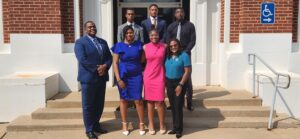
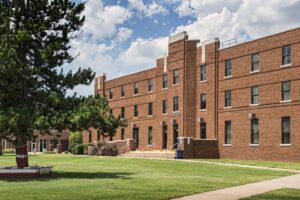
Code Blooded poses for a group photo in front of Moore Hall

Code Blooded: Langston University students compete in national Cyber Games competition

Release Provided By

by Ellie Melero

Dazjuan Johnson can’t wait for the 1890 Cyber + AI Games.

Planned as part of the Second Morrill Act 135th Anniversary celebrations, the 1890 Cyber + AI Games are a national cyber capture-the-flag competition that will be held at the University of the District of Columbia on Sept. 9. They may not be a flashy spectacle like College Football Gamedays, but they will be fiercely competitive and exciting for anyone with an interest in cybersecurity or artificial intelligence. And Johnson can’t wait to play.

“I’m looking forward to testing our skills on a national stage, learning from other teams and representing Dear Langston with pride,” Johnson said.

A senior computer science major at Langston University, Johnson is one of six LU students who will make the trip to Washington, D.C., for the competition. These skilled student coders are all part of Code Blooded, LU’s cyber competition team.

Code Blooded regularly competes in events like code-a-thons and cybersecurity competitions, and they’ve even beaten teams from Ivy League schools like Yale in the past. This will be Code Blooded’s first challenge with its new team lineup for the 2025-26 school year, and it will be Johnson’s first competition with the team.

“It’s been an exciting and fast-paced experience, pushing me to sharpen my skills and collaborate closely with talented peers,” Johnson said. “I’m grateful for this opportunity and confident it will be a valuable step toward my future in tech and cybersecurity.”

Twenty teams from each of the 1890 Land-Grant Institutions plus the host school will participate in the 1890 Cyber + AI Games. They will be held in a capture-the-flag jeopardy style format, testing students’ skills in areas such as digital forensics, reconnaissance and geo-tagging.

The theme for the Games will be Agriterrorism. The teams will be given a hypothetical scenario in which there has been a disruption to the U.S.’s food supply chain through the introduction of biological, chemical, physical or cyber-physical threats via malware, ransomware, sensor/actuator tampering, network intrusions, phishing or social engineering. The students will have to work together to resolve the scenario.

Ralph Grayson, the chair of LU’s Department of Computer Science and Code Blooded’s coach, said the six members of the competition team were chosen because they each have an expertise in a different area that will be featured in the competition. Having students with a variety of skill sets makes the team more well-rounded and competitive.

“Competitions are always great because we want them to get used to what happens in the workforce,” Grayson said. “In the workforce, you have to work on teams, and there are always issues that come up. They have to work well together, and they have to develop and execute skills that they may not have had before.”

Selam Terefe, a junior computer science major, has been on Code Blooded since his freshman year, but he’s never competed in an event quite like this. That’s because this will be the first 1890 Cyber + AI Games.

Put on by Katzcy PlayCyber and the 1890 Universities Foundation, the 1890 Cyber + AI Games were created as part of the Second Morrill Act anniversary celebrations. They are intended to highlight the growing need for cybersecurity in agriculture, leading to the theme of Agriterrorism.

As Code Blooded prepares for the Games, Johnson and Terefe have reflected on the theme and what opportunities there are for computer science students in agriculture. They’re thankful for the opportunity to participate, and now, they’re ready to compete.

“I believe it is a great opportunity for HBCU students interested in the intersection of agriculture, artificial intelligence and cyber defense to get hands-on exposure and connect with peers with the same interest,” Terefe said. “I would like to thank Langston University’s Sherman Lewis School of Agriculture & Applied Sciences and the Computer Science department for giving us this opportunity.”

Sanderson Hall on Langston Campus

From Theory to Practice: Langston University Celebrates 25th Annual Research Day

Release Provided By

(This story was originally published in ‘E Roar | Vol. 2 Issue 4 in June 2025)

By Jet Turner, Assistant Director of Communications

Langston University held its 25th Annual Research Day on April 18, 2025. Research Day includes various disciplines, majors and students. Whether you are a biology or chemistry student, psychology student or even a computer science student, you are welcome to participate in Research Day.

Research Day aims to help students understand the practical applications of their learning. It shows students how their knowledge can serve society and provides an opportunity to demonstrate their problem solving and articulation skills. It also allows students to build their resumes, prepare for internships and graduate school applications, among many other skills.

“It’s the value added,” said Dr. John K. Coleman, Interim Dean of the College of Arts and Sciences. “Once you get a culture where students (are presenting their research), you look at the student and you just see the product. Now they are starting to learn why they’re learning these theories and why they learn these concepts, and then what you can actually do with it and how you can help society. You’re here to learn, but you leave to serve. So how do you use what you’re learning? This is the part that teaches you how you use what you’re learning to serve society.”

Dr. Lindsay Davis, associate professor of chemistry, participated in the 13th Research Day when she was a student at LU.

Despite her fear and hesitation to present her research, she was well prepared and supported.

“Ultimately, Research Day gave me the confidence that I needed to pursue graduate school and to make these presentations a norm for me,” Dr. Davis said. “I was so scared of public speaking, and now it’s easy.

“So, Research Day definitely helps with their communication skills. But most importantly, I think it allows them to be a scientist, to communicate through research and to really achieve their goals.

This year over 20 students participated in Research Day. 


Josiah Grayson – Selection of Undergraduate Degree Major Among College Students

Senior, Computer Science Major

Josiah Grayson’s research explored the psychological and social factors influencing how college students, especially those at Historically Black Colleges and Universities (HBCUs), choose their academic majors.

Grayson’s studies revealed personal interest is the most important factor when a prospective student selects a major, which contradicts his hypothesis that financial considerations would be at the forefront of their decision-making process.

Grayson highlights that student interests are often “shaped by what they have been exposed to,” meaning individuals are more likely to pursue careers and majors they have seen modeled in their communities. For Black students specifically, this means decisions are “shaped by survival, legacy and representation.”

“Institutional culture and climate impacts persistence,” Grayson said. “What goes on at the university and then specifically in the department, how they teach the information, how they work with the students. Is there tutoring? These things highly impact whether or not somebody is actually going to finish their degree.”

Financial status, according to Grayson, still plays a significant role in a student’s decision in what major they select, even if it isn’t the primary driving force. Grayson notes that students from a lower socioeconomic status tend to be more risk-averse, often choosing a “more stable” career path, while students from higher socioeconomic backgrounds have more flexibility to pursue less conventional majors, if they so choose.


Kimbree Layton – Studying the Relationship Between Mental Health, Emotional Well-Being and Academic Well-Being Among College Athletes

Senior, Psychology Major

Kimbree Layton conducted a comprehensive study examining the relationship between mental health, emotional well-being and academic well-being among collegiate athletes at Langston University. Her research focused specifically on anxiety, depression and stress levels among student athletes.

The study employed a multi-scale survey approach, utilizing four different psychological assessment tools. Layton was able to collect data from 15 of Langston University’s student athletes, all of whom were female.

Findings revealed that Langston University student athletes generally demonstrated positive mental health indicators, showing no significant signs of depression, anxiety or stress.

“(The student athletes) think highly of professional help and seeking it when it is necessary,” Layton said.

Layton’s research highlighted several critical factors influencing student athlete mental health, including “the importance of their relationships” with coaches, professors and family. Modern student athletes must overcome a tough emotional landscape, and many challenge the stigma that they should always be “very mentally tough” and not show emotions.

While the study provides valuable insights, Layton recognized limitations in her research, including the small sample size and the use of somewhat dated psychological assessment scales. She recommended future research should “examine what relationships between scales and demographics” exist and potentially explore the impact of teammates on mental health, a dimension not fully explored in this current study.


Reginald M. Archibald II – Artificial Intelligence Biases in Healthcare

Senior, Computer Science Major

Reginald Archibald II explored the critical issue of artificial intelligence (AI) bias in healthcare, highlighting how AI models can perpetuate systemic inequalities.

Archibald’s research uncovered six types of bias in healthcare AI models: implicit, selection, measurement, confounding, temporal and algorithm bias.

An example pointed to in this research is the dermatology AI tool developed by Stanford University, which was trained predominantly on images of lighter-skinned individuals. This could have a significant negative impact on patients who have a darker skin complexation.

“When you go in and they’re trying to detect for skin cancer, oftentimes they’re not able to find it, and they might (misdiagnose) you,” Archibald said.

Several other real-world scenarios demonstrate the potential harm of biased AI. During the COVID-19 pandemic, pulse oximeters were found to miss conditions in Black patients three times more often than in other races. Another study revealed an AI algorithm that based healthcare decisions on costs that systematically undervalued Black patients’ health needs.

To address these critical issues, Archibald proposes multiple solutions. These include conducting bias audits before AI deployment, training healthcare professionals on AI decision-making processes and incorporating synthetic data to improve representation.

He emphasizes the importance of diversity in AI development, stating that diverse team members can provide “ethical background knowledge about their race, their gender, their age group and their economic status.”