LANGSTON, Okla.–President Ruth Ray Jackson announced Wednesday that distinguished alumnus Sherman L. Lewis will serve as the speaker for the 126th Commencement of Langston University on Saturday, May 9, 2026, at 10 a.m. in W.E. Anderson Stadium. Lewis will also receive an honorary doctorate degree during the ceremony.
Lewis is a proud alumnus and long-time supporter of LU. He has served the university for more than fifty years in various capacities, including as the current chair of the Langston University Board of Trustees for the Urban Campuses and a member of the LU Foundation Board. He was a trailblazer in the field of conservation, a successful entrepreneur, and he is the most prolific individual donor in the university’s history
“Langston University is proud of the work Mr. Sherman Lewis has done for Oklahoma and the agriculture industry, and we are grateful for all the ways in which he gives back to his alma mater,” Dr. Jackson said. “Over the years, his generous donations have helped countless LU students pursue their degrees while also enhancing the student experience. He is the single largest donor in the university’s history, but he also gives his time through his work on the Board of Trustees for Urban Campuses, the LU Foundation Board and his participation in various events throughout the year.”
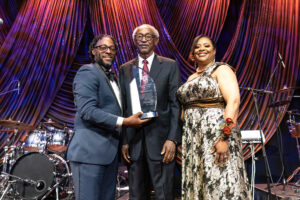
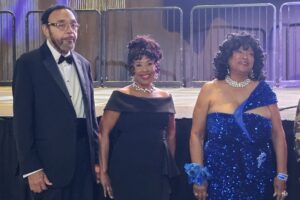
President Ruth Ray Jackson awarded Sherman Lewis the first ever Presidential Award of Excellence during the 20th Annual President’s Scholarship Gala in 2025.
Lewis grew up on a farm near Beggs, Oklahoma, and earned his bachelor’s degree in agricultural economics with a minor in mathematics from LU in1964. After graduation, he spent two years in the military before joining the USDA Soil Conservation Service, now the Natural Resources Conservation Service (NRCS), in 1967.
He was quickly recognized for his outstanding service, and in 1971, Lewis became the first Black District Conservationist in Oklahoma, serving as the District Conservationist for Rogers County. He continued to rise through the ranks, and he eventually became Director of the Conservation Planning Division in Washington, D.C. In 1997, he retired as Deputy Administrator for Management and Strategic Planning for NRCS.
Lewis returned to Langston University as the Director for the Center for Outreach Programs, where he focused on recruiting students, providing technical assistance to producers and minority-owned businesses, and developing partnerships with federal and state agencies to secure scholarships, internships and career opportunities for students.
After eight years at LU, Lewis decided to venture into the private sector. He and his family started several businesses in Houston, Texas, including quick service restaurants, construction project management, real estate, wholesale and retail gas distribution and a Mexican restaurant.
Lewis was awarded the Heart of the Lion Award in 2014 and received the 1890 Career Exemplar Award from the Association of Public and Land-Grant Universities in 2015. In 2022, he and his family established the Sherman and Berniece Lewis Endowment, which was the largest single donation in university history. Shortly after, the university renamed the School of Agriculture and Applied Sciences to the Sherman Lewis School of Agriculture and Applied Sciences. In 2025, he received the first ever Langston University Presidential Award of Excellence.
For more information about Langston University’s commencement ceremony, please visit langston.edu/commencement.
Computer science is often ranked among the best college degrees in the United States, and U.S. News & World Report cites diverse career opportunities as one of the many benefits. Among STEM majors, a degree in computer science prepares students to thrive in technology-driven careers. These positions are often in high demand with leading companies who are focused on innovation and growth.
For those interested in computer science, Langston University is an excellent place to earn your degree.
Since spring 2021, the Langston University Computer Science program has boasted a 100% job placement rate. LU’s computer science graduates have all received jobs in their chosen industry, often solidifying their new jobs prior to graduation. In the past five years, Langston University has also realized a 95.5% enrollment growth in computer science.
Reginald Archibald II, Emoree Coley and Jathaniel Wakefield are just three of Dear Langston’s successful computer science graduates. Their preparation in mastering programming, algorithm design, data structures and developing software applications has paid dividends. In 2024, they earned their Bachelor of Science degrees in computer science. Today, they are living their dream with goals of achieving even more.
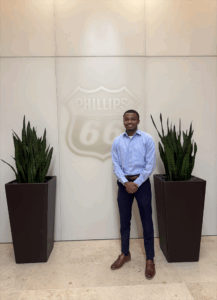
Reginald Archibald II accepted a job as an advisor and developer in commercial analytics for Phillips 66.
Reginald Archibald II
As an advisor and developer in commercial analytics for Phillips 66 in Houston, Texas, Reginald Archibald II is off to a great start. In this position, Archibald leverages his technical skills and tools in helping Phillips 66’s commercial business unit make more informed decisions to provide energy and improve lives.
Prior to graduation, he completed two summer internships as a software engineer with Boeing. Archibald also served as the lead computer scientist for NASA Rock On, where he contributed to the integration of a payload into a two-stage terrier Orion Rocket, and specialized in using a minicomputer to collect atmosphere data.
What Archibald appreciates most about his job is the “great work life balance” and the opportunity to network with fellow professionals.
The most challenging part of his job, Archibald said, is becoming comfortable with the uncomfortable.
”Just using problem-solving skills and networking that I learned from Langston helps me navigate through these real-world scenarios,” Archibald said. “We had conversations amongst peers and professors about scenarios and circumstances we may face in our careers and in the world. These deep conversations not only made me feel prepared in my technical skills and knowledge, but more importantly, my soft skills.”
Ralph Grayson, chair of the computer science department, was instrumental in Archibald’s choice of major. Grayson’s influence continued throughout Archibald’s matriculation, guiding him through internships, projects and coursework.
“I saw how passionate he was about his students’ success,” Archibald said. “He allowed me into his classes my freshman year as a business management major to observe and ask questions of the upperclassmen about their experiences. I was able to witness students who came before me and land amazing careers, and I told myself, that could be me if I buckle down and hit my studies hard.”
Archibald was awarded an Edwin P. McCabe Honors scholarship in addition to becoming an OK-LSAMP scholar. He was also chosen to attend the Thurgood Marshall College Fund Leadership Institute. His other achievements include being named the most outstanding computer science student and the Dr. In Hai Ro awardee for excellence in computer science, and becoming a member of Kappa Alpha Psi Fraternity, Inc.
Grateful for his faith, his family, and LU faculty and professors, Archibald encourages those seeking to pursue their computer science degree to choose Langston University.
“It’s more than a program,” Archibald said. “It is a family – from professors to the students. We uplift one another, hold each other accountable and recognize our peers’ successes.”
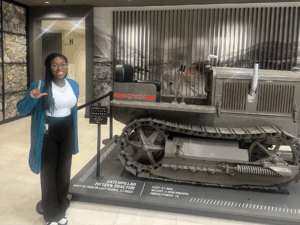
Emoree Coley accepted a job as an Information Technology Analyst with Caterpillar Financial Services Corporation after earning her bachelor’s in computer science at LU.
Emoree Coley
Emoree Coley grew up in Broken Bow, Oklahoma. Today, she is an Information Technology Analyst with Caterpillar Financial Services Corporation in Nashville, Tennessee. She is a part of the Cat Financials program, a two-and-a-half-year rotational program that will allow her to gain experience in different areas of the company before being placed with a permanent team.
Currently, Coley is working with the Cat Vantage Rewards team where she spends most of her time developing and working on tickets in the Salesforce platform. She has also been given the title of Co-Chair for the rotational program, which is a leadership role.
“I have the opportunity to organize events, support recruitment and intern efforts, and represent my fellow members to influence the evolution of the program,” Coley said.
Coley said she loves meeting new people, learning new things, and getting different experiences. The work is different than anything she’s done before, but she said her team makes it easy to figure things out, and she loves the work environment and company culture.
Coley transferred to Langston University from North Carolina Agricultural and Technical State University because of LU’s computer science program and the opportunities she knew she would have.
”(LU) just felt like the right fit for me, and it definitely was!” Coley said. “The classes covered a wide range of topics and taught me how to think critically and solve problems in different ways. The professors were always willing to help and pushed me to be my best.
“Even though what I’m working on now is new to me, the preparation I received at Langston University has made it easier to adjust and keep moving forward.”
Following in her father’s footsteps, Coley says she couldn’t ask for a better example to look up to. Growing up, she watched her father solve problems, build solutions and love his work. That passion made her want to pursue a career where she could feel the same way. He encouraged Coley to explore computers and technology from an early age. From there, her interest kept growing until she realized this was the path she wanted to follow.
She also credits her mom, grandmother, brother, boyfriend, closest friends and Grayson in helping her down this path.
During her LU journey, Coley achieved many awards and recognitions. Some of these accomplishments include being a USDA 1890 Scholar, a two-time Folds of Honor Scholarship recipient, making the Dean’s List every semester, and a triple scholar recipient (OK-LSAMP, TMCF, ITSMF).
Coley served as a member for several student organizations including Women of Purpose, the Computer Science Club, and LU NAACP. A spring 2025 initiate of the Apha Zeta Chapter of Alpha Kappa Alpha Sorority, Incorporated, she is also proud that as a transfer she completed her bachelor’s degree in three years, and received a full-time job offer before her final semester.
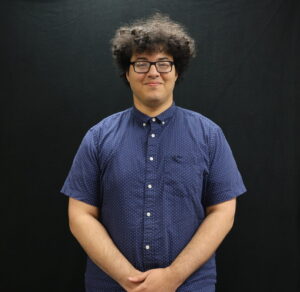
Jathaniel Wakefield secured a job at Paycom in Oklahoma City as a Level 2 Developer and received his first promotion a few months later.
Jathaniel Wakefield
As Oklahoma’s HBCU, Langston University has a legacy of generational enrollment. Jathaniel Wakefield and his family are part of that legacy. His parents, Misty and Jay, met on the Langston Campus while pursuing their education. Two decades later, their son followed in their footsteps.
“I am legacy,” Wakefield said. “On top of being a McCabe Scholar and not having to incur any debt for my education, it made for very persuasive reasons to attend.”
The younger Wakefield represented the family name well. Graduating summa cum laude, he quickly secured a job at Paycom in Oklahoma City as a Level 2 Developer and received his first promotion a few months later. Now as a Software Developer, Wakefield is responsible for the software development of new projects and applications. His duties involve testing and verifying functionality and then working with products to ensure their vision is properly applied.
Wakefield says the most enjoyable part of his job is the opportunity to solve complex problems by leveraging the tools and languages developed at Paycom, and to create a product that heavily impacts small and large businesses alike.”
His connection to Dear Langston allowed Wakefield to meet Grayson. He helped Wakefield understand what computer science is as well as how to apply basic concepts to real world scenarios and in industry use cases.
“(Grayson was) very influential and helped me by providing opportunities and challenges to grow and develop my understanding of computer science and how to apply it,” Wakefield said.
For those considering computer science, Wakefield recommends starting early and being responsible for your own development.
“When you start early, it gives you time to understand and work with complex topics like data structures and algorithms, which are used heavily throughout the industry to solve problems dealing with large amounts of data and information,” Wakefield said. “Being responsible helps your drive to continue learning. Computer science is not a career that allows you to quit learning as more and more things are discovered and leveraged to improve performance and understanding.”
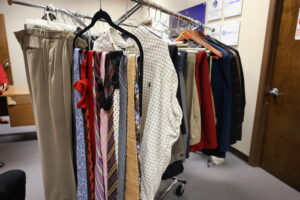
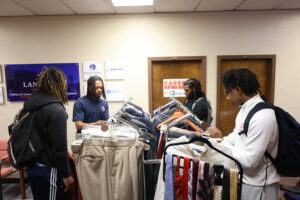
The Brothers of The Kappa Alpha Psi Fraternity ,Inc., collaborated with Alexandria Wright, Director of Career and Professional Development, to donate professional men’s business wear to the Langston University Career Closet.
Wright reached out to Dr. Andre Washington, Associate Professor and Rehabilitation Counselor and Executive Director at the LU-OKC Campus, and informed him that the men’s department of the Career Closet was lacking. She asked him for some assistance.
Dr. Washington, in turn, reached out to his fraternity brothers to see what they could do.
“To donate not just to the brothers of Kappa Alpha Psi, but all young men on the campus, giving them an opportunity to get some things that they can enjoy and look professional,” Dr. Washington said.
The Brothers of the Alpha Pi chapter of Kappa Alpha Psi Fraternity, Inc., along with the Langston and Oklahoma City alumni chapters, donated 28 suits, 35 pairs of slacks, 33 ties, 18 pairs of dark socks, two pairs of brand new dress shoes and several button-down collar shirts.
This is one of the largest donations ever made to the career closet.
“I just really wanted it to be a space where students could come and feel comfortable to find things that they may not be able to afford or be able to get themselves,” Wright said. “Having events like this where we have organizations make donations are so important to the survival of the closet.”
The goal of the career closet is to provide students with new or gently used professional clothing attire. This is important because being in the Town of Langston can sometime prove make finding clothes infeasible. This causes students to drive outside of the town of Langston, so the Career Closet provides an alternative to the general expense of business attire.
Kevin Cox, Former state representative of Oklahoma City from 1980-2004, was awarded an honorary doctorate from Langston University in 2005 under the then-president, Dr. Earnest Holloway.
“Langston University has quality graduates that have achieved all over the United States and the world,” Cox said. “We already know that, but if you don’t show it, you won’t get a chance to prove it. You prove it in the interview and then become a successful individual.”
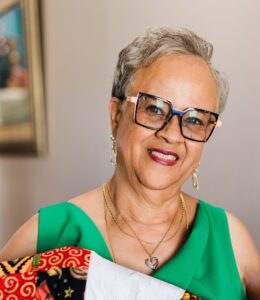
Beverly Huggins Kirk, a Langston University alumna, master quilter, educator and cultural historian, found her public voice later in life; now she urges seniors across America not to wait for certainty before stepping into purpose.
“Uncertainty has a way of making people pause, but I’ve learned that waiting for the ‘right time’ can quietly become a decision to stay silent,” Kirk said. “My message to seniors is simple: Today is the time to act.”
In 2026, with leadership priorities, economic pressures, and growing concern about aging, loneliness and relevance, many seniors have reassessed their place in a rapidly changing world. After decades in corporate America, Kirk discovered her creativity and calling had intensified.
At a stage where many have been encouraged to slow down, she leaned forward, transforming quilting into a powerful medium for faith, healing, history and legacy.
“Life didn’t become quieter for me at 72,” Kirk said. “It became clearer.”
That reassessment became a turning point.
Kirk is an LUSB alumna and the founder of Scissor Tales Guild, Oklahoma’s first African American quilt guild.
Kirk is the founder of Scissor Tales Guild–Oklahoma’s first African American quilt guild–and the creator of “A Maker of Quilts,” a limited-edition, 26-page, full-color booklet that weaves together quilt photography, personal reflection and cultural storytelling. Her quilts address themes that resonate deeply today, such as resilience across generations, healing after loss and grief, and faith in uncertain seasons.
“America is like a quilt,” Kirk wrote in the booklet’s opening pages. “Many patches. Many stories. Held together by something stronger than we can see.”
Although innovation, leadership and creativity can often be associated with youth, Kirk represents a growing but often overlooked truth: some voices are meant to rise later. Her message aligns with that of the mission of Langston University’s School of Business—to elevate purpose-driven leadership across the lifespan.
“Beverly Kirk embodies what so many seniors need to see right now,” said Dr. Daryl Green, dean of LUSB. “In a time when uncertainty can paralyze people, she chose expression over fear. Her work reminds us that our later chapters can be our most influential.”
Kirk’s work speaks to a generation navigating transition in an era defined by disruption, reminding people they can reinvent, reengage and lead at any age.
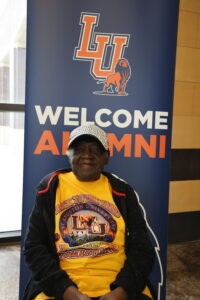
Music, laughter and conversation filled Langston University-Tulsa’s front lobby on the Tuesday of Homecoming Week as students, faculty, staff, alumni, community members and their families flocked to the campus for its annual Homecoming Block Party on Oct. 7. Sitting at a table in the middle of the lobby, happily chatting with anyone who wanted to stop by, sat 98-year-old Ozetta Parker (née Walker).
As Parker looked around at all the activity, it amazed her how much things had changed at Langston University since she was a student in 1946.
Parker grew up on a farm near Tulsa in the 1930s as one of nine kids. She enjoyed farm life, especially the big homemade meals her mother would prepare, but education was always a major focus in her community. So when her older sister Pauline moved to the city, Parker began staying with her during the school year so she could attend Booker T. Washington High School.
Parker enrolled at Langston University in 1946 with a major in home economics.
In the city, Parker and her siblings walked everywhere they needed to go, and they didn’t go out at night. They lived in a tight-knit community where everyone looked out for one another. Her teachers were strict, but Parker could tell they cared. When Parker graduated from high school in 1946, Pauline encouraged her to attend college and study home economics.
“She liked my cooking,” Parker laughed.
Langston University didn’t have a campus in Tulsa back then, so Parker made her way out to Logan County. She lived in Sanford Hall–which was a women’s dorm at the time–and studied home economics.
Life at LU was different than what Parker was used to. The rural campus felt almost isolated from normal society, and Parker thought her dorm room didn’t have much space. She especially missed her mother’s cooking. But there was a lot about life at Dear Langston that she loved, too.
The university offered plenty to do as far as providing students with social activities. Students went to sporting events and church regularly, and when there were dances, they were well attended. Parker met a lot of people and made a lot of friends.
“They had entertainment for us,” Parker said. “They had a little place where you could go dance. I don’t know what they called it … but you go there and socialize when you had the time.”
Although Parker spent a lot of time studying in her room or in the library, she said she enjoyed her classes. Her home economics courses taught her about a variety of things, including cooking, proper housekeeping and sewing. She learned she really enjoyed sewing. She loved drawing her own designs and then using them to create items like aprons and dresses.
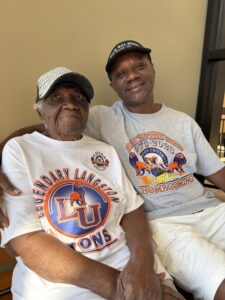
Parker passed her love for Dear Langston down to her children, and she brought them to Homecoming every year.
Parker loved her time at LU, but she had to leave after two years. She moved to Oklahoma City, found work, got married, started a family and moved back to Tulsa, but she never forgot about her time at Dear Langston.
For years, Parker would return to LU with her family for every Homecoming. She loved connecting with old friends and seeing how much the campus and university continued to grow. But as she got older, the trip out to Langston became harder to make, and she stopped going.
This year, her son saw an advertisement for the Homecoming Block Party at LU-Tulsa, and they were both excited to attend their first Langston University Homecoming celebration in several years.
This provided her the opportunity to remember not just what Langston University meant to her, but what it can mean to everyone.
“Education is what’s going to help us make this world a better place,” Parker said. “(Langston University) is a good place to go to learn and socialize and entertain and leave a legacy for the children behind us to go as high as they can.
Langston University employees and alumnae were honored at the Fourteenth Annual Ceremony and Banquet of the Oklahoma African American Educators Hall of Fame on Friday, Sept. 26.
The honorees included recent Langston University retiree Dr. John K. Coleman, alumna Mrs. Carolyn Gay Harris, alumna Dr. Jolly Henderson Meadows, and former Langston University professor Dr, Melvin B. Tolson, who was honored posthumously.
Dr. John K. Coleman
Dr. Coleman attended LU from 1961-65, graduating with honors and earning a Bachelor of Science degree in Chemistry and Mathematics. He continued his education at the University of Oklahoma, where he earned his Ph.D. in Theoretical Physical Chemistry in 1976 and completed post-doctoral studies in 1978. After some time away, Dr. Coleman returned to Langston University in 1993 at the request of the late President Ernest Holloway to serve as the Chair of the Department of Chemistry and Physical Sciences.
Over the past three decades, Dr. Coleman not only served as chair of the Department of Chemistry, but his impact also extended beyond academic metrics. For generations of Langston University students, he has been a mentor, advocate and example – a leader who never stopped believing in the transformative power of education. Many of his former students are now faculty members at Langston University in the Chemistry or Biology Departments, shaping new generations in the same spirit he so faithfully modeled.
Dr. Coleman was appointed the interim dean of the School of Arts and Sciences in 2023, and he retired at the conclusion of the 2024-2025 school year.
Mrs. Carolyn Gay Harris
Mrs. Harris joined Langston University as a majorette in the Marching Pride, which was known at the time as the Langston Lions Band. Her time at Langston University was marked by academic achievement as she earned her Bachelor of Arts degree, laying a foundation for her future career in education. Pursuing further academic excellence, she completed a Master of Education degree at the University of Central Oklahoma in 1974.
Mrs. Harris began her professional journey at Spencer High School in Spencer, Oklahoma, where she taught for five years. Her commitment to shaping young minds extended to middle school classrooms for six years, and thereafter to administrative roles as both elementary and middle school principal for another six years. Her dedication and expertise culminated in her leadership as an elementary school principal for a remarkable 16 years. These decades of service reflect a career that spanned a total of 33 years, during which she touched the lives of countless students, faculty members and families.
Dr. Jolly Henderson Meadows
Dr. Meadows earned her Bachelor of Science degree in Elementary Education in 1974 from Langston University, followed by a Master of Education degree in Reading from Northeastern State University in 1979. She obtained a Master of Education degree in Leadership from Northeastern in 1986 and her Doctor of Education degree in Educational Leadership from Oklahoma State University in 1997.
Dr. Meadows began her 51-year career in education at Liberty Elementary in Sapulpa, Oklahoma. She joined Tulsa Public Schools in 1975 when she accepted a teaching position at Riley Elementary School, and she was appointed assistant principal at Patrick Henry Elementary School in 1986. After two years she was appointed principal – a position she held for 23 years. In 2006, Tulsa Public Schools took notice of the impressive academic growth Patrick Henry Elementary School showed under Dr. Meadows’ tenure and assigned her to Monroe Middle School. She was transferred to Gilcrest Middle School in 2007.
As an administrator, Dr. Meadows was known for utilizing innovative and reliable programs with proven outcomes to achieve academic gains. She employed a collaborative approach to empower teachers to become leaders, to disaggregate test data and to research supplemental instructional materials. She retired from Tulsa Public Schools in 2009 and worked as an adjunct professor of urban education in the undergraduate and graduate programs at Langston University–Tulsa. She accepted a full-time position as an Assistant Professor in the Department of Education at the University of Tulsa.
Dr. Meadows is also the vice president of the Langston University National Alumni Association-Tulsa Chapter (2021-present).
Dr. Melvin D. Tolson
Dr. Tolson taught English and speech at Wiley College in Marshall, Texas, for nearly two decades. In addition to teaching English, he established an award-winning debate team, the Wiley Forensic Society, which became a pioneer in interracial collegiate debates. Beginning in 1930, the team debated against law students from the University of Michigan in Chicago. In 1931, the team participated in the first known interracial collegiate debate in the South against Oklahoma City University. This is the story that inspired the film “The Great Debaters,” starring Denzel Washington.
Dr. Tolson took a sabbatical from teaching in 1930 to study for a master’s degree at Columbia University in New York City. His thesis project, “The Harlem Group of Negro Writers,” was based on his extensive interviews with members of the Harlem Renaissance, which inspired him to write “A Gallery of Harlem Portraits,” his first major work.
In 1947, Dr. Tolson relocated to Langston University, where he taught English, drama, and was a dramatist and director of the Dust Bowl Theater. Students described Tolson as eccentric, driven, fearless and radical. It was not unusual for him to stand on top of a desk and jump off to engage and challenge students during lectures. While at Langston University, Dr. Tolson was elected to multiple terms as mayor of Langston City.
Dr. Tolson’s career in education at the collegiate level spanned 43 years. He died in Dallas, Texas, on Aug. 29, 1966, and is buried in Guthrie, Oklahoma. His award was accepted by Dr. Cindy Ross, Chair of the LU Department of English and Foreign Languages in the School of Arts and Sciences.
It takes a lot to be a successful agribusinessman.
From hard, physical labor to the complexities of proper natural resource management, there’s more to it than most people would think, and no one knows that better than Cleaon Bradford.
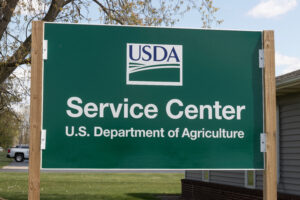
A native of Boley, Oklahoma, Bradford has been in the agribusiness industry his entire life. He has spent countless hours meeting with people, learning about best practices and available resources, and doing whatever was needed to build a thriving cattle farm in his hometown. Throughout it all, he has also spent his 21-year career with the United States Department of Agriculture (USDA) helping other Oklahoma farmers do the same.
“Just as I was able to receive it, I want those individuals to be able to have those opportunities as well,” Bradford said.
Like most Oklahomans, Bradford was exposed to Oklahoma’s thriving agriculture industry at a young age. Photo credit: Michael Flippo/AdobeStock.
Like most Oklahomans, Bradford was exposed to Oklahoma’s thriving agriculture industry at a young age. He came from a family of farmers, and he was active in 4-H. He knew he wanted to own his own farm one day, so he took every opportunity he could to learn more about the industry.
His senior year of high school, as the president of his local 4-H club, Bradford attended the Retired Educators for Youth Agriculture Program at Oklahoma State University. Through his participation in the program, he was able to secure an internship with the USDA.
He spent the summer working for the local USDA office where he learned about natural resource conservation. He decided that was what he wanted to do with his life, so he began making plans for after high school.
Growing up in Boley, Bradford was familiar with Langston University and the opportunities it could provide, especially in the realm of agricultural research and education. So when he received a national scholarship from the Bureau of Reclamation, it was an easy decision to go to LU to study natural resource management.
“It was the college to go to,” Bradford said. “People spoke highly of it. It was a school where you were going to not only get your education, but you’d kind of feel like people cared about you and wanted you to succeed.”
Although he was getting ready to move for school, Bradford still hadn’t given up on his dream of owning his own farm. Actually, he was more motivated than ever. Not long after his high school graduation, 18-year-old Bradford secured a loan to lease land and purchase his first cattle stock, marking the beginning of his cattle production operation in Boley.
In addition to raising the livestock, he also grew and bailed hay with which to feed the animals in the winter. It was hard work, and he wouldn’t have been able to do it without the help and support of his family. He relied on that help even more when he began at Langston University in the fall of 2000.
Bradford was very involved with SAAS as a student, and to him, SAAS felt like its own club. He applied what he learned in class to his own farm throughout school.
Bradford was dedicated to his farm, but he was even more dedicated to his studies. He wasted no time when he arrived on the Langston Campus, determined to get involved in the School of Agriculture and Applied Sciences (SAAS) every chance he had. For him, going to classes and attending events wasn’t just about getting a degree; it was about learning concepts and skills that he could turn around and apply on his farm.
“For me, it was just very encouraging that the things I was learning, I was able to use that on my own operation,” Bradford said. “That desire to learn and be successful in agriculture is one of the things that just really drove me.”
To anyone who met him, Bradford’s motivation to learn inside and outside the classroom was evident. Sherman Lewis, the LU alumnus and former USDA employee for whom SAAS is now named, worked at Langston University when Bradford was a student. He said Bradford’s potential was evident from the beginning.
According to Lewis, young Bradford had a strong work ethic and even stronger moral character. He knew Bradford would be successful in whatever career he chose, so he tried to encourage and support Bradford throughout their shared time at Dear Langston.
“He’s an outstanding young man,” Lewis said. “His work is always above and beyond any reproach, he’s always been a very hard worker, and he’s committed to doing what is necessary to make sure he gets the job done. And you know, he’s been that way from the day I met him.”
Bradford said the support he received from Lewis and the other faculty and staff in SAAS is part of why he thrived in college. From the beginning, SAAS felt like its own club where everyone wanted one another to succeed, and he had it drilled into his mind not to waste the opportunities LU provides.
He attended the semiannual career fair his freshman year where he spoke to recruiters from the USDA Natural Resource Conservation Service (NRCS) in Oklahoma. They told him about the USDA Student Career Experience Program, now called the Pathways Internship Program, which is a year-round paid internship for students that offers a guaranteed full-time job upon graduation to those who complete a minimum number of hours in the program.
Bradford interned with the USDA throughout college and accepted a job offer from the USDA’s Natural Resource Conservation Service after graduation. Photo Credit: jetcityimage/AdobeStock
He applied and, having already completed a USDA internship in high school, was readily accepted to the program. He was grateful for the experience and extra income the internship provided, but balancing his classes, his job and his farm was challenging.
“I was a very busy student,” Bradford said. “People used to say to me, ‘Man, you’re just real serious.’ And I’d say, ‘You know what? I am.’ I really took things serious, and I really wanted to take advantage of my time out there and really be successful.”
Bradford graduated in 2004 and accepted a job offer from NRCS as a Soil Conservationist in Wewoka, Oklahoma. He later became a district conservationist and served in roles as a supervisor and a team lead. Now, he’s the Outreach Coordinator for NRCS Oklahoma.
A large part of his job boils down to making sure Oklahoma’s producers are aware of the resources available to them through NRCS and helping them take advantage of what’s there when they need it. From guiding them to NRCS’ technical support to educating them about financial assistance programs, Bradford spends his days trying to help Oklahoma’s farmers.
As with many aspects of the agricultural industry, the work may not be glamourous, but Bradford said it’s rewarding. In every position he has held with NRCS, he has always enjoyed the outreach aspect of the job. He likes going out into the field and being with the farmers. He likes talking with them, working through their problems, and knowing at the end of the day he is helping people become successful agribusinessmen/women.
“I can look back at the times we put on an outreach event or had something going on, and you hear from the producers about how you helped them, helped their operation,” Bradford said. “That’s always rewarding.”
Agribusiness is one of the largest industries in Oklahoma. Nearly 75% of the state is farmland, and it produces $1.8 billion in agricultural exports per year while being one of the nation’s top producers of beef and rye, according to the Oklahoma Department of Commerce. Having spent his own career in the USDA, Lewis knows the systems that support this high level of agricultural industry are themselves held up by the people who work for them. People like Bradford.
Lewis worked at the NRCS’ national office in Washington, D.C., not long after Bradford graduated from LU, and he kept tabs on Bradford’s progress through the organization. He spoke with people from NRCS Oklahoma and other agencies who all knew Bradford and spoke highly of him.
Bradford has dedicated his career to helping Oklahoma’s farmers. As a fellow farmer, Bradford works every day to uplift Oklahoma’s agriculture industry.
According to Lewis, Bradford excelled not only at the technical aspects of his job, but also the relationship-building aspects. As he moved through the ranks, he did what he could to help newer employees succeed so they could help their constituents succeed. He even served as the president of the Oklahoma chapter of the National Organization of Professional Black NRCS Employees, an organization dedicated to mentoring young professionals in the workplace.
The combination of his skilled fieldwork and successful professional relationships have allowed him to have a broad impact on NRCS and Oklahoma agriculture.
“Any time you’re out there on the ground, working with individual farmers and assisting them, educating them and conserving a natural resource base, you’re doing something for the overall health and welfare of agriculture here in the state of Oklahoma,” Lewis said. “That’s what Cleaon has been doing. He’s touched the lives of many, many farmers.”
Throughout it all, Bradford has continued farming.
Every day, he goes to work with NRCS, then drives to Boley to tend to his herd before going home to his wife and kids. Over the years, he bought land as it became available, and with the help of his family––especially his father––he continues to grow his cattle and hay operation.
The farm is important to Bradford for many reasons. It’s a way for him to connect with his children and teach them practical skills. It’s a way for him to provide for their future. It’s tangible evidence of the hard work he’s done over two and half decades. And it’s a way for him to show others that it’s possible to be successful in an industry that can sometimes feel like too much.
“I want to continue to grow and master being in the ag business,” Bradford said. “I want to be a successful agribusinessman and be able to show that success, shine a light on the potential, the possibilities, the opportunities and make sure I’m educating others.
“Throughout my life, I want to make sure I spread that knowledge and encourage the future for people who want to get involved with agriculture.”
AUSTIN, Texas – Texas Legislative Black Caucus Chairwoman Barbara Gervin-Hawkins (D120) and the Texas Legislative Black Caucus announce Chelle Luper Wilson as Executive Director.
“We are thrilled to welcome Chelle Luper Wilson to the Texas Legislative Black Caucus (TLBC). As a leader focused on effective change, Ms. Wilson is dedicated to assisting the TLBC reach greater heights and fully supporting the TLBC’s top priorities moving forward,” said Texas Legislative Black Caucus Chairwoman Representative Barbara Gervin-Hawkins (D120).
Ms. Luper Wilson brings to the role a wealth of experience. In addition to her professional experience, she is an extraordinary communicator who brings great passion to this important work. Additionally, her professional background held in some of the nation’s largest advocacy organizations are a big asset to TLBC.
A third-generation HBCU graduate, Ms. Luper Wilson holds a B.A. in Broadcast Journalism from HBCU Langston University, a M.A. in Multicultural Women’s and Gender Studies from Texas Woman’s University, where she is also a third-year doctoral student in the department of Language, Culture and Gender.
“I have been engaged in political advocacy my entire life and have seen up close and personal the tremendous leadership and impact TLBC has here at the state capitol and across the great state of Texas. As we write the next chapter of the TLBC story in this unique time in history, I am excited for the opportunity to lend my experience and passion for supporting the collective vision and important work of this storied Caucus.” – Chelle Luper Wilson
A dedicated community advocate and trailblazer, Chelle is a former member of the National Board of Directors of the NAACP, member of the National CROWN Act Collective Strategic Partnership Council, American Heart Association National Diversity Leadership Council, former South Central Regional Director and International Secretary of Alpha Kappa Alpha Sorority, Inc®. She is also an active member of The Links, Inc., Jack & Jill of America, Inc., and the National Association of Black Journalists. Ms. Luper Wilson is the daughter of the late civil rights activist, Clara Luper.
“I have no doubt that the Texas Black Caucus Foundation will be in capable hands under her leadership,” said Senator Royce West (D23), Chairman of the Texas Black Caucus Foundation Board of Directors. “I warmly welcome Chelle Luper Wilson, and I look forward to working with her. She has the full support of the TBCF Board to carry out this critical leadership role.”
It’s always a special moment to watch a loved one walk across the stage at graduation, but for the Barnett family, this year’s Langston University commencement ceremony was doubly special.
Mother-Daughter duo Cerita and Alexis Barnett both graduated with their master’s degrees in rehabilitation counseling this May, and their family and friends cheered loudly from near and afar as the two walked across the stage together as proud members of the Class of 2024.
“We laughed a lot, we studied a lot,” Alexis said. “We learned how to work as a team to grow.”
Alexis and Cerita didn’t always plan to go to school together.
A 1992 graduate of Langston University, Cerita wanted to work in a public school system, particularly with at risk students, to help provide guidance to young people as they navigate their next steps in life. After earning her bachelor’s in sociology, she intended to earn a master’s degree in pursuit of this goal. But life had other plans for her.
Certia Barnett graduated from Langston University in 1992 with her bachelor’s in sociology. Thirty-two years later, she graduated from LU again with her master’s in rehabilitation counseling.
Cerita got married, found a job and had kids. Her family became her priority, but she never gave up the idea of pursuing her master’s.
“I decided, okay, I’ll wait ‘til [the kids] get a little older so that it would be easier for me to actually do a program and do the homework, read the chapters, everything that was required of me,” Cerita said. “So, I was content working as a substitute teacher so that I can help still teach and guide my own children.”
As a substitute teacher in the Tulsa Public School system, Cerita had the opportunity to work with kids like she wanted, and she also had the flexibility to take an active role in her own children’s lives. That included taking an active role in their education.
In the classroom, she always tried to impress upon students the importance of taking their education seriously, and she did the same at home. She would volunteer in her kids’ classrooms, volunteer with their extracurriculars, help them with homework and do whatever she needed to help them succeed in school. And succeed they have.
Alexis graduated from the University of Oklahoma with a double major in psychology and sociology in 2021. Like her mother, Alexis knew she wanted to pursue a master’s degree.
After graduating with her bachelor’s from the University of Oklahoma, Alexis Barnett encouraged her mother to pursue their master’s degrees together.
“I know that education can open doors,” Alexis said. “So, I had my mind set on [a master’s degree]. I knew that’s something I wanted to challenge myself to do, and I’m glad I did.”
After Alexis graduated from OU, Cerita began to think it might finally be time to return to school herself. Her family, including Alexis, encouraged her. Alexis and Cerita were both interested in counseling, so they began looking to see what programs were available in the Tulsa area.
Cerita, confident in the quality educational experience she would receive at Langston University thanks to her experience as an undergraduate student, began looking into the rehabilitation counseling program at LU-Tulsa. Alexis followed suit and decided to apply, but Cerita was still hesitant about whether she was ready to return to school yet.
“I was able to encourage her to go ahead and apply after I had applied,” Alexis said. “We were able to apply around the same time, and we both got accepted to the Spring ‘22 cohort.”
Cerita smiled and nodded as she remembered how excited their family was when the two announced their decision to go to school together.
“My family was excited for me because they knew at some point, I wanted to go back to school,” Cerita said. “And they thought it was neat, ‘Mama and Alexis is going to school together!’ And actually, at one point, I was not going to tell anybody just in case I changed my mind. But my husband, Harvel…”
“He started telling people,” Alexis laughed. “He was excited.”
With the support of their family–Harvel, Alexandria, Albany and Arnetta–and friends behind them, Cerita and Alexis began their graduate school journey together.
Cerita (left) and Alexis helped and supported each other throughout the two-year rehabilitation counseling program and graduated together in May.
Thanks to the way the two-year rehabilitation counseling program is structured, Cerita and Alexis took all their classes together. While some of their classes reinforced things they had learned in their undergraduate courses, others introduced new concepts and encouraged them to look at things from new perspectives. With a built-in study-buddy, the Mother-Daughter duo tackled all their coursework head on.
After 30 years on the other side of the classroom, Cerita had to adjust to being a student again. Thankfully, Alexis was there to help.
Alexis introduced her mother to some new studying techniques, helped her relearn APA Style–which had experienced a few updates since Cerita had last used it–and helped her navigate the technology they needed to use. In return, Cerita helped Alexis talk through and simplify concepts, helped her manage her time efficiently and always provided encouragement when she needed it.
“Our relationship as students helped to reinforce what we were learning in the class,” Alexis said. “We were able to provide one another with output. And when you put two brains together, then you have a strengthened perspective.”
“It’s like old school with new school,” Cerita agreed.
They helped and supported each other through the whole program, taking turns being each other’s shoulder to lean on when needed. After two years of hard work, they graduated this spring.
With her new degree, Cerita still plans to assist people in the counseling area. Alexis would like to give back and help people. Cerita and Alexis both expressed gratitude to God for this joyous, momentous opportunity.
“We are especially grateful that our mother/grandmother Marilyn is alive and celebrating our accomplishment with us,” Alexis said.
“It felt so special to be hooded,” Cerita said. “Our experience will remain in our hearts. I knew it was going to be a challenge to get back into the regimen of studying while wearing different hats. This was one of the most challenging things I’ve ever done in my life, but God helped me through.
“What was rewarding for me was, this is something I’ve been wanting to do for a long time. And now it’s happening, I’m walking in it. It’s a reality. And whatever challenges came, we were able to work with it. Better together.”
by Gary Piercy, Program Manager of the Southern Plains Tribal Health Board
OKLAHOMA CITY–Rasheedah Blackwood, a recent healthcare administration graduate at Langston University, made a significant impact during the eight-week Tribal Health Experiential Internship Seminar (THESIS) program. THESIS, a virtual internship, focuses on promoting Tribal public health and is funded by the Centers for Disease Control and Prevention (CDC) Office of Minority Health and Health Equity through their Lewis Scholars Program.
As one of seven organizations in the Lewis Scholars Program, THESIS operates under the Southern Plains Tribal Health Board in Oklahoma City. Interns delve into Native American culture, resilience, and various aspects of public health, including epidemiology and research. Their intensive eight-week journey culminates in the creation of research posters, which they present at the CDC headquarters in Atlanta, Georgia.
Blackwood’s research topic centered around “Addressing the Impact of Limited Sexual Education in the American Indian/Alaska Native Community.” Reflecting on her THESIS experience, she shared how beneficial the program was for her own personal and professional growth in the healthcare field.
“My experience with THESIS was nothing short of amazing,” Blackwood said. “The lessons forming around Native American culture and its history, proper ways to conduct ourselves as individuals in professional settings, and embedding effective research methods for our various topics over Tribal Health were paramount in my development in public health research. Being able to hear stories of individuals from a Native background felt genuine, personable and inviting into their experience.
“The opportunity to receive professional and academic advice from individuals in the field was beneficial; showing a very substantial interest in the development of our professional careers and end products of our projects for THESIS. The most valuable aspect I experienced from the program was the ability to connect with future Public Healthcare Professionals.
“The drive, support, and compassion placed into every conversation during the program was very inspiring, which kept the program engaging. This allowed me to have a voice along other individuals who shared the same passions in facing public health disparities and creating initiatives in the betterment of all individuals. I will forever cherish the opportunity to participate in the THESIS Program. My experience with the amazing individuals I was able to connect with and the passionate presentations on Tribal Health have left a great mark and I am excited to further carry it into my journey with public health.”
For more information about THESIS and the Lewis Scholars Program, visit https://thesis.spthb.org.