Tag: student research

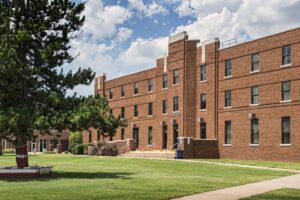
Sanderson Hall on Langston Campus

Faculty research panel encourages students to get involved with research, provides insights for next steps

Release Provided By

by Ellie Melero

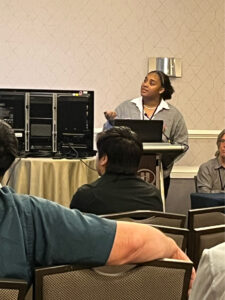
Six Langston University faculty researchers from various departments came together to share their research and graduate school experiences with students during a discussion panel on Nov. 11, encouraging students to get involved with undergraduate research and providing insights on how to do so.

“It was just an opportunity for us to let (students) know that we also go through these different steps,” said Dr. Desmond Delk, the coordinator and moderator for the event. “They, too, can do it, and we’re resources for them. And really, the main thing is to also get them interested in research and let them know how research looks different.”

Dr. Delk, the chair of the Department of Health, Physical Education and Recreation (HPER), brought together faculty with a variety of research interests for the “Scholarly Works in Progress: An Early Career Perspective” research panel. Dr. Chukwuebuka Ezeakacha, the director of LU choral activities; Dr. Lindsey Davis, the chair of the Department of Chemistry; Yaisa Mann, a professor in the Department of English; Dr. Brittany Mays, a professor in the HPER Department; Dr. Emisha Maytubby, the chair of the Department of Family and Consumer Sciences; and Alexis Montague, a professor in the Department of Public Health, all participated in the panel.

The panelists talked to students about their educational and research backgrounds, which covered topics ranging from sub-Saharan African music to infectious diseases. The faculty members discussed why they chose to pursue their areas of study and research interests, some of the challenges they’ve had to overcome while conducting research, and then answered student questions about research.

Junior biology major Kiaorie Stewart-Ricks already has some experience conducting research thanks to an internship he had this past summer, and he plans to continue pursuing research as he works toward his goal of becoming a sports physician. He was excited for a chance to listen to the LU faculty’s stories, especially those who are themselves LU alumni.

“I wanted to just come see my fellow researchers that are alums of Langston (University) and see what their challenges were doing research and the things they went through,” Stewart-Ricks said. “I thought maybe I could get some insight through their challenges.”

Providing students insight into life as a researcher was part of Dr. Delk’s goal when he coordinated the event. He wanted to give students a chance to learn about what LU’s faculty do outside of class, and he hoped they could inspire some of the students to get involved with research early.

Cynsere Boyd, a senior public health major with a minor in corrections, came to the event because she hoped to hear some advice about how to manage research and school. Like Stewart-Ricks, she enjoyed listening to the faculty members’ stories, and she appreciated the advice they shared regarding mentors and peer collaboration.

“I think the panel was a great opportunity to show us how we can make it through college and find other routes for grad (school) and figure out how to make connections with different peers,” Boyd said.

As an 1890 land-grant institution, Langston University takes pride in the high-quality research conducted at all three campuses, and there are countless ways for students of any year or major to get involved with research during their time at LU. Scores of students attended the mid-day panel, proving that research is a big draw for many students.

Dr. Delk made sure to take advantage of the time they had with students to not only share the panelists’ research, but also to share summer research internship opportunities. Many students expressed appreciation for this addition as well as for the advice the faculty shared.

“I think it went well,” Dr. Delk said. “The faculty members gave some great insight. Some of the students had some good questions. We connected them to resources, summer programs, we gave them access to some of our own personal publications.

“So, I’m encouraging students to ask questions, connect with people, and just dive into this idea of research.”
A photo of Daysha Isaac presenting her research

Biology senior earns scientific merit award at national conference

Release Provided By

by Ellie Melero, Media Relations Specialist

Biology senior Daysha Isaac won a Scientific Merit Award at the National IDeA Symposium of Biomedical Research Excellence (NISBRE) Conference in Washington D.C. this summer.

The 9th Biennial NISBRE Conference, put on by the National Institute of General Medical Sciences (NIGMS) from June 16-19, was a showcase of the accomplishments of the NIGMS’s IDeA program. Undergraduate and graduate students, postdoctoral fellows, junior and senior investigators, and staff from IDeA-supported programs came together to share their research. At the conference’s end, various awards were presented, including merit awards, mentorship awards, and entrepreneurship awards.

“I used to be a student who struggled with education and could barely understand the concept, to now being a student who can properly explain a complex topic to a plethora of people,” Isaac said. “So this award means that no matter what obstacles are thrown my way, I am able to grow past them.”

A native of Arlington, Texas, Isaac has been interested in biology and medicine since she was a child. She was born with an umbilical hernia that had to be removed when she was 8, and her time in the hospital gave her an insight into what a life in medicine was like. Since then, she has worked toward her goal of becoming a doctor, and she aspires to be a pediatrician or a neonatal physician.

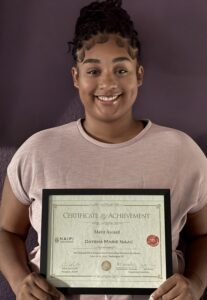
Isaac poses with her award
Daysha Isaac won a Scientific Merit Award at the National IDeA Symposium of Biomedical Research Excellence (NISBRE) Conference in Washington D.C. this summer.

Isaac came to Langston University looking for a place where she could thrive with individuals who looked like her and had the same aspirations as her, and she has found a supportive community that has helped her grow as a person and a scholar.

“Being an African American in a field that is not as diverse means I have to work extremely hard to spread my name across the room,” Isaac said. “Therefore, when professors see my talent, it makes me grateful for all my hard work. It excites me when others see my potential and are able to help me network. It motivates me when I am able to expand my name across a plethora of audiences.”

Isaac’s foray into research began when she met Dr. Kj Abraham in his Honors Natural Science Biology-I class. She impressed him with her eagerness to learn, and he has been her faculty mentor for the past two years.

As a faculty mentor, Dr. Abraham introduces students like Isaac to biomedical research and helps prepare them for a career in biomedical sciences. He trains them in research techniques, teaches them fundamentals in research and helps them to build technical skills. They are also prepared to work independently on research projects. They are taught how to review research publications, write research abstracts, and make oral presentations.

Dr. Abraham introduced Isaac to the Kansas IDeA Network of Biomedical Research Excellence (K-INBRE) last year, and he said he is proud to see how much she has grown through her participation in the program.

“She was quick to learn and follows instructions very well,” Dr. Abraham said. “She was committed to her task and adapted very well to undergraduate research. Her growth was evident in the way she successfully completed her research internship at KSU and went on to win a poster prize at the Annual K-INBRE Symposium in January.”

Through K-INBRE, Isaac worked with Dr. Jocelyn McDonald at Kansas State University to do research on stalk cell movement in drosophila. She studied ovarioles in fruit fly ovaries and looked at several functions, including cell formation and the movement of stalk cells, and then marked the differences when mutations were added.

“This information allowed us to apply it to birth defects in infants,” Isaac said. “No way are we trying to cure it but gather more information about cell movement to make a connection. Such birth defects we compared it to were spina bifida and microcephaly.”

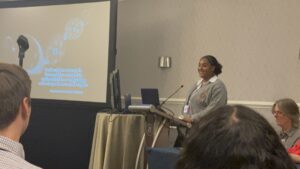
A photo of Isaac presenting her research
Isaac presented her research on stalk cell movement in drosophila at the NISBRE Conference.

Isaac presented this research at the K-INBRE Symposium in January, where she won an Award of Excellence in Poster Presentations, and was invited to present again at the NISBRE Conference. This time, she gave an oral presentation in addition to the poster presentation.

Isaac said she was nervous for her oral presentation, but she fought through her nerves to deliver an engaging presentation with energy and excitement. She was proud of her performance, and for good reason.

“After I presented, I was complimented many times,” Isaac said. “I was told by a professor that when I was ready to apply to graduate school to contact him, and another professor said he would want me to consider attending their medical school in Maine. I was told I brought the energy to the room, and I presented my research very well. Even with all the compliments, I still was extremely surprised that I won an award.”

Dr. Abraham said Isaac’s presentation was outstanding and that her confidence and knowledge were evident. He was not as surprised as Isaac that she won the Scientific Merit Award.

“This award shows that students from LU can be the best in the country and have proved that they can be top prize winners provided they are mentored and given opportunities,” Dr. Abraham said. “This also means that LU is on the national map in biomedical research.”

Isaac plans to continue being involved in research during her last year at Dear Langston, and she plans to apply for graduate school after graduation. She eventually plans to go to medical school.