

Pastures and Progress: Josie Throckmorton’s Journey to Shape the Future of Agriculture
(This story was originally published in ‘E Roar | Vol. 2 Issue 5 on Sept. 12, 2025)
by Jet Turner
The morning sunrise bleeds orange and blue hues as its light crests over the foothills of the Ozark Mountains. Its rays reach through her bedroom curtains as the rooster crows, but Josie Throckmorton isn’t focused on the noise; she is focused on the peace and tranquility of waking up on her grandparents’ farm.
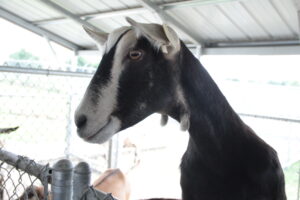
She crawls out of bed to begin her chores. The morning dew has made the hay too damp to harvest just yet, so Josie focuses on feeding the animals. The horses neigh and whinny, the cattle stir, the dogs get ready for the day, and even the cats quit their morning lounge as she approaches with their food.
Eventually the dew evaporates and it’s time to harvest the hay. At this young age, Josie is too little to reach the pedals of the hay truck, so her sister drives while she uses her hands on the pedals to brake and accelerate.
Josie doesn’t remember when she learned to do these things. She’s been riding horses since before she could walk and has helped take care of the animals and harvest the fields from the moment she could.
Josie grew up with these animals, and she grew up working the land.
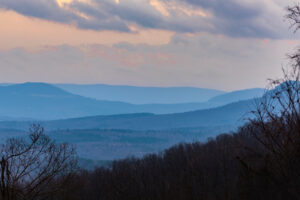
But this isn’t just any land they work. This land where the sky is so clear, where the stars are so bright at night you can literally watch the world spin around you, where even the air feels different, was the original Native American allotment of land given to Josie’s Cherokee ancestors when they signed the Dawes Rolls after walking from North Carolina down the Trail of Tears.
“Whenever you’re out there it’s like there’s not a care in the world,” Josie said. “There’s nothing else that matters except for that land and your family that’s built it.”
Josie and her family lived in those Ozark Mountain foothills until her father, Dusty, received an opportunity to be the assistant principal of Guthrie High School. Josie was about to start the third grade when they moved.
Learning is deeply ingrained into the Throckmorton’s family culture. Dusty and his wife Marjorie, who are each educators, made sure of it. Growing up on a farm taught their children to solve problems in real time, learn by doing and understand complex processes, among many other skills.
Marjorie and Dusty were training their daughters, of which they have three, for independence.
“When a kid’s raised on a farm, they’re exposed to more things than a kid that is less fortunate,” Dusty said. “I think it’s the richest environment to raise a child in.
“Whatever a young set of hands could do, we didn’t shy away from. We heated our house with 100% wood until (Josie) was 8 years old. So once a week, we were felling a tree, we’re getting the wood splitter, we’re cutting wood with a chainsaw, and I’d let the girls run the splitter. They’re stacking wood, they’re picking up sticks, they’re raking the yard.”
Dusty realizes that’s probably a heavier responsibility than most 8-year-olds are used to, but responsibilities like these laid the foundation for Josie’s work ethic, her love for learning, and her respect for the land she works and the agriculture that cultivates it.
After moving to Guthrie, the Throckmortons began working for Davis Farms in Logan County. There, they tended to the farm’s dry cows. Here, Josie learned how to show cows in addition to her other responsibilities.
When it came to her formal education, Josie’s parents always emphasized the role of meaningful, hands-on experiences outside of regular course work. They would tell her to, “Not let school get in the way of your education.”
They also told her, “You get out of school what you put into it,” a lesson that influenced how Josie interacted with her teachers and kept her involved in a multitude of extracurricular activities, such as 4–H and track and field.
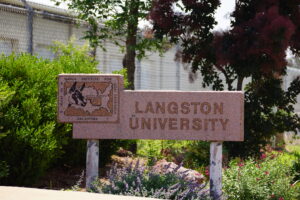
College was the next step for Josie upon graduating high school. She knew she wanted to study agriculture, and as she weighed her options, Langston University became a natural fit for her.
“Honestly, I came (to Langston University) for the agriculture program,” Josie said. “I wanted a small school where I wouldn’t be just a number. I wanted the professors to know who I am, and I wanted to know who they were. So, I came to Langston to deep dive into the ag program with all of the research that they have because Langston is known for their agriculture research. I came to get into that research and have a personal relationship with the people that are teaching me.”
Langston University was named a Research College and University by the Carnegie Classification of Higher Education Institutions in March, emphasizing the focus of research for the institution. Additionally, Langston University has a student-to-faculty ratio of about 17:1 and continues to be the most affordable four-year institution in Oklahoma.
Josie hit the ground running when she arrived to campus during the Fall 2022 semester, ensuring she introduced herself to professors, shared her interests with them and got involved where she could.
Throughout her time at LU, Josie has been involved in honeybee research under Dr. Malcolm McCallum and honeybee extension educator Hank Baker, and horticulture research under Dr. Tracey Payton. But what might end up defining her time at Langston University is the work she has done with the Drone Technology and Precision Agriculture team.
The Drone Technology and Precision Agriculture team is made up of Langston University students conducting research with drones. The goal of this research is to develop a smart but inexpensive drone that can help manage livestock and pastures for farmers. Dr. Leonard Kibet serves as the primary investigator.
Instructor Marcio White formally met Josie for the first time about two years ago at a Sherman Lewis School of Agriculture and Applied Sciences (SL/SAAS) event but had seen her around before because she was always at leadership meetings.
It was here where White approached Josie about the work the Drone Technology and Precision Agriculture team was doing. Josie was immediately interested, and after a couple of meetings she was voted onto the team by its existing members.
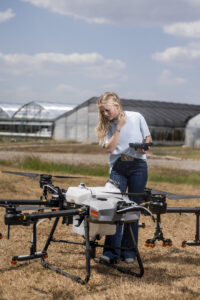
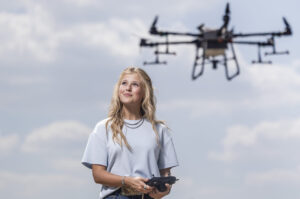
Josie is the Nutritive Differential Vegetation Index (NDVI) Specialist on the team. She is in charge of the pasture management component of the project and flies missions with the spray drone, which can very precisely––down to the inch––apply fertilizer, pesticide, herbicide and insecticide to a crop to ensure that only specific spots are targeted so no extra chemicals enter the land.
The Drone Technology and Precision Agriculture team has existed at Langston University for about 6 years, but White said this year’s team may be the best ever assembled, and Josie is a huge contributor to that fact.
“(Josie) has great character, and she has a brilliant intelligence,” White said. “She’s a dedicated hard worker, she’s committed to what she’s doing, punctual, and she’s very good at communicating not only her ideas, but how she feels about things. And she’s also a leader.”
White described Josie as a “participative type leader,” one who is always willing to get in and do the work, leading by example wherever she can.
As long as the Drone Technology and Precision Agriculture team has been at Langston University, White has tried to convince his students to study for and earn their commercial drone pilot license. His efforts were unsuccessful until this past Spring when, unknown to him, Josie began to study for her license.
Later that semester, Josie passed all tests and became the first active Langston University student to earn their commercial drone pilot license.
When she originally began planning her future career, Josie only wanted to preserve her family’s agricultural heritage and their ancestorial Cherokee allotment of land for future generations, but that passion has expanded.
Now, as Josie prepares to graduate in May, she sees herself bridging the gap between the traditional farming methods she learned on her grandparents’ land so long ago and new technologies like the drones she flies today.
“To us, that land is more of a sign of God’s provision for our family,” Josie said. “We know that we’ve been looked after and given so much, so what we hope to do is to keep this land in our family so that that whole story and that sacrifice and all the turmoil and hardships that my Cherokee ancestors faced is still alive in us today, and that we don’t forget the things that they went through to give us the stuff that we do have. I want to preserve that land so that my kids and my grandkids can grow up running around in the creeks, up and down in the hollers and in the hay fields and fishing in the ponds, just like I did, and just like all of my ancestors before me.
“What I want to do for the rest of my life is talk to people and educate them on what the future of agriculture is, what their role is in it, and how to preserve what they already have.”