


Education for All: Nine inmates graduate from Langston University Second Chance Pell Program

by Ellie Melero
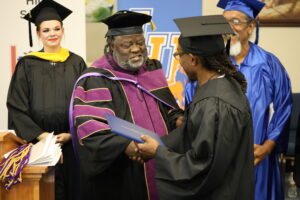
Prentice Ponds II fought back tears as he shook hands with Dr. Alonzo Peterson.
An inmate at Dick Conner Correctional Center (DCCC) in Hominy, Oklahoma, Ponds never thought he would have the opportunity to attend college. It was one of the many doors he assumed had been closed to him for good when he received a life sentence for a robbery conviction in 2017. But thanks to Langston University’s Second Chance Pell Program, Ponds graduated with his Bachelor of Business Administration degree on Aug. 14.
“It was just an experience that I thought I would never have,” Ponds said. “And I had the opportunity and a chance to take it. So I did, and I love it. You know, and I advocate for (this program) all the time.”
Ponds was one of nine inmates who graduated from Langston University and participated in a small graduation ceremony at the medium security chapel at the DCCC. Many of the inmates had friends and family who attended, along with several LU faculty and staff.
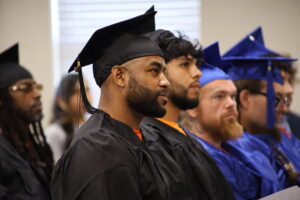
The celebration included remarks from Dr. Ruben Herron, a professor in LU’s Department of Rehabilitation and Disability Studies, as the guest speaker; an honors student recognition for those on the Dean’s and President’s Honor Rolls; induction into the Delta Mu Delta Honor Society for qualifying students; and the formal conferral of degrees. The ceremony also included a recognition and diploma conferral for inmates who graduated from the Oklahoma Department of Corrections’ Lakeside High School.
Seven men graduated with their Bachelor of Business Administration, and two men graduated with their Bachelor of Science in Rehabilitation Services.
“It was truly a special day,” said Dr. Peterson, LU’s Vice President for Academic Affairs. “You could see what the moment meant not only to the graduates, but also to their families and loved ones, as well as our faculty and staff who have worked with these students along the way.”
The Second Chance Pell Program operates under LU’s Tulsa Campus. It was established in 2017 under the U.S. Department of Education’s Second Chance Pell Initiative, which restored Pell Grant eligibility for incarcerated individuals in 2015. Beginning with the 2026-27 school year, the Second Chance Pell Program will transition to a Prison Education Program.
Students in the program are able to choose between degrees in Business Administration or Rehabilitation Services. These degree programs were chosen because they are best suited to serve the graduates when they complete their sentences and re-enter the workforce.
Sylvester Stanley, a Rehabilitation Services graduate, said he loved the program because it helped him learn more about himself and has motivated him to keep pursuing education.
“It helped me to kind of grow and change in here to where I know I’m locked up, but I’m not locked up,” Stanley said. “Because it’s a mindset thing. So, I take my mind and use it as a tool to help me better myself and the people around me. I’ve got this support system in the world, and I want to let them know that I’m not allowing prison to be the deciding factor of how I act or dictate my mood or my feelings.”
To qualify for graduation, the inmates must meet all the same degree requirements as regular LU students. For many, this takes longer than the standard four years because they may have to take a semester off to work or see to responsibilities within the court system. Ponds and Stanley remained dedicated to their studies, and they both earned honors for their work. Ponds was even able to graduate with a perfect 4.0 GPA.
Stanley said it was important to him to devote his time to his studies because he has goals for his life after DCCC. When he’s released, he wants to work with at risk youth in Tulsa to help prevent them from making the same mistakes he did. He hopes to have an opportunity to begin working on his master’s while still in jail so that he will be one step closer to becoming a licensed professional counselor when he leaves.
For Dr. Peterson, this is the true goal of the program. He doesn’t see it as simply a way for the inmates to earn degrees; it’s a way for them to take control of their futures.
“I am proud that Langston University is able to provide this opportunity,” Dr. Peterson said. “These men made a decision to use education to change the direction of their lives, and they worked hard to earn their degrees. When they return to their communities, they will do so as college graduates with an education they can use to create new opportunities for themselves and their families. And just as importantly, they are now proud alumni of Langston University.
“For me, this is what our work is really about: changing lives, creating opportunities and giving people hope for what comes next.”