



Langston University Alumnus serves on Artemis II Naval Recovery Mission

by Ellie Melero
On April 1, the world watched excitedly as astronauts Reid Wiseman, Victor Glover, Christina Koch and Jeremy Hansen launched into space as part of the Artemis II Mission–NASA’s first crewed lunar flyby since 1972. For 10 days, people eagerly awaited updates as the Artemis II crew orbited the moon and traveled the greatest distance from Earth humans have ever achieved. On April 10, the crew reentered the Earth’s orbit and splashed down off the coast of San Diego.
The first person to greet them was Langston University alumnus Laddy Aldridge.
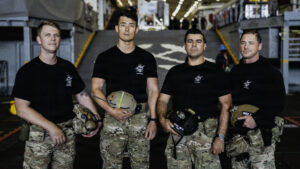
Aldridge is a Senior Chief Petty Officer in the U.S. Navy, and he serves as the Independent Duty Corpsman for Explosive Ordinance Disposal Expeditionary Support Unit 1. He was one of four Navy Sailors selected for the Navy Dive Medical Recovery Team for the Artemis II Mission, serving as a first-contact medical provider inside the Orion capsule. But long before that, he was just a boy from Oklahoma.
“To be a part of this mission is truly an honor,” Aldridge said. “I am humbled to have been just a small part in it.”
Aldridge grew up in Cushing, Oklahoma, and he found his passion for medicine at a young age. His father, a former U.S. Coast Guardsman, had a long medical history and was at the doctor’s often. Sometimes Aldridge accompanied him, and he was inspired to pursue a medical career after seeing the many interactions between his dad and Dr. Ike Hubbard.
After that, he talked to his high school career counselor. She suggested he apply to Langston University’s Bachelor of Science in Nursing (BSN) program because the school’s licensure exam pass rate was better than that of the University of Oklahoma. Additionally, LU was more affordable and closer to his family. So, in the fall of 2005, Dear Langston became Aldridge’s new home.
For the next two years, Aldridge worked over 40 hours a week while balancing a full course load each semester and commuting from Cushing. It was hard, but he was determined. His professors were helpful and supportive, and one of his chemistry professors was particularly influential in his decision to enlist in the Navy.
“She never hesitated to ask if I was grasping the concepts in class at the end of every session,” Aldridge said. “Making small talk one day, I mentioned my father’s military background and said something like, ‘I would join if I was not currently enrolled.’ She supported the thought and also immediately offered to help search for more scholarships if I was struggling financially. I will always remember how supportive she was of me no matter what direction I wanted to go in life.”
In 2007, Aldridge decided to pause his studies and join the Navy as an enlisted Hospital Corpsman. His naval career has taken him places he never imagined. Over the past 19 years, he’s had the opportunity to work with wonderful people, learn from next-level leaders, and gain skills and viewpoints that he said will forever shape his life.
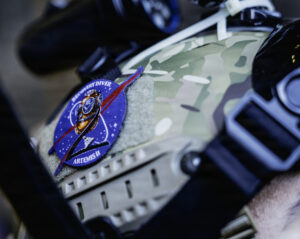
In 2017, NASA announced the Artemis Program, a moon exploration program made up of several missions of increasing complexity with the end goal of establishing a permanent lunar base on the moon.
When the Artemis II Mission was announced, Aldridge was excited to be named to its Navy Dive Medical Recovery Team. His initial excitement was quickly followed by nervousness and then eagerness to learn more about space medicine and physiology. Then the training began.
“Over the past few years, our team took several trips to NASA’s Neutral Buoyancy Laboratory located in Houston, Texas,” Aldridge said. “These helped familiarize the team with the procedures and gear utilized in the mission. Along with those trips, we conducted several underway trips on various U.S. Navy ships where we would practice the mission with a training capsule in the open ocean.”
The Team’s years of training paid off. When the Orion capsule landed in the Pacific Ocean, they went straight to work.
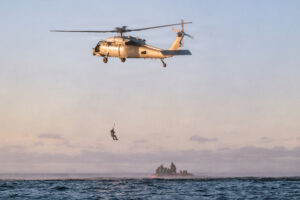
Once they opened the capsule, Aldridge was the first person to make contact with the astronauts. He entered the capsule and began conducting initial medical exams for the crew. The Navy Dive Medical Team provided care as needed and then assisted the astronauts out of the capsule and onto a raft set up by Navy divers. They then prepared the astronauts for a helicopter airlift to the USS John P. Murtha for further medical evaluations.
Reflecting on the mission afterward, Aldridge was honored to participate. Growing up in Oklahoma, he never would have imagined he would one day work with NASA to care for astronauts returning from a lunar mission. He knows he wouldn’t have had the opportunity without the support of people throughout his life, from Cushing and Langston to his many naval duty stations.
“LU prepared me not only academically for life after college but also for life in general!” Alrdidge said. “To Langston University, my first home after high school, thank you for helping me build the foundation of who I am as a person and a student. Even though I never completed my initial goal of a degree from LU, I will always be a Lion at heart.”