As she stepped into the Pollinator Sanctuary, Andria took a moment to assess her surroundings.
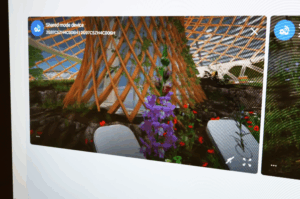
She stood in the middle of a circular path lined with bushes and flowers. Butterflies, bees and other flying insects flitted between the plants, buzzing contentedly and paying her no mind. Her eyes followed the route of a bumblebee as it circled a purple flower to her right and flew over her head, bringing her gaze up to admire the bright blue sky that shone through the crisscrossing wooden beams enclosing her and the insects inside a giant ring.
She returned her eyes to the front and saw six pedestals in front of her. Each held a flower and was labeled with a different pollinator. She stepped forward, reached out, and plucked a bright red and orange marigold from its pedestal. Immediately, a honeybee came and landed on the flower, allowing her to get a good, close look at it. She brought the flower eye-level, and a voice began speaking in her ear, telling her about the daily habits of honeybees.
“Usually, if I saw it in real life, I would get scared,” Andria said. “If I saw a bee, I would run. But since I knew it wasn’t real, I was kind of investigating it, seeing what was on the bug and stuff.”
The VR Pollinator Sanctuary helped students learn about pollination, the insects that pollinate, and how that process plays into everyday life.
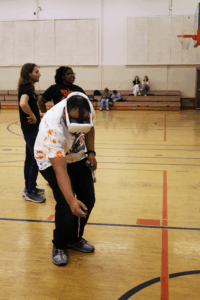
Observing different bees, butterflies and moths up close on the flowers was one of several activities Andria did through the Pollinator Sanctuary Virtual Reality Experience at Langston University on Thursday.
A rising junior at Stillwater High School, Andria is a camper at LU’s 2026 Math and Science Academy. The annual summer camp brings students from all over Oklahoma and surrounding states to the Langston Campus for two weeks to learn about STEM careers, life in college and strategies for taking the ACT. Activities like the Pollinator Sanctuary give the students opportunities to learn about STEM and agriculture in new and exciting ways, which is why Shar Carter is trying to make it more accessible.
Carter is an extension educator with LU’s Cooperative Outreach and Extension Programs (CEOP). She worked with Aaru Entertainment, a virtual reality company based in Tulsa, to bring the Pollinator Sanctuary to Langston for the Math and Science Academy. For two years, she has worked with Aaru to put on similar events around Tulsa with some of the other educational labs they offer, such as a virtual reality space simulation. This summer, she wants to do more.
“We can take them to places, whether that’s botanical gardens or museums, that they might never see in their lifetime,” Carter said. “There’s just so many applications that we can do, and what Dr. (Welsey) Whitaker, Dr. (Alonzo) Peterson and President (Ruth Ray) Jackson have allowed me to do is engage with other departments and adapt it to what they want to do.”
For the Math and Science Academy, Carter wanted it to showcase one of the many intersections of STEM and agriculture.
In the VR Pollinator Sanctuary, students could get a close look at insects and flowers and learn about the importance of pollination and pollinator conservation.
By donning the VR headset, students were transported from LU’s Multipurpose Gymnasium into a state-of-the-art insect sanctuary and observatory to learn about pollination, the insects that pollinate, and how that process plays into everyday life. They looked at bugs and flowers up close, walked through a grocery store with empty shelves where all the food requiring pollination should have been, and learned about pollinator conservation.
For many of the students, this was their first experience with virtual reality, and they were impressed.
“I was excited because I always wanted to try VR,” Andria said. “At first, it wasn’t like how I expected it to be, but it was still fun. It was cool looking around and seeing random things flying around. I think it’s a fun way to learn, especially since it’s kind of like a video game, and most people like video games.”
The experience stuck with the students as more than just a fun activity. Many said they learned things about bees they hadn’t known before, and the impact of seeing the empty grocery store shelves is something many said will stay with them.
Aaiyah, a rising junior at Wiley East High School in Dallas, said the experience was eye-opening.
“It’s showing you how all the pollinators are gonna be gone, and how we’re not really gonna have any food,” Aaiyah said. “Like, in year 2080, we’re really only gonna have bread and wine. It was just really sad because we need to work on it.”
Despite the somber feeling she had when she took off the headset, Aaiyah was still impressed by the VR experience.
“You see things, like articles and stuff like that,” Aaiyah said. “But this was like, you actually got to engage with it. To see the future and back and the difference, and to actually take it in.”
Carter and Aaru will host the next virtual reality STEM education lab on the Langston Campus on June 25 as part of the Sherman Lewis School of Agriculture and Applied Sciences’ HERC Field Day. Carter is working to schedule more around Oklahoma throughout the summer.
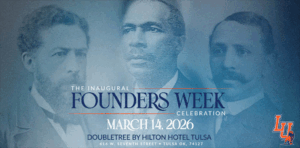
Langston University is set to celebrate 129 years since its founding with a week of ceremonies and celebrations in Langston and Tulsa. The events will include musical performances, the annual Founders Day Program and an Inaugural Founders Week Celebration Gala.
The Langston University Department of Music will present The Chamber Collective musical performance on Tuesday, March 10. This collection of small ensembles will feature both choral and instrumental performances. The event will be held in the I.W. Young Auditorium on the Langston Campus at 6:30 p.m.
The annual Founders Day Program will be held at the I.W. Young Auditorium on the Langston Campus at 11 a.m. on Thursday, March 12. The theme for this year’s program is “Honoring Our Past, Empowering Our Promise,” and the featured speaker will be Dr. Tiffany Crutcher, Founder and Executive Director of the Terence Crutcher Foundation.
Dr. Cruther is an alumna of Langston University, and she is a nationally recognized justice advocate, community leader and social impact advisor. As Founder and Executive Director of the Terence Crutcher Foundation, she leads transformative initiatives focused on public safety, criminal justice reform, economic mobility and community healing. She also serves as a Founding Board Member of Justice for Greenwood, Senior Advisor to Black Tech Street and Advisor to Roc Nation’s United Justice Coalition.
Langston University will end the week with the Inaugural Founders Week Celebration Gala in Tulsa on Saturday, March 14.
The Founders Week Celebration Gala, a black-tie optional event, will include a formal dinner, awards presentation and live music. There will also be a special presentation to commemorate the 25th anniversary of the Master’s in Rehabilitation Counseling program, which has since spurred the creation of a bachelor’s program, the formation of the Department of Rehabilitation and Disability Studies, the establishment of two federally funded Rehabilitation Research Training Centers, and the creation of a post-doctoral research program.
The Chamber Collective and annual Founders Day Program are free and open to the public. The Founders Week Celebration Gala is a ticketed event. Tickets can be purchased online at langston.edu/founders-week through Friday, March 6.
Dry air fills Gloire Houmba Mayindou’s lungs as he runs, his worn shoes beating the concrete surface of the park’s basketball court.
The “Diablo Rouge,” Mayindou’s club team, practice on the outdoor court nearly every day in The Republic of the Congo, his home country. Dribble, stop, shoot, rebound, pass… the 5-on-5 drills of the day were as normal and intense as any other day.
The 11-year-old watches as a shot soars overhead, the ball bouncing wildly between the backboard and rim. Realizing the ball isn’t going in the basket, Mayindou jumps to secure the rebound. He suddenly feels hands, followed by a shoulder, hit him in the back as his feet leave the ground, causing them to swing out from under him. He lands shoulder first on the unforgiving concrete. A teammate falls on top of him.
The impact dislocates his right shoulder.
Young Gloire Houmba Mayindou poses for a photo in the Republic of the Congo.
“I couldn’t shower, couldn’t dress myself, couldn’t eat, couldn’t move,” Mayindou said. “So, dealing with that pain and then knowing that you cannot go to the hospital to get help, man, it’s mentally challenging.”
Access to healthcare, much less physical therapy, is limited in the Republic of the Congo. Even if you can get to a hospital or other healthcare provider, services are so expensive that most people don’t even consider it an option when they are hurt.
This experience, along with his observations of how many people are living with chronic pain without the assistance they need, drove Mayindou to come to the United States and eventually Langston University to earn his doctorate in physical therapy.
Now Mayindou, a first-year physical therapy student, can not only learn his trade in a program that boasts a 92% National Physical Therapy Exam pass rate and a 100% job placement rate, but he can soon get hands-on experience much more quickly than the average physical therapy student when Langston University completes construction on a physical therapy clinic being built right on the Langston Campus.
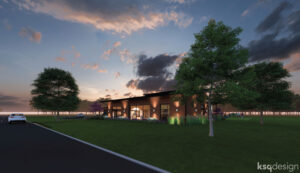
Construction has already begun on this Physical Therapy Clinic, which is being funded through Title III grants.
Dr. Elicia Pollard, Dean of the School of Physical Therapy, said this clinic will not only have an impact on students at LU, but on the community as well.
“There’s no physical therapy clinic here (in Langston),” Dr. Pollard said. “If locals want services, they’ll either drive or do without. So, we are going to fill that need there. We are going to be offering this clinic to people who are uninsured or under insured or low-income families. We are going to eliminate potential barriers such as transportation and cost.”
The closest clinics to the town of Langston are in Guthrie, which forces those who seek assistance to drive upward of 20 minutes for care.
The clinic is not designed like a typical medical facility with a labyrinth of halls and little rooms. The Langston University Physical Therapy Clinic will have an open concept with only a few rooms with doors for private needs. This allows for the area to be reconfigured for different patient populations and research needs.
Dr. Anthony Sylvester, Director of Clinical Services at Langston University, has been instrumental in the development and design of this clinic since its inception. As a two-time Langston University graduate with experience running small, rural health clinics in addition to 25 years of experience as a clinical instructor, he understands the importance of ensuring the space is being used to its fullest potential to optimize client and student outcomes.
Because of his experiences, Dr. Sylvester understands how unique this clinic is to Langston University.
“This isn’t typical of other physical therapy schools,” Dr. Sylvester said. “I think we’re going to be pretty unique in reference to what most schools, a lot of PT schools, will have. We’ll have that daily experience here. Students will see a patient they’ve worked with progress through their care.”
The Physical Therapy Clinic will also offer opportunities for students to participate in research, different forms of patient care, community events and much more.
This level of experience is why students like Mayindou come to Langston University to study physical therapy.
“The first time I learned that they were building a clinic, everyone, at least all my classmates, we are all so excited,” Mayindou said. “That’s kind of a dream come true. In our field, there’s nothing better than experience. To work with a patient one-on-one is a different thing.
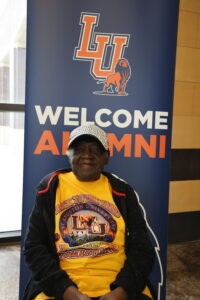
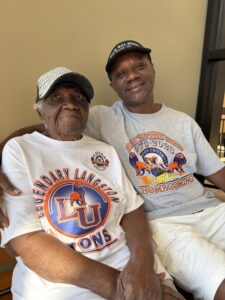
Music, laughter and conversation filled Langston University-Tulsa’s front lobby on the Tuesday of Homecoming Week as students, faculty, staff, alumni, community members and their families flocked to the campus for its annual Homecoming Block Party on Oct. 7. Sitting at a table in the middle of the lobby, happily chatting with anyone who wanted to stop by, sat 98-year-old Ozetta Parker (née Walker).
As Parker looked around at all the activity, it amazed her how much things had changed at Langston University since she was a student in 1946.
Parker grew up on a farm near Tulsa in the 1930s as one of nine kids. She enjoyed farm life, especially the big homemade meals her mother would prepare, but education was always a major focus in her community. So when her older sister Pauline moved to the city, Parker began staying with her during the school year so she could attend Booker T. Washington High School.
Parker enrolled at Langston University in 1946 with a major in home economics.
In the city, Parker and her siblings walked everywhere they needed to go, and they didn’t go out at night. They lived in a tight-knit community where everyone looked out for one another. Her teachers were strict, but Parker could tell they cared. When Parker graduated from high school in 1946, Pauline encouraged her to attend college and study home economics.
“She liked my cooking,” Parker laughed.
Langston University didn’t have a campus in Tulsa back then, so Parker made her way out to Logan County. She lived in Sanford Hall–which was a women’s dorm at the time–and studied home economics.
Life at LU was different than what Parker was used to. The rural campus felt almost isolated from normal society, and Parker thought her dorm room didn’t have much space. She especially missed her mother’s cooking. But there was a lot about life at Dear Langston that she loved, too.
The university offered plenty to do as far as providing students with social activities. Students went to sporting events and church regularly, and when there were dances, they were well attended. Parker met a lot of people and made a lot of friends.
“They had entertainment for us,” Parker said. “They had a little place where you could go dance. I don’t know what they called it … but you go there and socialize when you had the time.”
Although Parker spent a lot of time studying in her room or in the library, she said she enjoyed her classes. Her home economics courses taught her about a variety of things, including cooking, proper housekeeping and sewing. She learned she really enjoyed sewing. She loved drawing her own designs and then using them to create items like aprons and dresses.
Parker passed her love for Dear Langston down to her children, and she brought them to Homecoming every year.
Parker loved her time at LU, but she had to leave after two years. She moved to Oklahoma City, found work, got married, started a family and moved back to Tulsa, but she never forgot about her time at Dear Langston.
For years, Parker would return to LU with her family for every Homecoming. She loved connecting with old friends and seeing how much the campus and university continued to grow. But as she got older, the trip out to Langston became harder to make, and she stopped going.
This year, her son saw an advertisement for the Homecoming Block Party at LU-Tulsa, and they were both excited to attend their first Langston University Homecoming celebration in several years.
This provided her the opportunity to remember not just what Langston University meant to her, but what it can mean to everyone.
“Education is what’s going to help us make this world a better place,” Parker said. “(Langston University) is a good place to go to learn and socialize and entertain and leave a legacy for the children behind us to go as high as they can.
LANGSTON, Okla.––Thanks to the efforts of the Oklahoma Legislature to fully match Langston University’s Evans-Allen federal funding, the LU Cooperative Extension and Outreach Program (CEOP) is preparing to expand its services to two new counties while increasing its program offerings in counties it already serves.
With the additions of Woodward and Johnston Counties, CEOP will offer extension programs in 48 of the 77 counties in Oklahoma. CEOP’s programs offer vital services to these communities, providing resources in areas ranging from family and youth development to a wide range of food and agricultural support. Dr. Roger Merkel, Associate Extension Administrator for CEOP, said that by expanding its services, CEOP seeks to fulfill its mission of advancing the well-being of Oklahomans and fostering resilient, thriving communities across the state.
“The Cooperative Extension and Outreach Program of the Sherman Lewis School of Agriculture and Applied Sciences is committed to serving the citizens of Oklahoma by promoting improved quality of life, enhancing agricultural and business productivity, and fostering community development,” Dr. Merkel said. “Central to the mission of Extension is the cultivation of meaningful human connections. Extension educators prioritize the establishment of respectful, supportive relationships that yield measurable, positive outcomes in the communities they serve.”
The Oklahoma Department of Agriculture, Food and Forestry (ODAFF) fully matched Langston University’s Evans-Allen federal funding for the first time in FY 2025, and ODAFF made strides to maintain the full match for FY 2026 by increasing CEOP’s state funding. Thanks to this full funding match, CEOP is strategically expanding its services throughout Oklahoma through investments in essential resources such as personnel, transportation, technology, program supplies, professional development opportunities and other forms of operational support.
With enhanced resources, the program intends to both broaden existing initiatives and implement new, impactful activities. Anticipated outcomes include:
An increased number and multiplicity of food preservation courses
Expanded fiber arts programming
A broadened youth STEM curriculum and engagement with schools and other community organizations.
Establishment and support of new 4-H clubs.
Expansion of small ruminant production and related value-added product development programs into new areas of the state.
Growth of apiculture support and education, including the development of a formal training curriculum for beekeepers.
Expanded horticulture and precision agriculture education and outreach initiatives
Strengthened collaboration with and support for community-based organizations
Continued adult and youth nutrition education support programs.
A new initiative to provide adult and youth programming with Oklahoma City Parks and Recreation
This expansion effort is one of the ways in which Langston University aims to broaden its impact in Oklahoma through its land-grant mission.
“Langston University is grateful for its enhanced funding,” said Dr. Wesley Whittaker, Dean of the Sherman Lewis School of Agriculture and Applied Sciences. “Consumers, producers and industry professionals recognize that funding for agricultural extension and research in Oklahoma creates value on many levels. It helps to develop new revenue streams for farmers and ranchers, expand value-added products, encourage diversified agricultural practices and strengthen the competitiveness of Oklahoma agriculture.
“Our dedicated team is energized and ready to do all that is necessary to ensure impactful outcomes from our work.”
As we transition into the new academic year, we are excited to share the progress our Division of Operations has made throughout the summer to enhance our campus facilities. With a relentless focus on improvement and modernization, our team has been working tirelessly to overcome many of the most critical infrastructure challenges and ensure that our students, faculty, and staff have access to comfortable learning and living environments.
Importantly, the projects we have been managing throughout the summer have come at no cost to our students. We are proud to have leveraged grant funds and state allocations to pursue these projects, and we are grateful to the Division of Academic Affairs for their partnership in the use of Title III grant funds for our academic buildings. Langston University is also extremely grateful to the Oklahoma Legislature, including Gov. Stitt and notably Sen. Chuck Hall, for the ongoing investments made to address deferred maintenance needs on campuses throughout our state. These summer projects were made possible using grants and state-allocated funds coupled with months of planning, preparation, and project management.
Academic Building Climate Control Upgrades
Four of our academic buildings on the Langston Campus are receiving comprehensive Heating, Ventilation, Air Conditioning (HVAC) improvements through Title III grant funding. These buildings include Moore Hall, Sanford Hall, Jones Hall, and the G. Lamar Harrison Library. In collaboration with a professional engineering firm, we developed detailed specifications which were utilized in a competitive bid process in the spring. A vendor was selected from the bid process to install new chiller systems within the buildings, and their work has already begun.
The new chillers and pumps for these four buildings are set for delivery in mid-September 2025. By the end of September, all permanent systems should be installed, calibrated, and fully operational, ensuring optimal learning conditions for the fall semester and beyond within these four buildings. In the meantime, temporary chillers are being rented to provide relief in each of the four buildings until the permanent chillers are in place. While renting temporary chillers is extremely costly, it is a worthwhile investment in the short term until our new equipment is in place. We are finding that the temporary chillers are drawing more power than is typical for our Langston Campus. As a result, we have encountered occasional brownouts or brief power outages. We appreciate your patience as we work through these isolated instances.
Additional climate control improvements are underway at Allied Health, where we intend to replace an outdated split chiller system with a properly sized solution designed by our professional engineering partner. This project is in the initial planning phase and will be subject to competitive bidding before work can begin. In the meantime, we are working to implement a temporary chiller solution at Allied Health for the fall semester.
The comprehensive HVAC overhaul of C.F. Gayle’s Gymnasium, Atrium, and the John Montgomery Multipurpose Building is shaping up to be one of our most ambitious undertakings. The Division of Operations worked closely with our professional engineering partner over many months to develop the detailed specifications for the project, which we anticipate will be published for competitive bidding in August 2025. This priority project, funded through the Oklahoma Capital Asset Management and Protection (OCAMP) Deferred Maintenance allocations through the Oklahoma Legislature, demonstrates our commitment to maintaining our most heavily utilized facilities for student activities, athletics, and community events.
Residential Housing Transformation
Perhaps most significantly, we are revolutionizing the HVAC systems through HEERF grant-funded projects across four residential communities. These improvements represent the most comprehensive housing upgrades in decades, and this large-scale project has proceeded at an extraordinary speed.
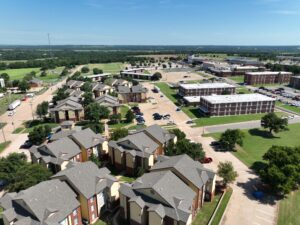
Centennial Court Apartments, Buildings 1-5, are receiving entirely new HVAC systems with redirected air delivery, finally addressing long-standing mechanical issues due to construction defects. Residents of Cimarron Gardens Apartments will experience, for the first time ever, thermostat-controlled central air conditioning, as we replace outdated window units and aged furnace infrastructure. Our construction partner, Nabholz Construction, is working to put the final touches on the upgrades within Centennial Court and Cimarron Gardens.
Commons Apartments and Scholars’ Inn will receive updated HVAC systems with state-of-the-art cooling. This project is also funded through the remaining institutional allocation of the HEERF grant. These systems will be installed throughout the Fall semester as equipment arrives.
Even facing unforeseen challenges due to supply chain setbacks and other compliance-related delays, we remain committed to completion with contingency plans in place to ensure all residential HVAC improvements are finished by December 30, 2025.
You may see our teams working to wrap up construction, replace sod, and clean the construction site. We ask for your patience as we continue this important work.
Infrastructure Modernization Projects
Our commitment to accessibility and safety continues with the ongoing Sanford Hall elevator modernization project. This project was initially proposed and approved in September 2024. In the intervening months, a great deal of work has occurred to procure the necessary equipment and prepare for its arrival and installation. This turnkey project entails electrical, telephonic, fire suppression, and mechanical upgrades for the elevator installation, which began on July 22, 2025. We anticipate a completion date in mid-August, contingent upon scheduling the required state inspection, after which time students and staff will have access to a fully modernized, reliable elevator system. Similar modernization projects for additional elevators throughout our campuses are already in the planning stages.
Protecting the LU-OKC Campus
Our Oklahoma City campus restoration continues with the roof replacement project, which is now moving through the final phases of procurement. The November 2024 storm that damaged our campus facility has since been classified by FEMA as a natural disaster. The University engaged with an architectural firm to develop detailed specifications for roof replacement which were utilized for competitive bid in the selection of our roofing partner. We are now working through bonding requirements to award the contract and initiate the project. While temporary roof repairs remain secure with interior restoration ongoing, a full roof replacement supported by OCAMP Deferred Maintenance funding and potential grant reimbursement will restore full protection for our campus in Oklahoma City.
Looking Forward
The work happening across our campuses demonstrates our commitment to providing an exceptional educational environment in support of student success and campus excellence.
As we continue this momentum throughout the academic year, the Division of Operations remains focused on progress, innovation, and the continuous improvement of our campus infrastructure. We will pursue additional projects with our FY26 OCAMP Deferred Maintenance allocation. Priorities will include electrical and utility upgrades, roadway repairs, elevator upgrades, and more. We anticipate the funding will be released by the state in September 2025. These investments in our physical environment directly support our mission of educational excellence and ensure that Langston University continues to provide world-class educational experiences for generations to come.
We thank our campus community for your patience during construction periods and look forward to the enhanced comfort and functionality these improvements will provide.
Theresa Powell Vice President, Division of Operations
Every year on Mother’s Day, Dr. Emily Patterson Harris gets a call from one of her former students.
When that student was younger, he attended and dropped out of two colleges. Dr. Harris wouldn’t have it.
“It took me two years to talk him into coming to Langston University and giving it another try,” Dr. Harris said. “And he did. We had some rough times in there, but he finished, and he calls me on Mother’s Day.”
Not all of her student stories are as friendly.
Once, while walking down the stairs at the LU-Tulsa Campus, a student stopped Dr. Harris to talk. He was a student who sometimes struggled to balance his schoolwork with his responsibilities as a father, but Dr. Harris knew he was capable of it and always made sure to let him know it.
“He stopped me, and he said, ‘Well, I want you to know that I’m going to graduate, if for no other reason than to get you off of my back!’” Dr. Harris said. She smiled and responded with an upbeat, “OK!”
That student did graduate, and he went on to earn his master’s degree. She still sees him occasionally and always makes the time to talk with him.
Dr. Harris has countless stories like these because she’s been working with students for over 40 years. She has worked tirelessly to develop well-defined and relevant programs that will help students get jobs after graduation, and she has dedicated countless hours to making sure students make it to graduation. From working with them in the classroom to advising those who left to figure out how to come back, Dr. Harris doesn’t give up on her students. She cares about them, and she knows that for many, earning their degree will change their life.
Education is Transformative
Dr. Harris has always believed in the power of education, and she understands better than most that the transformative effects of earning a degree can be felt for generations. Her own family is a prime example. Her maternal grandmother, Emily Alford, only had an 8th grade education, but she was determined to send her children to college. They came to Langston University.
Violet Alford, Dr. Harris’ mother, graduated from Langston University with a B.S. in Business in 1950.
Dr. Harris’ mother, Violet, graduated from Langston University in 1950 with a B.S. in Business. Her father, Lee V. Patterson, Sr., graduated from LU that same year with a B.S. in Industrial Arts. They both had successful teaching careers in Oklahoma, and they made sure their children understood education was important. The message was echoed by Dr. Harris’ aunts and uncles throughout her childhood, and she and her cousins eventually passed the message along to their children, too.
Today, the younger generations of the family understand education is transformative. Dr. Harris’ son Erick said they all expect to go on to earn the highest-level degrees available for their chosen professions. Four generations after Emily Alford, the average degree in the family is a masters.
“I go back to that initial decision that my grandmother made that a college education was important,” Dr. Harris said. “That one decision has impacted generations of my family.”
It also allowed Dr. Harris to impact thousands of others.
Dr. Harris graduated from her father’s alma mater, Booker T. Washington High School in Tulsa, Oklahoma, but she did not follow in her parents’ footsteps to attend Langston University. Instead, she chose to attend Central State University in Wilberforce, Ohio, and her experiences there reinforced her beliefs about the power of HBCUs. She went on to earn her Master of Library and Information Studies from the State University of New York at Buffalo before moving to Texas to serve as a librarian at Houston Community College.
After a three-year stint in Houston, Dr. Harris came home to Oklahoma. Thanks to the efforts of Dr. Roosevelt Mack, she officially joined the Lion Pride as a librarian at the LU-Tulsa Campus in 1981.
Building Something
Langston University’s Tulsa campus opened in 1979. It was the first public institution to offer graduate and upper level higher education courses in Tulsa.
The Langston University-Tulsa Campus had been established just two years prior when Dr. Harris joined the staff.
It was the first public institution to offer upper-level higher education classes in Tulsa, and in 1982, it worked together with Oklahoma State University (OSU), the University of Oklahoma (OU) and Northeastern State University (NSU) to form the University Center at Tulsa. Still a firm believer in the importance of education, Dr. Harris was excited to be a part of bringing access to higher education to her hometown.
Serving as a librarian for all academic programs gave Dr. Harris an opportunity to work closely with the students in Tulsa, and she found she enjoyed getting to know them while helping them access the materials they needed for their classes. She was good at her job, and she was soon asked to move to the Langston Campus to serve as the Acting Director of the G. Lamar Harrison Library while the school looked for a permanent director.
When she returned to LU-Tulsa a year later, she knew she was ready to take on more responsibility.
She transitioned from the library to a position as an academic counselor. It was around this time that Dr. Wessylyne A. Simpson, Dr. Harris’ aunt who was then the Dean of the School of Education and Behavioral Sciences (SOEBS), was working to expand the program offerings at the Tulsa Campus. Dr. Harris worked with Dr. Simpson, SOEBS faculty and Diana Sharp to bring the Teacher Education program to Tulsa.
“We worked on paperwork and made sure we had all the bylaws and everything set up before we could start recruiting students,” said Sharp, who still works at LU-Tulsa as an administrative assistant. “We all put our heads together and started the program here, and it’s taken off ever since.”
Diana Sharp (right) has worked with Dr. Harris since she joined the LU-Tulsa staff in 1983.
Sharp liked working with Dr. Harris right from the start. When they first met in 1983, Sharp’s first impression was that Dr. Harris was a peppy, happy-go-lucky person with whom it was very easy to talk. Forty years later, Sharp said that’s still how she’d describe her.
LU Tulsa’s Teach Education program was the first of many projects Sharp and Dr. Harris would work on together over the years, and Sharp said she always appreciated Dr. Harris’ positive attitude and willingness to try several approaches until they found the one that would work. She also appreciated that Dr. Harris knew how to leave work at work, allowing them to form a personal friendship in addition to their professional one.
Thanks to their hard work, they brought the Teacher Education program to LU-Tulsa in 1985. The program was housed on the seventh floor of the building they shared with OSU at 440 S. Houston St., and Dr. Harris took on the role of Associate Director for Teacher Education at LU-Tulsa.
For 12 years, she supervised the teacher education program at the Tulsa Campus. She loved working with students and continued to serve as an advisor. In 1986, she also began teaching as an assistant professor in SOEBS, focusing mostly on psychology and education courses.
She went back to school and earned her Ed.D. in Higher Education Administration from OSU in 1989, and she said she is eternally grateful to the late Dr. Mack for his continual support throughout this time as she juggled her work and doctoral coursework. She also wanted to thank Dr. Ernest L. Holloway, LU’s longest-serving president, and Dr. C. Gary Crooms.
“There’ve been powerful leaders, master teachers and mentors that encouraged me and were great at their chosen fields,” Dr. Harris said. “The late Dr. Holloway continually focused on challenges as opportunities. Dr. Crooms taught me to look at those challenges from multiple perspectives.”
Dr. Harris finished her doctorate, completed additional coursework in Behavioral Sciences, and became certified to teach Social Studies, Language Arts and Library Media. She took her mentors’ lessons as well as everything she’d learned from her own classroom experiences as both a teacher and student to try to continually improve her own classes.
“What I loved about teaching is just the fact that there’s always more information,” Dr. Harris said. “And I’m a librarian, so I love looking for information. You can never get tired of finding new things or new ways of doing things, and sometimes your students will send you off in a different direction.”
Students First
Dr. Harris (far right) served as the Associate Vice President for the LU-Tulsa Campus for almost 12 years.
Dr. Harris was dedicated to her work, and that’s something to which her family can attest. Growing up, her two sons spent much of their free time at the LU-Tulsa Campus and witnessed how hard their mother worked for the students there.
One day, an 8-year-old Erick approached Dr. Virginia Schoats, the campus site director, and told her as much.
“My mom was always working hard,” Erick said. “I had just found out what the word ‘promotion’ meant, and once I realized that I said, ‘Oh, well she deserves one of those.’ And because (Dr. Schoats) was her boss I thought, ‘She’s the one that can give it to her.’”
Not long after, Dr. Schoats did recommend Dr. Harris for a promotion.
In 1997, she became the Associate Vice President for LU-Tulsa, the person who ran the campus. She also served as the Institutional Representative for Langston University to the University Center at Tulsa, advocating for the needs of LU students and faculty while working to improve access to higher education for all Tulsans.
Though her duties and responsibilities changed, her goal stayed the same: to guide students to degree completion.
At this time, the average age of the students at LU-Tulsa was about 34. Dr. Harris recognized early on that their needs would be different than the needs of students at the Langston Campus, so she tried to keep their work and familial responsibilities in mind. Under her leadership, the faculty and staff in Tulsa worked to make it as feasible as possible for non-traditional students to take classes. They offered everything from a bookstore to a registrar’s office on campus so students wouldn’t have to make the drive to the Langston Campus.
“We had it set up making sure that once they got out from work, we had every avenue for (students) to be able to take courses so that they would still be able to graduate,” Sharp said. “We made sure the students were happy and taken care of, no matter how many different hats we had to wear.”
Dr. Harris’ motto was to meet students where they were and never take anything personally, and she gave that advice to her student teachers as well as her faculty.
She understood that students, the same as everyone, had challenges in their lives outside of class and were sometimes prone to take that out on their teachers. But she also knew she had to look past that in order to assist them, which she was determined to do.
“We’re all works in progress,” Dr. Harris said. “I emphasize that we each have our own individual paths.”
Dr. Harris has always done everything in her power to help students make it to graduation.
Students drop out of college for all sorts of reasons. Sometimes they don’t feel they have time to go to class. Sometimes they can’t afford it. Sometimes they just don’t want to do it anymore. If a student dropped out of LU-Tulsa, Dr. Harris wanted to know why.
She would contact them to follow up on why they chose to leave school. Then she would brainstorm solutions to help them come back.
“She would make those calls, and once she got them here, she would do all the rest of it,” Sharp said. “She was making sure that students were taken care of and just trying to get them to realize that, you know, ‘You’re so close. Don’t lose this.’”
Many students returned to school thanks to Dr. Harris’ efforts, and many other students stayed in school for the same reasons.
Dr. Harris recalled that once, an alumnus whom she hadn’t seen in years walked up to her and abruptly told her that he used to hate her. Unflappable as always, she simply responded, “Oh, you did?” He said he really did.
He told her he used to complain about all the work she made them do in her classes. He didn’t appreciate all the readings, essays and other homework she assigned. It made him resent her during his time as a student.
“And then he said, ‘I just wanted to tell you that I earned my masters,’” Dr. Harris said. “And he told me the program he’d gone through, and he said, ‘If it hadn’t been for you, I would not have made it through that program. And I just wanted to come back and share that with you.’
“That’s the beauty, I think, about Langston University, no matter the campus. There is just a history of balancing those two things of nurturing a student but also having great expectations for those students. ‘LU graduates around the globe serve as leaders, innovators and engaged citizens,’ to quote our vision statement.”
A Lasting Legacy
Dr. Ruth Ray Jackson said Dr. Harris embodies the Alpha Kappa Alpha Sorority, Inc., motto: Service to All Mankind.
In 2008, Dr. Harris became the “Gear Up” Program Director and Coordinator for the Department of Psychology at LU-Tulsa. She worked closely with Tulsa Public Schools to design and deliver programs meant to encourage college attendance and completion at Tulsa-area middle and high schools while continuing her work as a professor and the leader of the psychology program in Tulsa.
In 2018, she was appointed Chair of the Department of Psychology for all LU campuses, and in 2019, she became Dean of the School of Education and Behavioral Sciences. She has also served, when the need arose, as Acting Dean of University Libraries. Throughout it all, she has continued her efforts to help students learn and make it to graduation.
“Dr. Harris has done a phenomenal job,” President Ruth Ray Jackson said. “Even in her role as Dean, she continues to advise students and to meet with transfer students. Of course, she’s now in a position where she’s solving problems and listening to complaints and concerns from both students and faculty, but she’s consistently energized and ready to meet somebody and help them get to where they want to go.”
Dr. Harris has become known for the positive energy she brings to projects and her willingness to try several routes until she finds the one that will work. Dr. Jackson called her a creative problem solver, and she’s had a lot of experience doing it.
During her 44 years at Langston University, Dr. Harris has tackled lots of challenges, from redesigning curricula to helping develop completely new ones. Although she had almost 40 years of teaching experience, she continued trying out different teaching strategies right up until she taught her last class in 2024. She did it because she knew there was always room for improvement.
Dr. Harris knows Langston University inside and out, and she has made a lasting impact.
“My mother is one of the most encouraging people that I’ve ever known,” Erick said. “She supports you, but there’s a nice edge to her that will push you and encourage you to keep moving forward. And that’s what she’s done at Langston University.”
Throughout her career, Dr. Harris has been the model of a servant-leader, both in her personal and professional life.
Her younger son, Christopher, said he’s grateful to have grown up with Dr. Harris as a role model because she inspires him to try to be a leader in his own industry, noting that he often models his own behavior after her in professional settings. He also recognized that his mother’s career at LU has always gone beyond her job descriptions.
“You recognize the sacrifice almost after the fact,” Christopher said. “She could have had positions and titles that would’ve paid more at other institutions and in other states, but not everything is about financial gain. It’s having us grow up around our grandparents, and from a career perspective, it’s saying that you can have a positive impact on people’s lives and be that role model of what leadership looks like.”
She is a longtime member of Alpha Kappa Alpha Sorority, Inc., and Dr. Jackson, a fellow AKA, said Dr. Harris perfectly embodies their sorority’s motto: Service to All Mankind.
Dr. Harris said it’s not hard to find ways to serve because they will usually find you. Now, after four decades of service to Dear Langston, she is finally ready to retire. Her last day will be June 30, though she jokes it will really be “the 12th of never.”
“I’m sure I will (miss teaching),” Dr. Harris said. “But I’m sure that I can find all kinds of creative things to do.
“I say, ‘Don’t look back. You’re not going in that direction.’”
Dr. Harris will retire from Langston University after 44 years of service on June 30.
Langston University is excited to announce an allocation of $10,125,000 from the Oklahoma State Legislature to address deferred maintenance projects across the university in fiscal year 2026. This special allocation is a direct result of the recent Carnegie designation of Research or College University awarded to our institution. The funding will be used to address infrastructure needs at all three LU campuses with a particular focus on the needs of the university’s historic Langston campus.
The Legislature passed Senate Bill 1169, which increases the percentage of Oklahoma Capital Asset Management and Protection (OCAMP) deferred maintenance funding allocated to Langston University by the Oklahoma Legislature. With this funding, the university plans to pursue a number of high-impact projects which are aimed at enhancing the experience for students, faculty, and staff including select HVAC upgrades, plumbing modernizations, and addressing various infrastructure priorities that will improve campus safety, accessibility and operational efficiency.
“The funding will help us make prioritized improvements which are essential to providing our students, faculty and staff with the quality learning, working and living environments they deserve,” President Ruth Ray Jackson said.
Langston University has continually made strategic investments through federal grants and other funding sources to address critical infrastructure needs at the Langston, Tulsa and Oklahoma City campuses. However, many of these necessary improvements take months of planning, must be competitively bid, and the scope of required improvements has consistently exceeded available resources. This increased funding will greatly aid the university as it prepares to take on these high-priority projects.
Last year, the university received $3.5 million to address deferred maintenance projects, $2.5 million of which is earmarked to replace the roof at the LU-Oklahoma City campus.
Langston University appreciates the leadership of the Oklahoma Legislature, Gov. Kevin Stitt, the Oklahoma State Regents for Higher Education and the Oklahoma A&M Board of Regents for their continued support of higher education infrastructure.
The university is especially grateful to Sen. Chuck Hall, who represents the Langston campus, for his leadership in advancing this legislation. The university also recognizes the broad, bipartisan support from legislators across the state who understand the critical importance of this investment in Oklahoma’s public institutions.
“Langston University is committed to responsibly stewarding these resources to advance our mission and continue serving our students and communities with excellence,” Dr. Jackson said.
Students in the Langston University School of Nursing and Health Professions participated in white coat ceremonies at the university’s Tulsa and Langston campuses last week, officially completing an honored rite of passage for medical professionals.
The School of Nursing and Health Professions held two white coat ceremonies, one in Tulsa on Tuesday evening and one in Langston on Thursday evening. The students’ families and friends came from all over Oklahoma, the United States, and even from as far as the Bahamas to attend the ceremonies.
“The white coat ceremony is an important rite of passage for these students,” Dr. Teressa Hunter, dean of the School of Nursing and Health Professions, said during Thursday’s ceremony. “They are entering into a profession––this is not a career, it is a profession––and the goal is, in two years, we will all be back here to celebrate their pinning.”
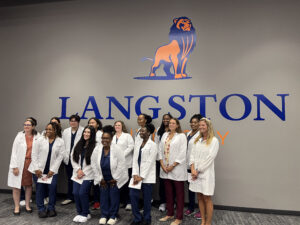
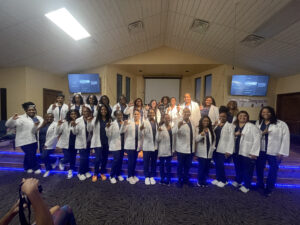
Students from the Langston University – Langston Campus received their white coats Thursday, Sept. 19, 2024.
A white coat ceremony is a rite of passage for students entering medical professions, such as nursing. The School of Nursing and Health Professions holds white coat ceremonies when students begin their clinical studies in their junior year. Students recite an oath to acknowledge medicine’s central obligation of caring for patients and are given their white coats. White coat ceremonies are common practice throughout the United States and in 19 countries.
Thirteen students received their white coats at the LU-Tulsa ceremony on Tuesday, and 25 students received their white coats at the Langston campus ceremony on Thursday.
The School of Nursing and Health Professions offers an accredited Bachelor of Science in Nursing (BSN) at the Langston and Tulsa campuses as well as the Ardmore Site. Additionally, the School offers an online RN to BSN program. LU’s nursing programs are accredited by the Accreditation Commission for Education in Nursing, and the nursing program has been accredited since 1987.
The online RN to BSN program is accepting applications for the fall semester through Sept. 30. The Tulsa and Ardmore sites will accept applications for Spring 2025 admission to the BSN program until Oct. 15. For more information, visit langston.edu.
LANGSTON, Okla. – Inasmuch Foundation has awarded Langston University a $200,000 grant for its “Forward Together Project,” a solutions-based media initiative designed to bring the historically rich and diverse communities within and surrounding its Langston, Tulsa, and Oklahoma City campuses.
Langston University is a historically black institution founded in 1897. With an enrollment of approximately 2,000, Langston University is the only HBCU in Oklahoma; and its core mission is education for service.
That dedication to service is at the heart of the Forward Together Project.
The history of Oklahoma, particularly the story of the Tulsa Race Massacre of 1921, is well documented, and its impact continues to be palpable, influencing perceptions, relationships and interactions among locals and people far beyond the region.
Through storytelling, social media tools, engagement analytics and community forums; Langston University’s Broadcast Journalism program, known for award-winning student work, will house the Forward Together Project. Students under the direction of professional journalists and professors will provide a collaborative platform for residents and civic leaders who, while ever mindful of the painful scars of the Oklahoma’s past, are inspiring hope and changing the narrative.
“We are immensely proud of the accomplishments of our students and our faculty. This generous gift will allow them to utilize their talents and training to advance this important work,” said Langston University President Kent J. Smith, Jr.
Inasmuch Foundation, based in Oklahoma City, champions journalism, education, human services, and community to improve the quality of life for Oklahomans. Founded by Edith Kinney Gaylord in 1982, The Foundation has funded programs and initiatives at several other universities, and this is the first project Inasmuch Foundation has funded at Langston University.
“The Forward Together Project will provide first-hand professional opportunities to Langston University journalism students,” said Robert J. Ross, Inasmuch Foundation Chairman and CEO. “Forward Together will produce impactful stories and showcase the beginning of a talent pipeline of Black Oklahoma journalists.”
Production on the project is expected to begin immediately, with the first stories expected to air sometime in mid-2023. Langston University is planning a community engagement event for early 2023 to solicit ideas for future projects.