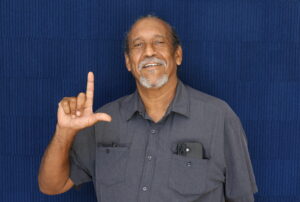
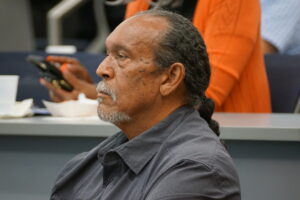
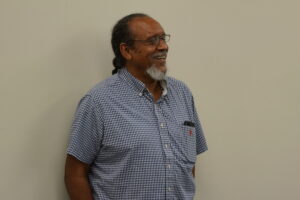
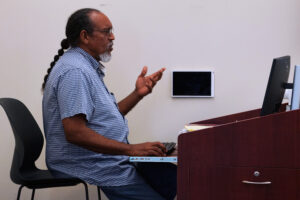
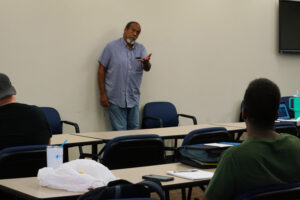
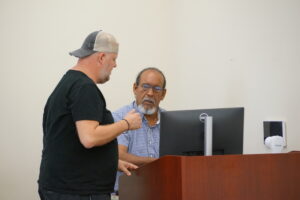
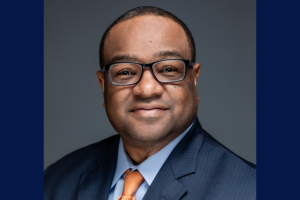
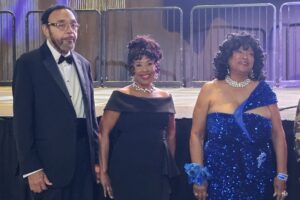
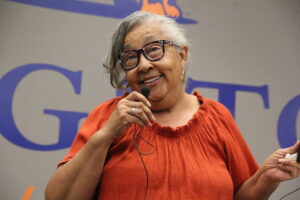
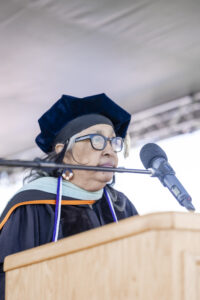
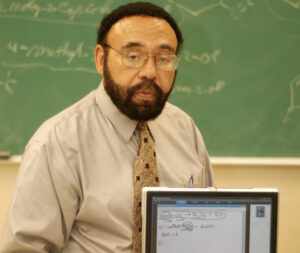
Dr. Charles Mambula was one of four economics professionals chosen to speak at the Renewed Hope USA General Meeting at the end of October, providing him the exciting opportunity to contribute to the discussion and share insights about how to grow and develop the Federal Republic of Nigeria.
Renewed Hope USA is a group concerned about the economic, infrastructural and social development of Nigeria. It is a group of Nigerians in the Diaspora from the United States, and it seeks to promote Nigeria’s Renewed Hope AGENDA. This includes finding ways to reform the economy to deliver sustained inclusive growth; focusing on education, health and social investment as to development; enhancing infrastructure and transportation as enablers of growth; and strengthening national security for peace and prosperity.
Dr. Mambula, who’s originally from Nigeria, is an associate professor in the LU School of Business. Because of Dr. Mambula’s previous work with similar groups, including ones with special interest in poverty alleviation, social and infrastructural development, and education, Renewed Hope USA invited Dr. Mambula to share his thoughts on how Nigeria can grow through Foreign Direct Investment (FDI).
“The presentation was basically to identify some of the progressive Foreign Direct Investment that is currently being carried out by the administration of President Bola Ahmed Tinubu and his team, while showcasing opportunities within the USA space and other parts of the world that Nigeria can take advantage of to help with the AGENDA for a better country,” Dr. Mambula said.
Companies or businesses participate in FDI when they invest in a company or business based in another country. For example, when foreign auto manufacturers open plants in the United States, that’s a form of FDI.
In his presentation, Dr. Mambula explained the benefits of FDI and shared his ideas for how Nigeria could promote FDI. As an expert on the topic, he was excited for a chance to present on FDI to an international audience. The General Meeting also offered an opportunity for Nigerian government officials and people close to government to have an opportunity to learn about his work.
Most importantly, he was excited for an opportunity to potentially contribute to the continued development and growth of his home country.
“I believe the global village idea for such a gathering will positively foster public engagement, showcase capacities and capabilities, and more importantly, promote opportunities for more collaborations,” Dr. Mambula said.
Standing at the front of the classroom on a Wednesday evening, Dr. Ruben Herron knows he’s exactly where he’s supposed to be.
As he leads the room of graduate students in an energetic discussion about client-provider dynamics in rehabilitation counseling, it’s hard to imagine there was a time when he felt like he didn’t have a calling. But for most of his early adulthood, Dr. Herron struggled to find his place in the world.
Throughout his 20s and 30s, Dr. Herron tried his hand at several careers, but he could never find a job where he felt truly fulfilled. Years of trial and error in various fields eventually brought him to Langston University to study rehabilitation counseling, and a chance opportunity years later brought him back to LU to teach. Now, he knows there was always a perfect career out there for him.
He just had to find it.
A Rough Beginning
Ruben Herron moved around a lot when he was a kid.
His family was from El Paso, Texas, but his dad was in the Army. As they accompanied him to each new duty station, the Herrons lived in places like Germany and England before eventually making their way to Wichita Falls, Texas.
Herron moved back to Wichita Falls after his time in the Marine Corps, but he had a hard time finding a job. Photo Credit: Craig Taylor Photo/AdobeStock
When Herron graduated high school, his father offered to pay for him to attend the local community college, but Herron didn’t want to go to school. He decided to enlist in the Marine Corps instead, and he spent a year in California at Camp Pendleton before he got out and moved back to Wichita Falls.
He returned to Texas during the 1980s “oil glut,” and work was hard to find. He took his dad up on his offer to pay for school, but Herron wasn’t a good student and soon dropped out. He got a job doing manual labor at a pipe yard until one Monday, he came to work to find out he’d been laid off.
“Suddenly, we all got pink slips,” Herron said. “And then there were no jobs in Wichita Falls because the big factory shut down. I mean, everybody was getting laid off.”
Herron and his wife decided it was time to leave Texas, so they moved to Tulsa, where his wife’s aunt lived. They arrived in two cars with three kids and a dog, and they were disappointed to find the job market wasn’t much better than it had been in Wichita Falls. Regardless, Herron was determined to provide for his family, and he finally found a part-time job as a sanitation worker.
It was hard, dirty and exhausting work, but Herron persevered. Eventually, he left the trash company for a job at Climate Control. He did his best to provide for his wife and kids, and he was grateful to receive government assistance during those days.
In the late ‘80s, Herron finally felt like he had a breakthrough. He found a new job as a maintenance man for an apartment complex, and he and his family moved out of government housing. For the first time in a while, they even had some money left over after their bills.
Herron and his wife began taking classes at TCC whenever they could afford it.
“They paid part of our rent at the apartment complex we was working at, and I was able to pick up a lot of overtime,” Herron said. “And so, we started to move up the ladder a little bit.”
During this time, Herron felt like he was starting to understand the importance of school. A better education could lead to a better job, and Herron wanted a better job. He and his wife decided to start taking classes at Tulsa Community College (TCC) together in bits and pieces as they could afford it.
Despite their improved circumstances, Herron’s success was short lived.
He felt dissatisfied with his life, and he began facing mental health issues. He sought out unhealthy coping mechanisms, and he ended up getting fired from the apartment complex. His marriage suffered because of it, and his wife left him.
Herron fell into a depression. He felt angry, hurt and frustrated, and he didn’t know what to do. He found himself involved in illegal activities, which led him to spend two and a half years in a correctional facility.
“Because of my own stubbornness, my own ignorance, my own selfishness, I chose the path I chose,” Herron said regretfully.
He felt like he had hit rock bottom, and he still has a lot of emotions to process when he thinks about that time. But he soon discovered the only thing to do was keep moving forward.
Never Too Late
When he was released from the correctional facility, Herron was determined not to go back.
He began working at Bennett Steel Inc. as a sandblaster, a job he thoroughly enjoyed because of how peaceful and almost meditative it was. He earned good money, and he felt like he was starting to move up in the world again. Most importantly, Herron met a man who would help him change his life: the company’s owner, Dave Bennett.
Seeing a counselor changed Dr. Herron’s life for the better.
Bennett was a great boss. He cared about his employees’ wellbeing, and he became a mentor for Herron. It meant a lot to Herron to have someone looking out for him. But as time went on, he found himself becoming restless again.
He liked his job and his boss, but he was still dealing with mental health issues. He still felt dissatisfied with his life. He began acting out in small ways, and Bennett noticed immediately.
Bennett wasn’t about to let Herron slip into old habits, so he convinced Herron to see a counselor.
“Through Dave Bennett’s help, I went and started seeing a counselor, which was really, really, really transformative,” Herron said. “She made me go there with myself, but she sort of held my hand. Like, ‘You know this is what you want. You know you want to let it out. Let it out. Trust yourself.’ And that was the biggest process.”
Counseling changed Herron’s life, and he found a kinder, softer version of himself. He learned how to take care of his mental health and how to cope with negative thoughts. He became someone he liked to be.
He continued to see the counselor while he worked at Bennett Steel, but the feelings of restlessness and dissatisfaction never went away completely. Once, he was having a particularly bad day when Bennett walked in, and he realized what he needed to do.
“Dave Bennett walks in, and I said, ‘Dave, will you loan me $375 bucks so I can go back to TCC?’” Herron said. “And he reached in his pocket and said, ‘Yeah.’ So that’s how I started back at TCC.”
In 2001, Herron went back to school. It was hard to study while working full time, and he faced some unexpected challenges, such as rapidly changing technology, but he was determined to see it through.
In 2004, he left Bennett Steel for a job at 12&12 as part of their substance abuse group counseling team, and he finally felt like he had found a calling. This motivated him as he continued his classes at TCC, especially when he worked two jobs in 2006 to buy his first house. In 2009, Herron graduated from TCC.
“I earned my associates after 28 years,” Herron said. “I earned my associates, and I didn’t know what to do. Then, a classmate of mine suggested I come up here (to Langston University), and I met Dr. (John) Sassin, and within five minutes of walking through his door, I was enrolled in the bachelor’s program.”
After earning his associate’s degree at TCC, Dr. Herron enrolled at Langston University and earned his bachelor’s degree in Rehabilitation Services before going on to earn his master’s degree in Rehabilitation Counseling.
Keeping the Momentum
Herron had learned he could be a good student, and he wanted to keep his momentum going as he pursued a career in counseling. He enrolled at LU-Tulsa in the rehabilitation services bachelor’s degree program in 2009, and he had a better college experience than he could have imagined.
A generous scholarship relieved him of the financial burden of his degree, and he felt like the doors to an untold wealth of knowledge had been opened. His professors became cherished mentors, and he truly understood what it meant to be part of the LU family.
In 2011, Herron had the great honor to walk across the stage at Langston University’s graduation ceremony with his daughter. A couple of months later, he was back in the classroom again as a student in LU’s rehabilitation counseling master’s program.
He continued to work at 12&12, and he continued to enjoy school. One day, Dr. Mary Ramey, an adjunct professor in the rehabilitation counseling program, kicked her shoes off in the middle of class and sat on a table. That behavior baffled Herron, who had always thought of academics as more formal and aloof. But Dr. Ramey seemed normal.
“It just sounds so strange, but that’s what it was to me,” Herron said. “And she looked right at me on that table and said, ‘You could be (a doctor) if you want to.’ And that’s the night it started. She inspired me.”
After that class, Herron contemplated pursuing his doctorate for weeks until one night, he realized that if he wanted to do it, he couldn’t wait.
The day after making that decision, he told Dr. Sassin about his new goal. Having taught and advised Herron for almost four years, Dr. Sassin was supportive of his plan. He helped Herron connect with faculty at the University of Arkansas, and after graduating with his master’s from LU in 2013, Herron enrolled in the University of Arkansas’ doctoral program in counselor education and supervision.
Dr. Herron returned to Langston University as a professor in the very program he graduated from, and he loves teaching and providing mentorship to students.
Herron went to school part time, making the two-hour drive to Fayetteville twice a week. It was difficult, and he even ended up sleeping in his car some nights, but he persevered. In 2017, he officially earned his professional counseling license and began working on his dissertation with Dr. Ramey as his dissertation committee chair.
Everyone Has a Place
Unbeknownst to Herron, other LU faculty had been keeping track of his progress throughout his doctoral program, too. In 2017, a faculty position opened in the LU-Tulsa rehabilitation counseling program, and Dr. Phillip Lewis reached out to Herron to invite him to apply.
“He had already gained his CRC and his LPC, which he is a Certified Rehabilitation Counselor and a Licensed Professional Counselor,” said Dr. Lewis, the graduate coordinator for the rehabilitation counseling program at LU-Tulsa. “So, it was a perfect fit for me to bring Dr. Herron in to fulfill that role, because I didn’t lose anything. I just kind of transitioned, and I didn’t have to worry about a person not having the credentials.”
Dr. Herron had never imagined he would become a teacher, but the opportunity to come back to Dear Langston was too good to pass up. He has thrived in the role since then.
Dr. Herron’s teaching style draws a lot on his own life experiences. As someone who has received counseling, administered counseling and studied counseling extensively, he brings invaluable insights into the classroom. His classes are often filled with lively discussions, and students walk away feeling like they’ve learned.
As both a friend and supervisor, Dr. Lewis loves working with Dr. Herron. According to Dr. Lewis, Dr. Herron’s unwavering positive attitude often lifts the spirits of the whole office.
“He’s been an excellent colleague, and to be honest with you, I don’t think I could’ve found better,” Dr. Lewis said. “Him working here, he’s a product of this program. He’s homegrown, you know. And I think it’s a blessing to kind of work your way back home sometimes.”
After so many years of struggling with feelings of dissatisfaction in his life, Dr. Herron is proud to say he loves his job. He has found a balance between work and his family, and all eight of his dimensions of wellness are being fulfilled.
When he was a young man, he never could have guessed where he’d be today. He loves teaching because it allows him to pass down the mentorship that he, too, received at LU, and he feels like he’s giving back to his community. Now that he has found his place in the world, he has no plans to slow down any time soon.
“I would say to young people, old people, it’s never too late,” Dr. Herron said. “If you look at all the possible jobs out there, there is a job for you that you can be passionate about, that you can enjoy doing. So don’t give up. Stay encouraged. Have some faith and trust yourself.”
Dr. Herron loves his job, and he knows that he has finally found his place in the world.
Six Langston University faculty researchers from various departments came together to share their research and graduate school experiences with students during a discussion panel on Nov. 11, encouraging students to get involved with undergraduate research and providing insights on how to do so.
“It was just an opportunity for us to let (students) know that we also go through these different steps,” said Dr. Desmond Delk, the coordinator and moderator for the event. “They, too, can do it, and we’re resources for them. And really, the main thing is to also get them interested in research and let them know how research looks different.”
Dr. Delk, the chair of the Department of Health, Physical Education and Recreation (HPER), brought together faculty with a variety of research interests for the “Scholarly Works in Progress: An Early Career Perspective” research panel. Dr. Chukwuebuka Ezeakacha, the director of LU choral activities; Dr. Lindsey Davis, the chair of the Department of Chemistry; Yaisa Mann, a professor in the Department of English; Dr. Brittany Mays, a professor in the HPER Department; Dr. Emisha Maytubby, the chair of the Department of Family and Consumer Sciences; and Alexis Montague, a professor in the Department of Public Health, all participated in the panel.
The panelists talked to students about their educational and research backgrounds, which covered topics ranging from sub-Saharan African music to infectious diseases. The faculty members discussed why they chose to pursue their areas of study and research interests, some of the challenges they’ve had to overcome while conducting research, and then answered student questions about research.
Junior biology major Kiaorie Stewart-Ricks already has some experience conducting research thanks to an internship he had this past summer, and he plans to continue pursuing research as he works toward his goal of becoming a sports physician. He was excited for a chance to listen to the LU faculty’s stories, especially those who are themselves LU alumni.
“I wanted to just come see my fellow researchers that are alums of Langston (University) and see what their challenges were doing research and the things they went through,” Stewart-Ricks said. “I thought maybe I could get some insight through their challenges.”
Providing students insight into life as a researcher was part of Dr. Delk’s goal when he coordinated the event. He wanted to give students a chance to learn about what LU’s faculty do outside of class, and he hoped they could inspire some of the students to get involved with research early.
Cynsere Boyd, a senior public health major with a minor in corrections, came to the event because she hoped to hear some advice about how to manage research and school. Like Stewart-Ricks, she enjoyed listening to the faculty members’ stories, and she appreciated the advice they shared regarding mentors and peer collaboration.
“I think the panel was a great opportunity to show us how we can make it through college and find other routes for grad (school) and figure out how to make connections with different peers,” Boyd said.
As an 1890 land-grant institution, Langston University takes pride in the high-quality research conducted at all three campuses, and there are countless ways for students of any year or major to get involved with research during their time at LU. Scores of students attended the mid-day panel, proving that research is a big draw for many students.
Dr. Delk made sure to take advantage of the time they had with students to not only share the panelists’ research, but also to share summer research internship opportunities. Many students expressed appreciation for this addition as well as for the advice the faculty shared.
“I think it went well,” Dr. Delk said. “The faculty members gave some great insight. Some of the students had some good questions. We connected them to resources, summer programs, we gave them access to some of our own personal publications.
“So, I’m encouraging students to ask questions, connect with people, and just dive into this idea of research.”
OKLAHOMA CITY––Dr. Corey Moore, a Professor and the Founding Chair of the Langston University Department of Rehabilitation and Disability Studies, received the 2025 Bobbie Atkins Distinguished Research Award from the National Rehabilitation Association at their national conference on Oct. 1.
The award, named after prominent rehabilitation researcher Dr. Bobbie J. Atkins, is a recognition of quality research from individuals or organizations which has an impact on improving services to people with disabilities. Dr. Moore was recognized for his distinguished record of research and publications, which have had a particularly strong impact on those with the most significant support needs.
“Dr. Atkins was truly a trailblazer and a giant in our field,” Dr. Moore said. “I proudly stand on her shoulders and carry her legacy of research in disability and rehabilitation.”
In addition to his roles as a professor and department chair, Dr. Moore serves as Founding Executive Director at the Rehabilitation Research and Training Center (RRTC) on Research and Capacity Building for Minority Entities and the RRTC on Advancing Employment Equity for Multiply Marginalized People with Disabilities, both at Langston University. In these roles, he has shown a long-standing commitment to research leadership and advocacy in the field of disability and rehabilitation.
He has also served as the principal investigator on twenty-three different research, training and service grants from the U.S. Department of Health and Human Services and the Department of Education, which total over $33 million. He is an author or co-author on over 90 peer-reviewed articles published in refereed professional trade journals, monographs and policy briefs.
In addition to his exemplary record of research and publications, his expertise has been recognized at the highest levels, as evidenced by his past appointments to federal agency bodies, including the advisory committee for the director of the National Institutes of Health (NIH).
Dr. Moore’s work continues to have a profound impact on the field as it helps shape policy, professional practice and academic scholarship.
In accepting this award, Dr. Moore acknowledged the contributions of all core RRTC investigators, official collaborators and mentors from various institutions, and he thanked Langston University President Ruth Ray Jackson and her administration for their ongoing strong support.
Langston University employees and alumnae were honored at the Fourteenth Annual Ceremony and Banquet of the Oklahoma African American Educators Hall of Fame on Friday, Sept. 26.
The honorees included recent Langston University retiree Dr. John K. Coleman, alumna Mrs. Carolyn Gay Harris, alumna Dr. Jolly Henderson Meadows, and former Langston University professor Dr, Melvin B. Tolson, who was honored posthumously.
Dr. John K. Coleman
Dr. Coleman attended LU from 1961-65, graduating with honors and earning a Bachelor of Science degree in Chemistry and Mathematics. He continued his education at the University of Oklahoma, where he earned his Ph.D. in Theoretical Physical Chemistry in 1976 and completed post-doctoral studies in 1978. After some time away, Dr. Coleman returned to Langston University in 1993 at the request of the late President Ernest Holloway to serve as the Chair of the Department of Chemistry and Physical Sciences.
Over the past three decades, Dr. Coleman not only served as chair of the Department of Chemistry, but his impact also extended beyond academic metrics. For generations of Langston University students, he has been a mentor, advocate and example – a leader who never stopped believing in the transformative power of education. Many of his former students are now faculty members at Langston University in the Chemistry or Biology Departments, shaping new generations in the same spirit he so faithfully modeled.
Dr. Coleman was appointed the interim dean of the School of Arts and Sciences in 2023, and he retired at the conclusion of the 2024-2025 school year.
Mrs. Carolyn Gay Harris
Mrs. Harris joined Langston University as a majorette in the Marching Pride, which was known at the time as the Langston Lions Band. Her time at Langston University was marked by academic achievement as she earned her Bachelor of Arts degree, laying a foundation for her future career in education. Pursuing further academic excellence, she completed a Master of Education degree at the University of Central Oklahoma in 1974.
Mrs. Harris began her professional journey at Spencer High School in Spencer, Oklahoma, where she taught for five years. Her commitment to shaping young minds extended to middle school classrooms for six years, and thereafter to administrative roles as both elementary and middle school principal for another six years. Her dedication and expertise culminated in her leadership as an elementary school principal for a remarkable 16 years. These decades of service reflect a career that spanned a total of 33 years, during which she touched the lives of countless students, faculty members and families.
Dr. Jolly Henderson Meadows
Dr. Meadows earned her Bachelor of Science degree in Elementary Education in 1974 from Langston University, followed by a Master of Education degree in Reading from Northeastern State University in 1979. She obtained a Master of Education degree in Leadership from Northeastern in 1986 and her Doctor of Education degree in Educational Leadership from Oklahoma State University in 1997.
Dr. Meadows began her 51-year career in education at Liberty Elementary in Sapulpa, Oklahoma. She joined Tulsa Public Schools in 1975 when she accepted a teaching position at Riley Elementary School, and she was appointed assistant principal at Patrick Henry Elementary School in 1986. After two years she was appointed principal – a position she held for 23 years. In 2006, Tulsa Public Schools took notice of the impressive academic growth Patrick Henry Elementary School showed under Dr. Meadows’ tenure and assigned her to Monroe Middle School. She was transferred to Gilcrest Middle School in 2007.
As an administrator, Dr. Meadows was known for utilizing innovative and reliable programs with proven outcomes to achieve academic gains. She employed a collaborative approach to empower teachers to become leaders, to disaggregate test data and to research supplemental instructional materials. She retired from Tulsa Public Schools in 2009 and worked as an adjunct professor of urban education in the undergraduate and graduate programs at Langston University–Tulsa. She accepted a full-time position as an Assistant Professor in the Department of Education at the University of Tulsa.
Dr. Meadows is also the vice president of the Langston University National Alumni Association-Tulsa Chapter (2021-present).
Dr. Melvin D. Tolson
Dr. Tolson taught English and speech at Wiley College in Marshall, Texas, for nearly two decades. In addition to teaching English, he established an award-winning debate team, the Wiley Forensic Society, which became a pioneer in interracial collegiate debates. Beginning in 1930, the team debated against law students from the University of Michigan in Chicago. In 1931, the team participated in the first known interracial collegiate debate in the South against Oklahoma City University. This is the story that inspired the film “The Great Debaters,” starring Denzel Washington.
Dr. Tolson took a sabbatical from teaching in 1930 to study for a master’s degree at Columbia University in New York City. His thesis project, “The Harlem Group of Negro Writers,” was based on his extensive interviews with members of the Harlem Renaissance, which inspired him to write “A Gallery of Harlem Portraits,” his first major work.
In 1947, Dr. Tolson relocated to Langston University, where he taught English, drama, and was a dramatist and director of the Dust Bowl Theater. Students described Tolson as eccentric, driven, fearless and radical. It was not unusual for him to stand on top of a desk and jump off to engage and challenge students during lectures. While at Langston University, Dr. Tolson was elected to multiple terms as mayor of Langston City.
Dr. Tolson’s career in education at the collegiate level spanned 43 years. He died in Dallas, Texas, on Aug. 29, 1966, and is buried in Guthrie, Oklahoma. His award was accepted by Dr. Cindy Ross, Chair of the LU Department of English and Foreign Languages in the School of Arts and Sciences.
Every year on Mother’s Day, Dr. Emily Patterson Harris gets a call from one of her former students.
When that student was younger, he attended and dropped out of two colleges, but Dr. Harris wasn’t having it.
“It took me two years to talk him into coming to Langston University and giving it another try,” Dr. Harris said. “And he did. We had some rough times in there, but he finished, and he calls me on Mother’s Day.”
Not all of her student interactions have been as friendly.
Once, while walking down the stairs at the LU-Tulsa campus, a student stopped Dr. Harris to talk. She knew the student sometimes struggled to balance his schoolwork with his responsibilities as a father, but she also knew he was capable of it.
“He stopped me, and he said, ‘Well, I want you to know that I’m going to graduate, if for no other reason than to get you off of my back,’” Dr. Harris said. She responded with an upbeat, “OK!”
That student did graduate, and he went on to earn his master’s degree, too. She still sees him and talks with him occasionally.
Dr. Harris has countless stories like these because she’s been working with students for over 40 years. She has worked tirelessly to develop well-defined and relevant programs that will help students get jobs after graduation, and she has also worked to make sure students make it to graduation. From working with them in the classroom to advising those who left to figure out how to come back, Dr. Harris doesn’t give up on her students. She cares about them, and she knows that for many, earning their degree will change their life.
Education is Transformative
Dr. Harris has always believed in the power of education, and she understands better than most that the transformative effects of earning a degree can be felt for generations. Her own family is a prime example. Her maternal grandmother, Emily Alford, only had an 8th grade education, but she was determined to send her children to college. They came to Langston University.
Violet Alford, Dr. Harris’ mother, graduated from Langston University with a B.S. in Business in 1950.
Dr. Harris’ mother, Violet, graduated from Langston University in 1950 with a B.S. in Business. Her father, Lee V. Patterson, Sr., graduated from LU that same year with a B.S. in Industrial Arts. They both had successful teaching careers in Oklahoma, and they made sure their children understood education was important. The message was echoed by Dr. Harris’ aunts and uncles as she and her cousins prepared to go to college, and they eventually passed the message along to their children, too.
Today, the younger generations of the family understand that education is transformative, and Dr. Harris’ son Erick said they all expect to go on to earn the highest-level degrees available for their chosen professions. Four generations after Emily Alford, the average degree in the family is a masters.
“I go back to that initial decision that my grandmother made that a college education was important,” Dr. Harris said. “That one decision has impacted generations of my family.”
It has also, in turn, allowed Dr. Harris to impact thousands of others.
Dr. Harris graduated from her father’s alma mater, Booker T. Washington High School in Tulsa, Oklahoma, but she did not follow in her parents’ footsteps to attend Langston University. Instead, she chose to attend Central State University in Wilberforce, Ohio, and her experiences there reinforced her beliefs about the power of HBCUs. She went on to earn her Master of Library and Information Studies from the State University of New York at Buffalo before moving to Texas to serve as a librarian at Houston Community College.
After a three-year stint in Houston, Dr. Harris came home to Oklahoma. Thanks to the efforts of Dr. Roosevelt Mack, she officially joined the Lion Pride as a librarian at the LU-Tulsa campus in 1981.
Building Something
Langston University’s Tulsa campus opened in 1979. It was the first public institution to offer graduate and upper level higher education courses in Tulsa.
The Langston University-Tulsa campus had been established just two years prior when Dr. Harris joined the staff.
It was the first public institution to offer upper-level higher education classes in Tulsa, and in 1982, it worked together with Oklahoma State University (OSU), the University of Oklahoma (OU) and Northeastern State University (NSU) to form the University Center at Tulsa. Still a firm believer in the importance of education, Dr. Harris was excited to be a part of bringing access to higher education to her hometown.
Serving as a librarian for all academic programs gave Dr. Harris an opportunity to work closely with the students in Tulsa, and she found she enjoyed getting to know them while helping them access the materials they needed for their classes. She was good at her job, and she was soon asked to move to the Langston campus to serve as the Acting Director of the G. Lamar Harrison Library while the school looked for a permanent director.
When she returned to LU-Tulsa a year later, she knew she was ready to take on more responsibility.
She transitioned from the library to a position as an academic counselor. It was around this time that Dr. Wessylyne A. Simpson, Dr. Harris’ aunt who was then the Dean of the School of Education and Behavioral Sciences (SOEBS), was working to expand the program offerings at the Tulsa campus. Dr. Harris worked with Dr. Simpson, SOEBS faculty and Diana Sharp to bring the Teacher Education program to Tulsa.
“We worked on paperwork and made sure we had all the bylaws and everything set up before we could start recruiting students,” said Sharp, who still works at LU-Tulsa as an administrative assistant. “We all put our heads together and started the program here, and it’s taken off ever since.”
Diana Sharp (right) has worked with Dr. Harris since she joined the LU-Tulsa staff in 1983.
Sharp liked working with Dr. Harris right from the start. Her first impression of Dr. Harris in 1983 was of a peppy, happy-go-lucky person who was very easy to talk with. Forty years later, Sharp said that’s still how she’d describe her.
This was the first of many projects Sharp and Dr. Harris would work on together over the years, and Sharp said she appreciated Dr. Harris’ positive attitude and her willingness to try several approaches until they found one that would work. She also appreciated that Dr. Harris knew how to leave work at work, allowing them to form a personal friendship in addition to a professional one.
Thanks to their hard work, they were able to bring the Teacher Education program to LU-Tulsa in 1985. The program was housed on the seventh floor of the building they shared with OSU at 440 S. Houston St., and Dr. Harris took on the role of Associate Director for Teacher Education at LU-Tulsa.
For 12 years, she supervised the teacher education program at the Tulsa campus. She loved working with students and continued to serve as an advisor. In 1986, she also began teaching as an assistant professor in SOEBS, focusing mostly on psychology and education courses.
She went back to school and earned her Ed.D. in Higher Education Administration from OSU in 1989, and she said she is eternally grateful to the late Dr. Mack for his continual support throughout this time as she juggled work and doctoral coursework. She also wanted to thank Dr. Ernest L. Holloway, LU’s longest-serving president, and Dr. C. Gary Crooms.
“There’ve been powerful leaders, master teachers and mentors that encouraged me and were great at their chosen fields,” Dr. Harris said. “The late Dr. Holloway continually focused on challenges as opportunities. Dr. Crooms taught me to look at those challenges from multiple perspectives.”
Dr. Harris finished her doctorate, completed additional coursework in Behavioral Sciences and became certified to teach Social Studies, Language Arts and Library Media. She took her mentors’ lessons as well as everything she’d learned from her own classroom experiences as both a teacher and student to try to continually improve her own classes.
“What I loved about teaching is just the fact that there’s always more information,” Dr. Harris said. “And I’m a librarian, so I love looking for information. You can never get tired of finding new things or new ways of doing things, and sometimes your students will send you off in a different direction.”
Students First
Dr. Harris (far right) served as the Associate Vice President for the LU-Tulsa Campus for almost 12 years.
Dr. Harris was dedicated to her work, and that’s something to which her family can attest. Her two sons spent a lot of their free time at the LU-Tulsa campus and witnessed how hard their mother worked for the students there.
One day, an 8-year-old Erick approached Dr. Virginia Schoats, the campus site director, and told her as much.
“My mom was always working hard,” Erick said. “I had just found out what the word ‘promotion’ meant, and once I realized that I said, ‘Oh, well she deserves one of those.’ And because (Dr. Schoats) was her boss I thought, ‘She’s the one that can give it to her.’”
Not long after, Dr. Schoats did recommend Dr. Harris for a promotion.
In 1997, she became the Associate Vice President for LU-Tulsa, the person who ran the campus. She also served as the Institutional Representative for Langston University to the University Center at Tulsa, advocating for the needs of LU students and faculty while working to improve access to higher education for all Tulsans.
Though her duties and responsibilities changed, her goal stayed the same: to guide students to degree completion.
At this time, the average age of the students at LU-Tulsa was about 34. Dr. Harris recognized early on that their needs would be different than the needs of students at the Langston campus, so she tried to keep their work and familial responsibilities in mind. She, the faculty and staff in Tulsa tried to make it as feasible as possible for students to take classes, offering everything from a bookstore to a registrar’s office on campus so students wouldn’t have to make the drive to the Langston campus.
“We had it set up making sure that once they got out from work, we had every avenue for (students) to be able to take courses so that they would still be able to graduate,” Sharp said. “We made sure the students were happy and taken care of, no matter how many different hats we had to wear.”
Dr. Harris’ motto was to meet students where they were and never take anything personally, and she gave that advice to her student teachers as well as her faculty.
She understood that students, the same as everyone, had challenges in their lives outside of class and were sometimes prone to take that out on their teachers. But she also knew she had to look past that in order to assist them, and she was determined to help them.
“We’re all works in progress,” Dr. Harris said. “I emphasize that we each have our own individual paths.”
Dr. Harris has always done everything in her power to help students make it to graduation.
Students drop out of college for all sorts of reasons. Sometimes they don’t feel they have time to go to class. Sometimes they can’t afford it. Sometimes they just don’t want to do it anymore. If a student dropped out of LU-Tulsa, Dr. Harris wanted to know why.
She would contact them to follow up on why they chose to leave school. Then she would encourage them and brainstorm solutions.
“She would make those calls, and once she got them here, she would do all the rest of it,” Sharp said. “She was making sure that students were taken care of and just trying to get them to realize that, you know, ‘You’re so close. Don’t lose this.’”
Many students returned to school thanks to Dr. Harris’ efforts, and many other students stayed in school for the same reasons.
Dr. Harris recalled that once, an alumnus whom she hadn’t seen in years walked up to her and abruptly told her that he used to hate her. Unflappable as always, she simply responded, “Oh, you did?” He said he really did.
He told her he used to complain about all the work she made them do in her classes. He didn’t appreciate all the readings, essays and other homework she assigned, and it made him resent her during his time as a student.
“And then he said, ‘I just wanted to tell you that I earned my masters,’” Dr. Harris said. “And he told me the program he’d gone through, and he said, ‘If it hadn’t been for you, I would not have made it through that program. And I just wanted to come back and share that with you.’
“That’s the beauty, I think, about Langston University, no matter the campus. There is just a history of balancing those two things of nurturing a student but also having great expectations for those students. ‘LU graduates around the globe serve as leaders, innovators and engaged citizens,’ to quote our vision statement.”
A Lasting Legacy
Dr. Ruth Ray Jackson said Dr. Harris embodies the Alpha Kappa Alpha Sorority, Inc., motto: Service to All Mankind.
In 2008, Dr. Harris became the “Gear Up” Program Director and Coordinator for the Department of Psychology at LU-Tulsa. She worked closely with Tulsa Public Schools to design and deliver programs meant to encourage college attendance and completion at Tulsa-area middle and high schools while continuing her work as a professor and the leader of the psychology program in Tulsa.
In 2018, she was appointed Chair of the Department of Psychology for all LU campuses, and in 2019 she became Dean of the School of Education and Behavioral Sciences. She has also served, when the need arose, as Acting Dean of University Libraries. Throughout it all, she has continued her efforts to help students learn and make it to graduation.
“Dr. Harris has done a phenomenal job,” President Ruth Ray Jackson said. “Even in her role as Dean, she continues to advise students and to meet with transfer students. Of course, she’s now in a position where she’s solving problems and listening to complaints and concerns from both students and faculty, but she’s consistently energized and ready to meet somebody and help them get to where they want to go.”
Dr. Harris has become known for the positive energy she brings to projects and her willingness to try several routes until she finds the one that will work. Dr. Jackson called her a creative problem solver, and she’s had a lot of experience doing it.
During her 44 years at Langston University, Dr. Harris has tackled lots of challenges, from redesigning curricula to helping develop completely new ones. Though she has almost 40 years of teaching experience, she continued trying out different teaching strategies up until she taught her last class in 2024 because she knew there was always room for improvement. She knows Langston University inside and out, and she has made a lasting impact.
“My mother is one of the most encouraging people that I’ve ever known,” Erick said. “She supports you, but there’s a nice edge to her that will push you and encourage you to keep moving forward. And that’s what she’s done at Langston University.”
Throughout her career, Dr. Harris has been the model of a servant-leader, both in her personal and professional life.
Her youngest son, Christopher, said he’s grateful to have grown up with Dr. Harris as a role model because she inspires him to try to be a leader in his own industry, noting that he often models his own behavior after her in professional settings. He also recognized that his mother’s career at LU has always gone beyond her job descriptions.
“You recognize the sacrifice almost after the fact,” Christopher said. “She could have had positions and titles that would’ve paid more at other institutions and in other states, but not everything is about financial gain.
“It’s having us grow up around our grandparents, and from a career perspective, it’s saying that you can have a positive impact on people’s lives and be that role model of what leadership looks like.”
She is a longtime member of Alpha Kappa Alpha Sorority, Inc., and Dr. Jackson, a fellow AKA, said Dr. Harris embodies their sorority’s motto: Service to All Mankind.
Dr. Harris said it’s not hard to find ways to serve because they will usually find you. Now, after four decades of service to Dear Langston, she is finally ready to retire. Her last day will be June 30, though she jokes it will really be “the 12th of never.”
“I’m sure I will (miss teaching),” Dr. Harris said. “But I’m sure that I can find all kinds of creative things to do.
“I say, ‘Don’t look back. You’re not going in that direction.’”
Dr. Harris will retire from Langston University after 44 years of service on June 30.
By Jet Turner, Assistant Director of Communications
Dr. John Coleman received a call from the fourteenth president of Langston University, Dr. Ernest Holloway, in 1993. Holloway’s gregariousness led their conversation all over the place, but his message was clear: the students at Dear Langston needed additional support.
Coleman left his position as an assistant professor at Hudson Community College in New Jersey after that summer and journeyed back to his home state of Oklahoma. He only planned to stay for a couple of years, but his dedication to helping students be their best kept him on Langston University’s campus. After 32 years of service and mentorship, Coleman will retire at the conclusion of the 2024-2025 academic year.
His career as the Chair of the Department of Chemistry at LU has been dedicated to teaching science, technology, engineering and mathematics (STEM) subjects and equally to seeing that students learn to excel in academics and life. His influence can be seen all over the University and, more importantly, in its students.
Beginnings
Coleman grew up around educational excellence in Boley, Oklahoma.
Today, the historically Black town might seem unassuming, but when Coleman was growing up in the 1940s and ’50s, the town was described by Booker T. Washington as the “finest Black town in the world.” Many of the individuals Coleman grew up around had their doctoral degrees or some other form of higher education, including his parents.
Boley’s significance in education parallels no other Black town in the nation, historian Currie Ballard said in a 2017 article by The Oklahoma Eagle.
This meant Coleman was always surrounded by excellent teachers. One of whom was Holloway, his future president, who taught chemistry at Boley Junior High in the 1950s.
“Holloway knew what was happening in Boley and how we got prepared,” Coleman said. “You always have someone who is going to help you. You didn’t have to rely on just your resources at home.”
Community is where Boley found its strength, and Coleman carried that lesson with him throughout his academic career.
Coleman always expected to go to college, and Langston University was a natural choice.
Coleman began his freshman year at Langston University during the 1961-1962 academic year.
He began his freshman term during the 1961-1962 academic year. Buildings like Sanford Hall and Moore Hall still stood proudly where they are today, although their functionality was different from their modern day uses.
During his time at LU, he served as the freshman class president and was a brother of Alpha Phi Alpha Fraternity, Inc. Even though LU had been around for almost 75 years by the time Coleman graduated in 1965 with his bachelor of science in chemistry and mathematics, students still had to march at the Oklahoma State Capitol every year to fight for the university to remain open. Coleman was an active participant in these efforts.
Just as obtaining his undergraduate degree was expected for Coleman, working toward an advanced degree was a natural next step. He began his PhD in Theoretical Physical Chemistry at the University of Oklahoma in 1972.
OU was still integrating, and undergraduate Black students especially were facing discrimination at the hands of some students and employees. Coleman became a graduate advisor to the Alpha Phi Alpha chapter on campus during this time.
“There were cannons pointed south and all kinds of things going on,” Coleman said. “But we did a lot of things with students to try to help students feel more comfortable. We did a lot of tutoring. We did a lot of whatever, trying to make the students come in and be successful.”
Growing up in a Black town and attending a Historically Black University helped Coleman understand the importance of community. At every opportunity, Coleman shared that community with others.
Coleman graduated from Langston University in 1965.
He earned his PhD in 1976 and concluded his postdoctoral studies at OU in 1978.
Coleman was briefly a researcher at Halliburton Company before traveling east to become an assistant professor at several local institutions. First at Bergen County Community College in Paramus, New Jersey; then at City University of New York, and finally at Hudson Community College, where he received that call from Holloway.
Returning Home
Upon returning to Langston University, Coleman immediately got to work.
Coleman’s years of experience teaching STEM courses provided insights into the problems that frequently impede student learning. He encountered students’ wide-spread practice of what he calls “plug ‘n play.” Plug ’n play is when students use a solved “example” problem as a model and plug in variables from the new problem to find a solution. This bypasses the need to learn and apply core concepts.
Coleman developed and adopted instructional strategies embedded in a process he calls Competency Performance Recording for Learning (CPR-L). His CPR-L teaching and learning process has had a positive impact on student academic performance for his over 30-year career at Langston University and is the basis for how he approaches educating his students.
Dr. Alonzo Peterson, Vice President for Academic Affairs, witnesses Coleman’s commitment to Langston University’s students almost daily. Coleman can often be found on campus until 9 p.m. or later, depending on how many students still need help.
“He’s by far one of the smartest people I know,” Peterson said. “His ideas are very, very innovative. He spends a lot of time with students, hours and hours.
“One of the things I recognize from his tutoring processes is that he doesn’t give students answers. Students may ask, ‘how do you do this?’ and he responds, ‘well, how do you think we do it?’ And then he will go back and talk through the problem for them to solve it, not him. Some people are dispensers of knowledge, he is a facilitator of knowledge.”
In 2003, Coleman received a grant from the National Science Foundation which started Langston’s Integrated Network College (LINC) for STEM program. This program provided scholarships for students in STEM fields and required them to participate in research on campus and across the country. They would then present that research at conferences.
The goal of the LINC program was to produce more minority students in STEM fields who would then earn their doctoral degrees. This program was exceedingly successful.
LINC boasted a 92% graduation rate, with 60% of those students going on to earn graduate degrees. Many of these were earned at major universities that include Vanderbilt, University of Kansas, University of Texas, Baylor University, Johns Hopkins and more.
The students’ participation in summer research internships at institutions that include Johns Hopkins, University of Texas, Stanford, Cal Tech, University of California at Berkley, University of Oklahoma and more. Their research work generated over 300 Abstracts. Their participation in competitive research presentation events throughout the U.S. earned over 50 top awards.
These STEM professionals now hold prominent positions in both industry and education, including achieving success as entrepreneurs.
According to RTI International, of the STEM PhDs awarded in the U.S. in 2021, 5% went to Black scientists, even though the U.S. population is 12% Black, showing the disparity in the field.
Coleman was also encouraging students to stick with the STEM field, even if they did not think it would be for them.
Dr. Ryan Johnson, a former chemistry major and now professor at Langston University, was one of these students.
When Johnson began attending LU in the early 2010s, he was not interested in attending college, much less becoming a chemist. Even though he showed up to Dear Langston as an undeclared major, a mistake in the system had him listed as a chemistry major.
Wanting to change his major, Johnson was told to speak with Coleman before deciding.
That one conversation changed his life.
“He convinced me to stay,” Johnson said. “He told me I was doing well in my other STEM classes, and I was on track to take Chem I anyway. I took it the following semester and ended up staying with chemistry. Kind of weird, right? How those little conversations can change the trajectory of your life.”
As part of the LINC program, students had to at least apply for graduate schools as their undergraduate degrees concluded. Johnson had no intention of earning his doctorate, but another conversation with Coleman convinced him to apply to Louisiana State University, one of the leading producers of doctoral-prepared Black chemists in the nation.
Coleman was a member of Alpha Phi Alpha Fraternity, Inc. during his time at Langston University.
Innovation was another one of Coleman’s missions in the classroom.
Coleman was an early adopter of integrating technology into the classroom at Langston University, something that stood out to Dr. Byron Quinn when he was being taught by Coleman at Langston University.
“Even back in the early ’90s, at the beginning, he was at the forefront of this,” Quinn said. “He was working with really the first iteration, first generation, of tablets and PCs in the classroom, so that students could write and do homework on them and digitally turn them in.”
But Coleman’s impact is much farther reaching than the borders of Langston University’s campus.
About a year after his return to teaching at LU, Coleman set out to build strong science and math foundations when he received a grant to establishthe Langston University Summer Math and Science Academy.
It was here, when she was 14 years old, Dr. Lindsay Davis met a Black chemist for the first time in her life.
She hated chemistry.
“It was the hardest thing ever,” Davis said. “But Dr. Coleman had such an eloquent way of communicating chemistry. And so, by the end of that camp, I knew I wanted to be a chemist.”
She attended the Math and Science Academy many more summers after that. Her familiarity with the campus, its scholarship opportunities and its faculty led Davis to enroll at Langston University.
She took her first class with Coleman, Organic Chemistry, her sophomore year. It is still the most difficult course she has ever taken.
More than a third of black STEM PhD holders earn their undergraduate degrees at HBCUs according to American Institutes for Research.
But Coleman’s student-centric approach helped her through the class. She took three more classes with him throughout her time at LU and, after graduating, like so many of his students, was convinced by Coleman to pursue her doctoral degree.
“That took a lot of convincing, and there were a few mechanisms that helped me to go off and produce my PhD,” Davis said. “But Dr. Coleman being the first chemist I ever met inspired me to get a PhD.
“When you are able to see the representation in front of you, I think it either consciously or subconsciously inspires you.”
Because of Coleman’s influence, in 2021 Davis went on to become the first Black chemist to graduate with their PhD from the University of Texas at Arlington.
Legacy
Johnson, Quinn and Davis are just a handful of the students Coleman not only encouraged to go and earn their doctoral degrees, but to come back and teach at Langston University.
Quinn is currently the Chair of the Biology Department at Langston University, working closely with Coleman each day and utilizing the lessons he learned in using technology in the classroom to instruct his students and conduct world-renowned research.
Johnson just returned to Langston University as a professor in the chemistry department and is now providing the same mentorship, guidance and expectations Coleman gave to him as a student.
Coleman was voted “Most Intellectual” in 1965 alongside Louvenia Stidham.
Davis is not only a professor in the chemistry department but also leads the Math and Science Academy at Langston University, bringing her journey full circle. Now, she gets to be the same inspiration to the students who attend each summer that Coleman was to her as a teenager. She may even be the first Black chemist some of them meet.
“I hope I even have (a legacy),” Coleman laughed.
But his legacy is unmistakable. Coleman has built his own community of educational excellence at Langston University, in the STEM field and across the world.
His mission has been to ensure Dear Langston’s students have the support they need to lay the foundation for a brighter future. Now, Coleman gets to wrap up his career as the Interim Dean of the College of Arts and Sciences, where he is still buildingprograms and methods that will lay firm foundations and help educate students for the long term.
Langston University President Dr. Ruth Ray Jackson, who formerly served as the Vice President for Academic Affairs, has seen the impact of Coleman’s time at LU. She said regardless of his position, he has intentionally remained engaged with his students, ensuring they are well-prepared when they leave Langston University.
“I think that his lasting legacy really is his quest for knowledge, not just for himself, but for his students.
Dr. Clyde Montgomery, Jr., a retired Langston University professor and academic leader, was inducted into the Oklahoma Higher Education Hall of Fame during a ceremony at the University of Central Oklahoma on Monday evening.
Dr. Montgomery was one of 11 inductees honored at the 30th annual Oklahoma Higher Education Hall of Fame Banquet.
A dedicated servant to Dear Langston, Dr. Montgomery held many titles at the university over his 47-year tenure before he retired as the Vice President of Academic Affairs in 2019. His academic leadership had a significant impact in the STEM fields, created several important partnerships, secured accreditations and initiated programs that focused on professional development.
President Ruth Ray Jackson (left) said Dr. Clyde Montgomery, Jr., (center) was committed to academic excellence and institutional advancement during his time at LU. Dr. Jackson succeeded Dr. Montgomery in his role as Vice President for Academic Affairs when he retired in 2019, and Dr. Alonzo Peterson (right) now serves in the position.
“Over the course of 47 years of distinguished service to Langston University, Dr. Montgomery has made an enduring impact on the institution,” said Dr. Ruth Ray Jackson, President of Langston University. “Throughout his tenure and regardless of his position, he exemplified an unwavering commitment to academic excellence, student achievement and institutional advancement. Dr. Montgomery served as a role model to numerous students, faculty, and staff. His dedication to developing future leaders in higher education is truly exceptional, and I am personally grateful for the invaluable professional guidance he has extended to me.”
Under Dr. Montgomery’s leadership, Langston University secured more than $6 million for state and national grant-funded projects, which led to an increase in LU students who pursued graduate degrees in chemistry and biology among other positive outcomes. Additionally, Dr. Montgomery helped forge partnerships with various institutions that greatly benefitted both Langston University students and Oklahoma high school students, such as his collaboration with the Oklahoma State Regents for Higher Education to create a Math and Science Academy.
Dr. Montgomery, in an endeavor that ultimately saved the university thousands of dollars, pioneered the university’s implementation of technology throughout campus. He also instituted several professional development programs for faculty and instructors.
Dr. Montgomery accomplished all this while also serving in the United States Army and Army Reserves for 30 years.
When Sheila McGill agreed to come out of retirement and return to work at her alma mater, she only intended to stay for four months. Thirteen years later, she officially retired… again.
McGill served as the Director of the Office of Financial Aid and Scholarships at Langston University from 2011-2024, and after delaying her retirement one last time in March, her last day as a university employee was June 27.
“I believe God led me back here,” McGill said. “That was my assignment, but I think my assignment is complete and I feel good. I hope that if I made an imprint, I hope it’s a positive one that, you know, that my heart showed through all the things that we did.”
McGill began her career in financial aid as a student at Dear Langston. Like many, she participated in the Federal Work Study Program to help pay for expenses while in school. She worked in the Office of Financial Aid and Scholarships on the third floor of Page Hall while she studied criminal justice.
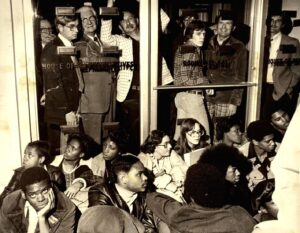
During her time as a student, Dear Langston quickly became a special place to McGill and she was in no hurry to leave. An active member of the campus community, McGill was crowned Miss Langston University in the Fall of 1978. She even participated in the 1978 sit-in protests at the Oklahoma Capitol to save the university when state legislators considered closing the school down.
Sheila McGill (back row, 3rd from the left) participated in a sit-in at the state Capitol on March 1, 1978. Students were demonstrating to gain more state funding for Langston University. Photo courtesy of The Oklahoman.
When she graduated in December 1978 and the Office of Financial Aid asked her to stay on as a receptionist for the spring semester, she gladly accepted. When a position opened for a financial aid counselor that summer, she decided to apply.
From 1979-84, McGill worked as a financial aid counselor. It wasn’t what she had ever pictured herself doing, but she enjoyed the work, she enjoyed helping students, and she felt she had found her calling.
“I tell students, ‘Do not knock federal work study,’” McGill said. “It can give you some valuable work experience, as well as help you pay your bill.”
As time went on, McGill knew she was ready to grow in her career, even if that meant leaving Dear Langston. Eventually, the position of assistant director of financial aid at Central State College opened. McGill applied, and Central State hired her.
She spent the next two years at Central State, now known as the University of Central Oklahoma (UCO), before accepting the position of director of financial aid at Cameron University. Three years later, the director position at UCO opened and a mentor encouraged her to apply.
McGill returned to UCO in 1989 and worked as their director of financial aid for 20 years before retiring at 50.
“When I retired, my plan was to be done with financial aid,” McGill said. “Financial aid was going through some major changes during that time, and I thought, ‘This is a good time to get out’ and I did so.”
Although retired, McGill wasn’t ready to stop working just yet. She worked as a census worker for two years, and she enjoyed getting to know her state better. She had no intentions of returning to work in higher education, but life had other plans for her.
In 2011, a friend asked McGill to be the temporary director of financial aid at Langston University. McGill couldn’t say no.
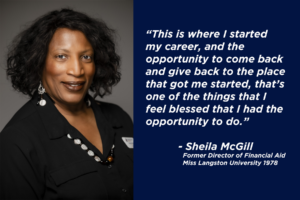
“One of the things that made me say yes to Langston was being able to come back to where I started,” McGill said. “This is where I started my career, and the opportunity to come back and give back to the place that got me started, that’s one of the things that I feel blessed that I had the opportunity to do.”
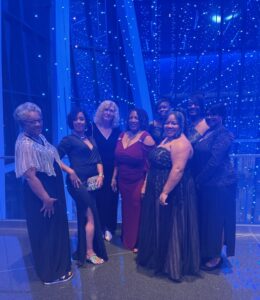
McGill (center) poses with the members of the Financial Aid office at the 18th Annual President’s Scholarship Gala in 2023.
That temporary position became a full-time position, and McGill was Dear Langston’s financial aid guru for 13 years. During that time, she impacted a lot of people, especially students.
Nacasaw Coppage, the assistant director of the Office of Financial Aid and Scholarships, said it was well known that if a student came in to ask McGill a financial aid question, they would often walk away with a life lesson, too.
“Her impact is her wealth of knowledge,” Coppage said. “If you are a student, you may come in with this one issue, but she explains it and she produces the knowledge where she surrounds it. So when you walk out of her door, you’re positive of the fact of, ‘OK, I can begin this process now. I know what I’m trying to get to, and I’m going to get to that.’”
Her wisdom and encouragement were not reserved just for students.
Coppage said McGill was a well-rounded leader, asking her team members hard questions and pushing them to get out of their comfort zones and grow. Coppage herself is a testament to the quality of McGill’s mentorship.
Coppage worked under McGill for 10 years, starting as a financial aid counselor and, with McGill’s guidance, working her way up to assistant director. But Coppage isn’t the only one who has benefited from McGill’s leadership.
Coppage’s role as assistant director has taken her out of the office for conferences and other professional development opportunities several times, and she has met many people on these trips who know McGill and can attest to the valuable lessons she’s taught them.
“That’s kind of amazing to me,” Coppage said. “Even though you’ve only been at Langston, UCO and Cameron, your touch is widespread. It is more than just those institutions. You’ve touched people that went on and became directors for other institutions. It’s really amazing to see.”
Over the past 13 years, McGill has helped shape the Office of Financial Aid and Scholarships into the well-oiled machine it is today. While sad to see McGill go, Coppage said thanks to McGill’s leadership throughout the years, she knows the Office will continue to provide students with high-quality financial aid service.
McGill said though she won’t be on campus as regularly, she hasn’t gone too far. Her granddaughter is a freshman at Dear Langston this fall, and McGill plans to come back to support her and continue to support her alma mater.
“I want to leave with a huge, ‘Thank you!’” McGill said. “Thank you, Langston, for the opportunity to jumpstart my career. This was not my plan, to go into financial aid and for financial aid become a career. That was God’s plan.
“But to circle around and bring me back to Langston, I believe that was part of His plan as well.”
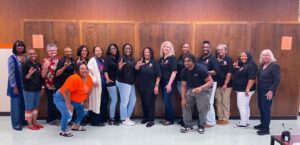
McGill (center) poses with past and current members of the Office of Financial Aid and Scholarships during her retirement reception.
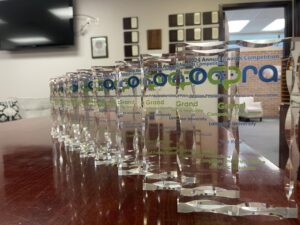
Langston University’s Public Relations team walked away with 18 awards at the annual Oklahoma Collegiate Public Relations Association (OCPRA) Awards Ceremony on July 15, including five Grand awards. It was the most awards won by a single institution.
This year’s awards competition received a record total 662 submissions across 37 categories from 31 departments/divisions at 24 institutions, making it the most competitive OCPRA awards competition to date. The competition included teams from Oklahoma State University, the University of Oklahoma, the University of Central Oklahoma and more.
Langston University’s 18 awards are the most awards the university has won in a single year at OCPRA. Senior Graphic Designer Brandon Clemoens earned nine of the awards.
“It’s crazy to think about, but I remember a time when I would go to this conference and I wouldn’t even leave with an honorable mention,” said Clemoens, the longest-serving member of the team.
This year’s awards haul is reflective of the hard work done by LU’s Public Relations team to roll out the university’s “We Roar” campaign, which launched in October. Aspects of the campaign have included commercials, podcasts, video series, and traditional and digital advertising.
Langston University won awards in graphic design, photography, videography, social media, writing and web design categories. The team won five Grand (1st place) awards, five Excellence (2nd place) awards, five Achievement (3rd place) awards, and three Honorable Mentions.
Grand Awards
The “We Roar” Campaign won first place in the General Campaign category at the 2024 OCPRA Awards Banquet. Components of the campaign included commercials, podcasts, video series, and traditional and digital advertising.
Campaign (General) – “We Roar” by the Langston University Office of Public Relations
Video Featurette – “We Roar” Commercials by the Langston University Office of Public Relations and 1577 Productions
Holiday Greeting – Black History Month by Brandon Clemoens
Poster Design (Sports) – Another Historic Lions Basketball Season by Brandon Clemoens
Social Media Campaign – “We Roar” Student Video Campaign by Ellie Melero
Excellence Awards
Brandon Clemoens “Fear the Roar” Sports Photos won second place in the Series Photography category at the 2024 OCPRA Awards Banquet.
Cover Design – “Fear the Roar” Homecoming Fan Guide by Brandon Clemoens
Stationary & Business Cards – Langston University’s 17th President’s Stationary by Brandon Clemoens
Series Photography – “Fear the Roar” Sports Photos by Brandon Clemoens
Viewbook – 2024 “We Roar” Viewbook by Brandon Clemoens
“Curtain Drop” by Brandon Clemoens won third place in AI Innovation at the 2024 OCPRA Awards Banquet.
AI Innovation – “Curtain Drop” AI Miss Langston University Pageant Images by Brandon Clemoens
Bright Idea (Alumni/Fundraising) – We Can’t Do It Without You, Lions by Jet Turner
Events/Promotion – “All In” Langston University Homecoming by the Langston University Office of Public Relations
Web Design – Langston University Website by the Langston University Office of Public Relations and the Design Group
Honorable Mentions
Brandon Clemoens earned an Honorable Mention for his 2024 Spring Concert poster design.
Poster Design (Culture & Fine Arts) – 2024 Langston University Spring Concert Poster by Brandon Clemoens
Portrait Photography – A Proud Graduate by Brandon Clemoens
Shoe String – Graduation Recap Video by Ellie Melero
“As Oklahoma’s only HBCU, Langston University delivers a high caliber education and an incredible student life experience,” said Director of Public Relations Heleen Sheets. “Our Public Relations Team is so proud to promote our institution and share the people, stories and brand that define us.
“We were excited to represent Dear Langston at the OCPRA Conference and to have our work recognized among our peers.”