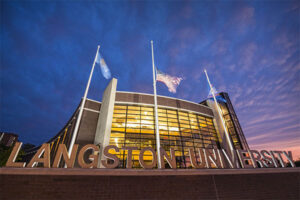
Langston University is set to celebrate 129 years since its founding with a week of ceremonies and celebrations in Langston and Tulsa. The events will include musical performances, the annual Founders Day Program and an Inaugural Founders Week Celebration Gala.
The Langston University Department of Music will present The Chamber Collective musical performance on Tuesday, March 10. This collection of small ensembles will feature both choral and instrumental performances. The event will be held in the I.W. Young Auditorium on the Langston Campus at 6:30 p.m.
The annual Founders Day Program will be held at the I.W. Young Auditorium on the Langston Campus at 11 a.m. on Thursday, March 12. The theme for this year’s program is “Honoring Our Past, Empowering Our Promise,” and the featured speaker will be Dr. Tiffany Crutcher, Founder and Executive Director of the Terence Crutcher Foundation.
Dr. Cruther is an alumna of Langston University, and she is a nationally recognized justice advocate, community leader and social impact advisor. As Founder and Executive Director of the Terence Crutcher Foundation, she leads transformative initiatives focused on public safety, criminal justice reform, economic mobility and community healing. She also serves as a Founding Board Member of Justice for Greenwood, Senior Advisor to Black Tech Street and Advisor to Roc Nation’s United Justice Coalition.
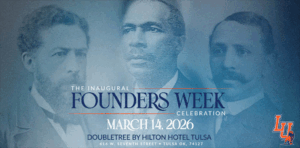
Langston University will end the week with the Inaugural Founders Week Celebration Gala in Tulsa on Saturday, March 14.
The Founders Week Celebration Gala, a black-tie optional event, will include a formal dinner, awards presentation and live music. There will also be a special presentation to commemorate the 25th anniversary of the Master’s in Rehabilitation Counseling program, which has since spurred the creation of a bachelor’s program, the formation of the Department of Rehabilitation and Disability Studies, the establishment of two federally funded Rehabilitation Research Training Centers, and the creation of a post-doctoral research program.
The Chamber Collective and annual Founders Day Program are free and open to the public. The Founders Week Celebration Gala is a ticketed event. Tickets can be purchased online at langston.edu/founders-week through Friday, March 6.
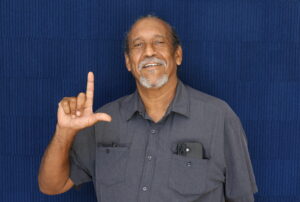
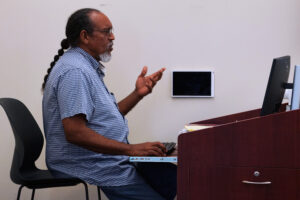
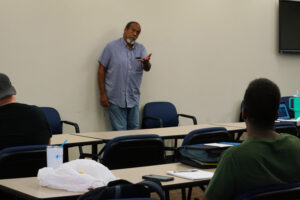
Standing at the front of the classroom on a Wednesday evening, Dr. Ruben Herron knows he’s exactly where he’s supposed to be.
As he leads the room of graduate students in an energetic discussion about client-provider dynamics in rehabilitation counseling, it’s hard to imagine there was a time when he felt like he didn’t have a calling. But for most of his early adulthood, Dr. Herron struggled to find his place in the world.
Throughout his 20s and 30s, Dr. Herron tried his hand at several careers, but he could never find a job where he felt truly fulfilled. Years of trial and error in various fields eventually brought him to Langston University to study rehabilitation counseling, and a chance opportunity years later brought him back to LU to teach. Now, he knows there was always a perfect career out there for him.
He just had to find it.
A Rough Beginning
Ruben Herron moved around a lot when he was a kid.
His family was from El Paso, Texas, but his dad was in the Army. As they accompanied him to each new duty station, the Herrons lived in places like Germany and England before eventually making their way to Wichita Falls, Texas.
Herron moved back to Wichita Falls after his time in the Marine Corps, but he had a hard time finding a job. Photo Credit: Craig Taylor Photo/AdobeStock
When Herron graduated high school, his father offered to pay for him to attend the local community college, but Herron didn’t want to go to school. He decided to enlist in the Marine Corps instead, and he spent a year in California at Camp Pendleton before he got out and moved back to Wichita Falls.
He returned to Texas during the 1980s “oil glut,” and work was hard to find. He took his dad up on his offer to pay for school, but Herron wasn’t a good student and soon dropped out. He got a job doing manual labor at a pipe yard until one Monday, he came to work to find out he’d been laid off.
“Suddenly, we all got pink slips,” Herron said. “And then there were no jobs in Wichita Falls because the big factory shut down. I mean, everybody was getting laid off.”
Herron and his wife decided it was time to leave Texas, so they moved to Tulsa, where his wife’s aunt lived. They arrived in two cars with three kids and a dog, and they were disappointed to find the job market wasn’t much better than it had been in Wichita Falls. Regardless, Herron was determined to provide for his family, and he finally found a part-time job as a sanitation worker.
It was hard, dirty and exhausting work, but Herron persevered. Eventually, he left the trash company for a job at Climate Control. He did his best to provide for his wife and kids, and he was grateful to receive government assistance during those days.
In the late ‘80s, Herron finally felt like he had a breakthrough. He found a new job as a maintenance man for an apartment complex, and he and his family moved out of government housing. For the first time in a while, they even had some money left over after their bills.
Herron and his wife began taking classes at TCC whenever they could afford it.
“They paid part of our rent at the apartment complex we was working at, and I was able to pick up a lot of overtime,” Herron said. “And so, we started to move up the ladder a little bit.”
During this time, Herron felt like he was starting to understand the importance of school. A better education could lead to a better job, and Herron wanted a better job. He and his wife decided to start taking classes at Tulsa Community College (TCC) together in bits and pieces as they could afford it.
Despite their improved circumstances, Herron’s success was short lived.
He felt dissatisfied with his life, and he began facing mental health issues. He sought out unhealthy coping mechanisms, and he ended up getting fired from the apartment complex. His marriage suffered because of it, and his wife left him.
Herron fell into a depression. He felt angry, hurt and frustrated, and he didn’t know what to do. He found himself involved in illegal activities, which led him to spend two and a half years in a correctional facility.
“Because of my own stubbornness, my own ignorance, my own selfishness, I chose the path I chose,” Herron said regretfully.
He felt like he had hit rock bottom, and he still has a lot of emotions to process when he thinks about that time. But he soon discovered the only thing to do was keep moving forward.
Never Too Late
When he was released from the correctional facility, Herron was determined not to go back.
He began working at Bennett Steel Inc. as a sandblaster, a job he thoroughly enjoyed because of how peaceful and almost meditative it was. He earned good money, and he felt like he was starting to move up in the world again. Most importantly, Herron met a man who would help him change his life: the company’s owner, Dave Bennett.
Seeing a counselor changed Dr. Herron’s life for the better.
Bennett was a great boss. He cared about his employees’ wellbeing, and he became a mentor for Herron. It meant a lot to Herron to have someone looking out for him. But as time went on, he found himself becoming restless again.
He liked his job and his boss, but he was still dealing with mental health issues. He still felt dissatisfied with his life. He began acting out in small ways, and Bennett noticed immediately.
Bennett wasn’t about to let Herron slip into old habits, so he convinced Herron to see a counselor.
“Through Dave Bennett’s help, I went and started seeing a counselor, which was really, really, really transformative,” Herron said. “She made me go there with myself, but she sort of held my hand. Like, ‘You know this is what you want. You know you want to let it out. Let it out. Trust yourself.’ And that was the biggest process.”
Counseling changed Herron’s life, and he found a kinder, softer version of himself. He learned how to take care of his mental health and how to cope with negative thoughts. He became someone he liked to be.
He continued to see the counselor while he worked at Bennett Steel, but the feelings of restlessness and dissatisfaction never went away completely. Once, he was having a particularly bad day when Bennett walked in, and he realized what he needed to do.
“Dave Bennett walks in, and I said, ‘Dave, will you loan me $375 bucks so I can go back to TCC?’” Herron said. “And he reached in his pocket and said, ‘Yeah.’ So that’s how I started back at TCC.”
In 2001, Herron went back to school. It was hard to study while working full time, and he faced some unexpected challenges, such as rapidly changing technology, but he was determined to see it through.
In 2004, he left Bennett Steel for a job at 12&12 as part of their substance abuse group counseling team, and he finally felt like he had found a calling. This motivated him as he continued his classes at TCC, especially when he worked two jobs in 2006 to buy his first house. In 2009, Herron graduated from TCC.
“I earned my associates after 28 years,” Herron said. “I earned my associates, and I didn’t know what to do. Then, a classmate of mine suggested I come up here (to Langston University), and I met Dr. (John) Sassin, and within five minutes of walking through his door, I was enrolled in the bachelor’s program.”
After earning his associate’s degree at TCC, Dr. Herron enrolled at Langston University and earned his bachelor’s degree in Rehabilitation Services before going on to earn his master’s degree in Rehabilitation Counseling.
Keeping the Momentum
Herron had learned he could be a good student, and he wanted to keep his momentum going as he pursued a career in counseling. He enrolled at LU-Tulsa in the rehabilitation services bachelor’s degree program in 2009, and he had a better college experience than he could have imagined.
A generous scholarship relieved him of the financial burden of his degree, and he felt like the doors to an untold wealth of knowledge had been opened. His professors became cherished mentors, and he truly understood what it meant to be part of the LU family.
In 2011, Herron had the great honor to walk across the stage at Langston University’s graduation ceremony with his daughter. A couple of months later, he was back in the classroom again as a student in LU’s rehabilitation counseling master’s program.
He continued to work at 12&12, and he continued to enjoy school. One day, Dr. Mary Ramey, an adjunct professor in the rehabilitation counseling program, kicked her shoes off in the middle of class and sat on a table. That behavior baffled Herron, who had always thought of academics as more formal and aloof. But Dr. Ramey seemed normal.
“It just sounds so strange, but that’s what it was to me,” Herron said. “And she looked right at me on that table and said, ‘You could be (a doctor) if you want to.’ And that’s the night it started. She inspired me.”
After that class, Herron contemplated pursuing his doctorate for weeks until one night, he realized that if he wanted to do it, he couldn’t wait.
The day after making that decision, he told Dr. Sassin about his new goal. Having taught and advised Herron for almost four years, Dr. Sassin was supportive of his plan. He helped Herron connect with faculty at the University of Arkansas, and after graduating with his master’s from LU in 2013, Herron enrolled in the University of Arkansas’ doctoral program in counselor education and supervision.
Dr. Herron returned to Langston University as a professor in the very program he graduated from, and he loves teaching and providing mentorship to students.
Herron went to school part time, making the two-hour drive to Fayetteville twice a week. It was difficult, and he even ended up sleeping in his car some nights, but he persevered. In 2017, he officially earned his professional counseling license and began working on his dissertation with Dr. Ramey as his dissertation committee chair.
Everyone Has a Place
Unbeknownst to Herron, other LU faculty had been keeping track of his progress throughout his doctoral program, too. In 2017, a faculty position opened in the LU-Tulsa rehabilitation counseling program, and Dr. Phillip Lewis reached out to Herron to invite him to apply.
“He had already gained his CRC and his LPC, which he is a Certified Rehabilitation Counselor and a Licensed Professional Counselor,” said Dr. Lewis, the graduate coordinator for the rehabilitation counseling program at LU-Tulsa. “So, it was a perfect fit for me to bring Dr. Herron in to fulfill that role, because I didn’t lose anything. I just kind of transitioned, and I didn’t have to worry about a person not having the credentials.”
Dr. Herron had never imagined he would become a teacher, but the opportunity to come back to Dear Langston was too good to pass up. He has thrived in the role since then.
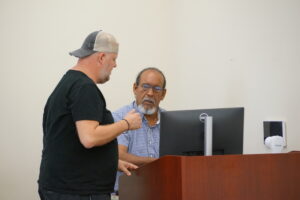
Dr. Herron’s teaching style draws a lot on his own life experiences. As someone who has received counseling, administered counseling and studied counseling extensively, he brings invaluable insights into the classroom. His classes are often filled with lively discussions, and students walk away feeling like they’ve learned.
As both a friend and supervisor, Dr. Lewis loves working with Dr. Herron. According to Dr. Lewis, Dr. Herron’s unwavering positive attitude often lifts the spirits of the whole office.
“He’s been an excellent colleague, and to be honest with you, I don’t think I could’ve found better,” Dr. Lewis said. “Him working here, he’s a product of this program. He’s homegrown, you know. And I think it’s a blessing to kind of work your way back home sometimes.”
After so many years of struggling with feelings of dissatisfaction in his life, Dr. Herron is proud to say he loves his job. He has found a balance between work and his family, and all eight of his dimensions of wellness are being fulfilled.
When he was a young man, he never could have guessed where he’d be today. He loves teaching because it allows him to pass down the mentorship that he, too, received at LU, and he feels like he’s giving back to his community. Now that he has found his place in the world, he has no plans to slow down any time soon.
“I would say to young people, old people, it’s never too late,” Dr. Herron said. “If you look at all the possible jobs out there, there is a job for you that you can be passionate about, that you can enjoy doing. So don’t give up. Stay encouraged. Have some faith and trust yourself.”
Dr. Herron loves his job, and he knows that he has finally found his place in the world.
It was a normal fall day in Oklahoma City, and Terrance Grayson was feeling restless. He had called in sick to work that morning, but he wasn’t physically ill. He was just sick of his job.
Grayson had been working for the same financial lending company since graduating college, and he was good at his job. He had risen quickly to a managerial position and was making good money, but he hated the work. He wanted to do something different with his life. He wanted a career that felt fulfilling and where he could help others. He just wasn’t sure what that career was.
That day, he told himself that because he hadn’t gone to work, he needed to find something productive to do. He decided to go for a walk. While strolling down the street, he saw a sign for Langston University and made an impulse decision to walk inside. At the front desk, Grayson asked what graduate programs they had available, and that’s when he learned about LU’s brand new master’s degree in Rehabilitation Counseling.
“I just walked up to Langston (University) and asked them if they had any programs,” Grayson said. “I literally walked in off the street and met with Dr. Moore, and I talked with him about it and filled out an application and just started down that path.”
Dr. Corey Moore is the Founding Chair of the Department of Rehabilitation and Disability Studies.
That was in 2000. Grayson was part of the inaugural class for the Rehabilitation Counseling master’s program. Now, he has been working for Rose State College in Midwest City, Oklahoma, for almost two decades, and he loves his job.
The Rehabilitation Counseling master’s program came together as the result of a partnership between LU and the Oklahoma Department of Rehabilitation Services. The two institutions collaborated on a grant proposal for the U.S. Department of Education’s Rehabilitation Services Administration and were awarded $500,000 to hire faculty, fund student scholarships and fund student conference travel.
Dr. Corey Moore was hired in October 2000 to create the program, and he became the Founding Director. Dr. Moore came from the University of Arkansas–Fayetteville’ Rehabilitation Research and Training Center on Persons who are Deaf and Hard-of-Hearing, where he served as a research assistant professor. His experience and expertise have shaped the LU program for the past 25 years.
“I saw the mission of the graduate program in rehabilitation counseling as to train rehabilitation and mental health professionals to meet the needs of people with disabilities,” Dr. Moore said. “Teaching, research and service.”
For months, Dr. Moore worked to recruit faculty and students while putting together a curriculum worthy of accreditation. In Spring 2001, the program officially launched at the LU-Oklahoma City campus with its first cohort of 18 students.
Alongside Grayson, Sharon Caldwell was a member of that inaugural class.
Caldwell was a graduating senior in LU’s Health, Physical Education and Recreation program when she first heard about vocational rehabilitation counseling. She had originally come to LU with the goal of becoming a physical therapist, but as she approached graduation, she was no longer sure that’s what she wanted. At her professor’s recommendation, she decided to attend an information session about the new Rehabilitation Counseling program.
“Initially, when I went to Langston, I felt like my passion was physical therapy because I knew I wanted to help people in some type of way,” Caldwell said. “When I heard about the rehab counseling program, those individuals work with individuals with disabilities to help them… to make them become more independent. The fact that the vocational rehab counselor was helping individuals achieve something, I think that kind of sparked my attention.”
Sharon Caldwell was a member of the first cohort for the Rehabilitation Counseling master’s program.
Grayson and Caldwell were excited about the program and the opportunities it offered them. With his scholarship, Grayson was able to quit the job he hated and focus on school full time. As she progressed through her classes, Caldwell discovered a clearer path to her future.
Their cohort became close friends during school. They joked they were “the guinea pig class” because the program was still trying to determine the best ways to do things, but the students knew they were still getting a quality education. They liked working with one another, they liked their professors and, even while working for hours on research papers, they were having fun learning.
“I’d say, educationally, it was the best experience I’ve ever had,” Grayson said. “They opened all these doors to me and provided me with all the support, and without that, I’m not sure I would’ve been able to do it… The environment was just so nurturing that it was everything I needed at the time.”
All 18 members of the first cohort graduated from the program on time and found work in the counseling industry. Grayson worked for the Oklahoma Department of Rehabilitation Services for almost three years before he began working at Rose State. He has held various positions there, and he is now the Director of Academic Outreach.
Caldwell completed an internship/practicum with one of her professors at PROS and Associates during school, and she accepted a full-time position there after graduation. She worked as a rehabilitation counselor for three institutions before accepting a position as a counselor with the U.S. Department of Veterans Affairs in 2012. Since then, she has worked in the Veterans Readiness & Employment Program in Oklahoma City, and she is now the Employment Coordinator.
The first few cohorts that went through the Rehabilitation Counseling program were so successful, the university decided to expand the program in 2004 and offer the master’s degree at the LU-Tulsa campus, too. In 2008, LU-Tulsa added a bachelor’s in Rehabilitation Services, and the School of Education and Behavioral Sciences officially created the Department of Rehabilitation and Disability Studies with Dr. Moore as the Founding Chair.
The Rehabilitation Counseling program earned its accreditation through the Council for Accreditation of Counselors and Related Educational Programs. In 2013 the Department of Rehabilitation and Disability Studies established LU’s first Rehabilitation and Research Training Center (RRTC) that conducts research on capacity building for minorities. A second RRTC has since been established that conducts research on advancing employment opportunities for people with disabilities with the greatest support needs.
The RRTCs are nationally recognized and funded by the National Institute on Disability, Independent Living and Rehabilitation Research. Through the RRTC, the Department of Rehabilitation and Disability Studies established a post-doctoral program for recent doctoral graduates to train in advanced research methodology and statistics. The RRTC has hosted seven doctoral fellows over the past eight years, all of whom have gone on to work at other universities, federal agencies or community-based rehabilitation service programs.
All of this grew from the master’s degree.
While they celebrate this milestone anniversary for the Rehabilitation Studies graduate program, Dr. Moore and the faculty in the Department of Rehabilitation and Disabilities Studies continue to look for ways to improve and grow the program. They are focused on workforce needs. They try to listen to their community and be responsive to the demands of employers. They have created an informed and research-based curriculum that prepares graduates for the demands of a career as a vocational rehabilitation counselor.
“It’s been 25 years of joy and of just a remarkable journey,” Dr. Moore said. “I’m excited about that, happy about that, thankful for it. We look forward to continuing to push the program forward in the future, and I think great things are beyond the horizon.”
By The Langston University Office of Public Relations
TULSA, Okla. – The Langston University – Tulsa Campus will begin offering Public Health and Healthcare Administration majors during the 2025-2026 academic year.
These additions to the LU – Tulsa campus support Langston University’s commitment to expanding the healthcare workforce not just in the Tulsa community, but also throughout the state of Oklahoma and beyond.
These additional programs added to LU – Tulsa expand learning opportunities for working adults, older learners and returning students to pursue a degree with the flexibility and support needed for their busy lives and career goals.
Assistant Professor Dr. Sandra Brown said the classes in the Langston University School of Nursing and Health Professions are designed to focus on the practical application of public health and healthcare management theories, offering real-world and dynamic teaching-learning experiences.
“We provide an interdisciplinary approach to learning,” Dr. Brown said. “Healthcare leaders can no longer afford to learn and work in silos. Interdisciplinary professional education is critical to understanding the multiple roles in healthcare, is essential in fostering mutual respect, and helps to enhance patient outcomes.”
Healthcare administrators are crucial for the efficient and effective operation of healthcare facilities, while public health professionals are critical for protecting and improving community health by focusing on disease prevention, health promotion and equitable access to healthcare.
Because of the importance of these programs, they will have a significant impact on the Tulsa area by producing a more skilled and better-prepared workforce to meet the growing demand in the healthcare industry. With a projected job growth rate of about 28% – one of the highest in the nation – there is no indication of a slowdown. By equipping professionals with advanced knowledge and practical skills, the public health and healthcare administration programs will contribute to enhancing the overall quality of care in the communities of Tulsa and surrounding areas.
Dr. Teressa Hunter, Dean of the School of Nursing and Health Professions, expressed her enthusiasm for the expansion.
“We are proud to expand Langston University’s presence in Tulsa by offering degree programs in Public Health and Healthcare Administration,” Dr. Hunter said. “These new majors reflect our strategic focus on workforce development and health equity throughout Oklahoma.”
With a low faculty-to-student ratio, students enrolled in the Public Health and Healthcare Administration majors will have more one-on-one learning opportunities. This creates a highly engaged and supportive learning environment. Students interested in these programs can expect a dynamic and enriching education led by experienced, compassionate faculty who are committed to student success.
Enrollment is now open for Healthcare Administration and Public Health classes at LU-Tulsa:
Healthcare Administration Courses:
HA 3253 – Introduction to Healthcare Administration
HA 3063 – Introduction to Gerontology
Public Health Courses:
PUH 2333 – Introduction to Public Health
PUH 2313 – Global Health
If you are currently a student at Langston University, you may enroll in these classes by contacting LU-Tulsa Campus Advisor Ms. Deborah O’Guin at deborah.oguin@langston.edu and at (918) 887-8123. You may also reach out to Langston Campus Advisor Ms. Carolyn Johnson at carolyn.s.johnson@langston.edu.
If you are not currently a student at Langston University, you may apply at the Langston University website.
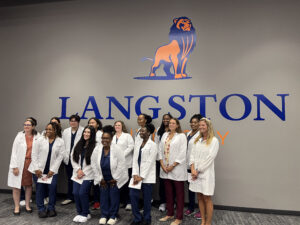
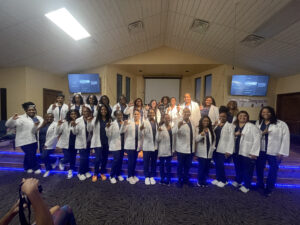
Students in the Langston University School of Nursing and Health Professions participated in white coat ceremonies at the university’s Tulsa and Langston campuses last week, officially completing an honored rite of passage for medical professionals.
The School of Nursing and Health Professions held two white coat ceremonies, one in Tulsa on Tuesday evening and one in Langston on Thursday evening. The students’ families and friends came from all over Oklahoma, the United States, and even from as far as the Bahamas to attend the ceremonies.
“The white coat ceremony is an important rite of passage for these students,” Dr. Teressa Hunter, dean of the School of Nursing and Health Professions, said during Thursday’s ceremony. “They are entering into a profession––this is not a career, it is a profession––and the goal is, in two years, we will all be back here to celebrate their pinning.”
Students from the Langston University – Langston Campus received their white coats Thursday, Sept. 19, 2024.
A white coat ceremony is a rite of passage for students entering medical professions, such as nursing. The School of Nursing and Health Professions holds white coat ceremonies when students begin their clinical studies in their junior year. Students recite an oath to acknowledge medicine’s central obligation of caring for patients and are given their white coats. White coat ceremonies are common practice throughout the United States and in 19 countries.
Thirteen students received their white coats at the LU-Tulsa ceremony on Tuesday, and 25 students received their white coats at the Langston campus ceremony on Thursday.
The School of Nursing and Health Professions offers an accredited Bachelor of Science in Nursing (BSN) at the Langston and Tulsa campuses as well as the Ardmore Site. Additionally, the School offers an online RN to BSN program. LU’s nursing programs are accredited by the Accreditation Commission for Education in Nursing, and the nursing program has been accredited since 1987.
The online RN to BSN program is accepting applications for the fall semester through Sept. 30. The Tulsa and Ardmore sites will accept applications for Spring 2025 admission to the BSN program until Oct. 15. For more information, visit langston.edu.
The Langston University urban campuses located in Oklahoma City and Tulsa will commemorate their 45-year anniversaries this June with celebratory luncheons.
These celebrations will honor the hard work done by the faculty, staff and site administrators at these campuses to provide quality educational opportunities for students in Oklahoma City and Tulsa since 1979. They will also serve as fundraisers to support the campuses as they continue to promote excellence in higher education and research in Oklahoma.
In January 2023, Griffin Media made the largest corporate donation in Langston University history when it gifted the university its KWTV News 9 building located at 7401 N. Kelley Ave. in Oklahoma City. The building has become the new home of the LU-OKC campus and a focal point for the Broadcast Journalism program.
In March 2023, the LU-Tulsa campus held the grand opening for the new Tulsa Allied Health Facility. The 17,000-square-foot building, home to the School of Nursing and Health Professions in Tulsa, includes simulation labs with mannikins powered by artificial intelligence, spacious classrooms, a lecture hall, conference and meeting rooms, and department and administrative office spaces.
These recent additions to each of the LU urban campuses reflect the university’s efforts to expand its footprint and impact in Oklahoma City, Tulsa, and the state as a whole.
LU-OKC will celebrate its 45-year anniversary with a luncheon in the Embassy Suites OKC Northwest on June 6. The deadline to purchase tickets is May 30. Tickets can be purchased for $45 at bit.ly/LUOKC45.
LU-Tulsa will celebrate its 45-year anniversary with a luncheon in the Doubletree by Hilton in Downtown Tulsa on June 13. The deadline to purchase tickets is June 6. Tickets can be purchased for $45 at bit.ly/LUTulsa45.
TULSA, Okla. – Langston University commemorated the opening of a state-of-the-art Allied Health Facility on its Tulsa Campus with a ribbon-cutting ceremony held Wednesday.
The 17,000-square-foot building, home to the Langston University School of Nursing and Health Professions in Tulsa, was built through a $16.25 million allotment from Vision Tulsa. The facility includes simulation labs with mannikins powered by artificial intelligence, spacious classrooms, a lecture hall, conference and meeting rooms, and department and administrative office spaces.
Dr. Kent J. Smith, Jr., President of Langston University, opened the program with remarks recounting the journey to create the new facility. In 2015, Langston University proposed the construction of the facility to Tulsa City Council for consideration and inclusion in Vision Tulsa. “At the time of our proposal, the pandemic was still unknown to us,” Smith said. “The construction of this facility could not have been more timely. Our new facility provides the very best healthcare education to students interested in pursuing a career in nursing and health professions.”
The Langston University – Tulsa Allied Health Facility was built with three objectives in mind: to enhance access to education in Tulsa, to meet the needs of the healthcare workforce, and to reduce health disparities in North Tulsa.
The grand opening event was well attended by Langston University students, faculty, staff, and alumni, as well as members of the Tulsa community. Mayor G.T. Bynum congratulated Langston University for opening a facility, which provides a direct positive impact on the Tulsa community. “The new Allied Health Facility on the Langston University Tulsa campus will help prepare students to fill a workforce need in the Tulsa area,” said Mayor G.T. Bynum. “Thank you to Tulsa voters for approving Vision Tulsa that made this $16.25 million economic development project possible.”
Several notable community members attended the event to celebrate the grand opening. Tulsa City Councilwoman Vanessa Hall-Harper addressed the attendees at the event, remarking on the importance of funding for Historically Black Colleges and Universities like Langston University. Partners who were instrumental in completing the project such as Beck Design, Flintco Construction, and Oklahoma State University Long Range Facilities Planning, were also in attendance.
Dr. Dytisha Davis, Executive Director for the Langston University – Tulsa Campus, was recognized for her leadership in the project, for which planning began in 2018. Dr. Teressa Hunter, Dean of the School of Nursing and Health Professions at Langston University, recognized the faculty and students for their support of the new facility and shared her thoughts on the importance of the project. “This new facility paves the way for current and future healthcare providers,” said Hunter. “It is poised to fulfill the legacy of Langston University as the promise-keepers, trailblazers, and guardians of the high standard built by Langston University School of Nursing graduates.”
President Smith announced his intension to name the new facility after former Tulsa City Councilman Jack Henderson, pending final approval by the Board of Regents for the Oklahoma A & M Colleges. “It cannot be understated how important Jack Henderson was to the success of this project,” said Smith. “He is a true champion for our mission and he made this project possible.”
The program included a formal ribbon cutting followed by tours of the new facility led by Langston University Nursing students and faculty.
TULSA, Okla. — Langston University President Kent Smith said an academic agreement with Oklahoma State University (OSU) will maintain Langston University’s (LU) presence in Tulsa while also strengthening the educational offerings of both institutions.
“I am pleased that OSU President Hargis recognized the potential of my proposal regarding the future of higher education in Tulsa. When making the proposal, it was important to me to preserve Langston University’s mission within the communities we serve, specifically North Tulsa,” said LU President, Kent Smith. “For us, this academic agreement allows us to focus on our programs of greatest strength and at the same time to enhance and expand our nursing program by partnering with the OSU Center for Health Services (OSU-CHS).”
“When President Smith proposed the concept some months ago, I was intrigued by the possibilities for both institutions,” said Burns Hargis, President of Oklahoma State University. “Both LU-Tulsa and OSU enjoy strong programs in Tulsa. This academic agreement will enable both institutions to pursue strategic objectives and to be more responsive long-term to the market’s higher education and workforce needs.”
LU and OSU are both governed by the OSU/A&M Board of Regents. The agreement is pending approval of the OSU A&M Board of Regents, which meets next week.
As part of the agreement, OSU and OSU-CHS will pay LU $15 million over a period of ten years. “The funds LU will receive from OSU and OSU-CHS will spur investment in innovative programs and services to distinguish LU and advance our mission to offer quality education to diverse populations,” Smith said. “As a historically Black college and university and a land-grant institution, we look forward to investing in and further elevating LU in both presence and stature while maintaining a presence in Tulsa.”
“I want to commend both LU and OSU for their efforts in identifying operational efficiencies and programmatic enhancements to better serve Tulsa and the surrounding region,” said Rick Davis, Chair of the OSU/A&M Board of Regents.
Davis also commended the Oklahoma State Regents for Higher Education (OSRHE) for signing an agreement earlier today with the Office of Civil Rights, resolving outstanding issues stemming from a complaint filed 17 years ago. “The agreement signed by the OSRHE helps create a clear path forward for LU to reimagine its role in Tulsa and beyond,” Davis concluded.
TULSA, Okla. – Langston University – Tulsa and Green Country Permaculture received a grant for a new summer gardening STEM program for Tulsa area students to get hands-on experience of growing their own vegetation.
The summer program allows students a better understanding of how to live off the land by working on a small-scale organic farm in Broken Arrow this summer.
The goal of this program is to increase interest in sustainable agriculture among younger generations. With National Geographic reporting that the nation’s farmers are 17 years older than the national average American working, Langston University and Green Country Permaculture want to address the lack of youth in agriculture.
The grant will also help Tulsa Public Schools expose students and teachers to agriculture once school starts on Aug. 20. Some classrooms will have hydroponic systems – a process where plant roots come in direct contact with a water-based, nutrient-rich solution, while also having access to oxygen, which is often a faster method than traditional methods and better suited for the school year.
Founded in 2012, Green Country Permaculture (GCP) is a consulting and ecological landscaping organization that provides alternatives to conventional landscape practices. CGP specializes in drainage issues, edible landscaping, native landscaping, school garden programs, and Permaculture design.
Langston University (LU) is a public Historically Black University enrolling a close-knit community of under 3,000 students. Langston University is recognized as a top institution of higher learning for affordability by afforableschools.net and bestvalueschools.com. Founded in 1897, LU is located in rural Logan County and has urban campuses in Oklahoma City and Tulsa. Langston offers more than 40 associate, bachelors, masters, and doctoral programs across six academic colleges. Visit us online at http://www.langston.edu.