By The Langston University Office of Public Relations
TULSA, Okla. – The Langston University – Tulsa Campus will begin offering Public Health and Healthcare Administration majors during the 2025-2026 academic year.
These additions to the LU – Tulsa campus support Langston University’s commitment to expanding the healthcare workforce not just in the Tulsa community, but also throughout the state of Oklahoma and beyond.
These additional programs added to LU – Tulsa expand learning opportunities for working adults, older learners and returning students to pursue a degree with the flexibility and support needed for their busy lives and career goals.
Assistant Professor Dr. Sandra Brown said the classes in the Langston University School of Nursing and Health Professions are designed to focus on the practical application of public health and healthcare management theories, offering real-world and dynamic teaching-learning experiences.
“We provide an interdisciplinary approach to learning,” Dr. Brown said. “Healthcare leaders can no longer afford to learn and work in silos. Interdisciplinary professional education is critical to understanding the multiple roles in healthcare, is essential in fostering mutual respect, and helps to enhance patient outcomes.”
Healthcare administrators are crucial for the efficient and effective operation of healthcare facilities, while public health professionals are critical for protecting and improving community health by focusing on disease prevention, health promotion and equitable access to healthcare.
Because of the importance of these programs, they will have a significant impact on the Tulsa area by producing a more skilled and better-prepared workforce to meet the growing demand in the healthcare industry. With a projected job growth rate of about 28% – one of the highest in the nation – there is no indication of a slowdown. By equipping professionals with advanced knowledge and practical skills, the public health and healthcare administration programs will contribute to enhancing the overall quality of care in the communities of Tulsa and surrounding areas.
Dr. Teressa Hunter, Dean of the School of Nursing and Health Professions, expressed her enthusiasm for the expansion.
“We are proud to expand Langston University’s presence in Tulsa by offering degree programs in Public Health and Healthcare Administration,” Dr. Hunter said. “These new majors reflect our strategic focus on workforce development and health equity throughout Oklahoma.”
With a low faculty-to-student ratio, students enrolled in the Public Health and Healthcare Administration majors will have more one-on-one learning opportunities. This creates a highly engaged and supportive learning environment. Students interested in these programs can expect a dynamic and enriching education led by experienced, compassionate faculty who are committed to student success.
Enrollment is now open for Healthcare Administration and Public Health classes at LU-Tulsa:
Healthcare Administration Courses:
HA 3253 – Introduction to Healthcare Administration
HA 3063 – Introduction to Gerontology
Public Health Courses:
PUH 2333 – Introduction to Public Health
PUH 2313 – Global Health
If you are currently a student at Langston University, you may enroll in these classes by contacting LU-Tulsa Campus Advisor Ms. Deborah O’Guin at deborah.oguin@langston.edu and at (918) 887-8123. You may also reach out to Langston Campus Advisor Ms. Carolyn Johnson at carolyn.s.johnson@langston.edu.
If you are not currently a student at Langston University, you may apply at the Langston University website.
Every year on Mother’s Day, Dr. Emily Patterson Harris gets a call from one of her former students.
When that student was younger, he attended and dropped out of two colleges. Dr. Harris wouldn’t have it.
“It took me two years to talk him into coming to Langston University and giving it another try,” Dr. Harris said. “And he did. We had some rough times in there, but he finished, and he calls me on Mother’s Day.”
Not all of her student stories are as friendly.
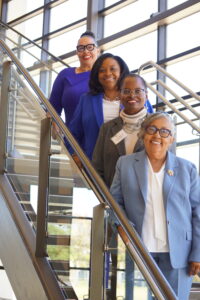
Once, while walking down the stairs at the LU-Tulsa Campus, a student stopped Dr. Harris to talk. He was a student who sometimes struggled to balance his schoolwork with his responsibilities as a father, but Dr. Harris knew he was capable of it and always made sure to let him know it.
“He stopped me, and he said, ‘Well, I want you to know that I’m going to graduate, if for no other reason than to get you off of my back!’” Dr. Harris said. She smiled and responded with an upbeat, “OK!”
That student did graduate, and he went on to earn his master’s degree. She still sees him occasionally and always makes the time to talk with him.
Dr. Harris has countless stories like these because she’s been working with students for over 40 years. She has worked tirelessly to develop well-defined and relevant programs that will help students get jobs after graduation, and she has dedicated countless hours to making sure students make it to graduation. From working with them in the classroom to advising those who left to figure out how to come back, Dr. Harris doesn’t give up on her students. She cares about them, and she knows that for many, earning their degree will change their life.
Education is Transformative
Dr. Harris has always believed in the power of education, and she understands better than most that the transformative effects of earning a degree can be felt for generations. Her own family is a prime example. Her maternal grandmother, Emily Alford, only had an 8th grade education, but she was determined to send her children to college. They came to Langston University.
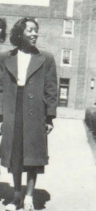
Violet Alford, Dr. Harris’ mother, graduated from Langston University with a B.S. in Business in 1950.
Dr. Harris’ mother, Violet, graduated from Langston University in 1950 with a B.S. in Business. Her father, Lee V. Patterson, Sr., graduated from LU that same year with a B.S. in Industrial Arts. They both had successful teaching careers in Oklahoma, and they made sure their children understood education was important. The message was echoed by Dr. Harris’ aunts and uncles throughout her childhood, and she and her cousins eventually passed the message along to their children, too.
Today, the younger generations of the family understand education is transformative. Dr. Harris’ son Erick said they all expect to go on to earn the highest-level degrees available for their chosen professions. Four generations after Emily Alford, the average degree in the family is a masters.
“I go back to that initial decision that my grandmother made that a college education was important,” Dr. Harris said. “That one decision has impacted generations of my family.”
It also allowed Dr. Harris to impact thousands of others.
Dr. Harris graduated from her father’s alma mater, Booker T. Washington High School in Tulsa, Oklahoma, but she did not follow in her parents’ footsteps to attend Langston University. Instead, she chose to attend Central State University in Wilberforce, Ohio, and her experiences there reinforced her beliefs about the power of HBCUs. She went on to earn her Master of Library and Information Studies from the State University of New York at Buffalo before moving to Texas to serve as a librarian at Houston Community College.
After a three-year stint in Houston, Dr. Harris came home to Oklahoma. Thanks to the efforts of Dr. Roosevelt Mack, she officially joined the Lion Pride as a librarian at the LU-Tulsa Campus in 1981.
Building Something
Langston University’s Tulsa campus opened in 1979. It was the first public institution to offer graduate and upper level higher education courses in Tulsa.
The Langston University-Tulsa Campus had been established just two years prior when Dr. Harris joined the staff.
It was the first public institution to offer upper-level higher education classes in Tulsa, and in 1982, it worked together with Oklahoma State University (OSU), the University of Oklahoma (OU) and Northeastern State University (NSU) to form the University Center at Tulsa. Still a firm believer in the importance of education, Dr. Harris was excited to be a part of bringing access to higher education to her hometown.
Serving as a librarian for all academic programs gave Dr. Harris an opportunity to work closely with the students in Tulsa, and she found she enjoyed getting to know them while helping them access the materials they needed for their classes. She was good at her job, and she was soon asked to move to the Langston Campus to serve as the Acting Director of the G. Lamar Harrison Library while the school looked for a permanent director.
When she returned to LU-Tulsa a year later, she knew she was ready to take on more responsibility.
She transitioned from the library to a position as an academic counselor. It was around this time that Dr. Wessylyne A. Simpson, Dr. Harris’ aunt who was then the Dean of the School of Education and Behavioral Sciences (SOEBS), was working to expand the program offerings at the Tulsa Campus. Dr. Harris worked with Dr. Simpson, SOEBS faculty and Diana Sharp to bring the Teacher Education program to Tulsa.
“We worked on paperwork and made sure we had all the bylaws and everything set up before we could start recruiting students,” said Sharp, who still works at LU-Tulsa as an administrative assistant. “We all put our heads together and started the program here, and it’s taken off ever since.”
Diana Sharp (right) has worked with Dr. Harris since she joined the LU-Tulsa staff in 1983.
Sharp liked working with Dr. Harris right from the start. When they first met in 1983, Sharp’s first impression was that Dr. Harris was a peppy, happy-go-lucky person with whom it was very easy to talk. Forty years later, Sharp said that’s still how she’d describe her.
LU Tulsa’s Teach Education program was the first of many projects Sharp and Dr. Harris would work on together over the years, and Sharp said she always appreciated Dr. Harris’ positive attitude and willingness to try several approaches until they found the one that would work. She also appreciated that Dr. Harris knew how to leave work at work, allowing them to form a personal friendship in addition to their professional one.
Thanks to their hard work, they brought the Teacher Education program to LU-Tulsa in 1985. The program was housed on the seventh floor of the building they shared with OSU at 440 S. Houston St., and Dr. Harris took on the role of Associate Director for Teacher Education at LU-Tulsa.
For 12 years, she supervised the teacher education program at the Tulsa Campus. She loved working with students and continued to serve as an advisor. In 1986, she also began teaching as an assistant professor in SOEBS, focusing mostly on psychology and education courses.
She went back to school and earned her Ed.D. in Higher Education Administration from OSU in 1989, and she said she is eternally grateful to the late Dr. Mack for his continual support throughout this time as she juggled her work and doctoral coursework. She also wanted to thank Dr. Ernest L. Holloway, LU’s longest-serving president, and Dr. C. Gary Crooms.
“There’ve been powerful leaders, master teachers and mentors that encouraged me and were great at their chosen fields,” Dr. Harris said. “The late Dr. Holloway continually focused on challenges as opportunities. Dr. Crooms taught me to look at those challenges from multiple perspectives.”
Dr. Harris finished her doctorate, completed additional coursework in Behavioral Sciences, and became certified to teach Social Studies, Language Arts and Library Media. She took her mentors’ lessons as well as everything she’d learned from her own classroom experiences as both a teacher and student to try to continually improve her own classes.
“What I loved about teaching is just the fact that there’s always more information,” Dr. Harris said. “And I’m a librarian, so I love looking for information. You can never get tired of finding new things or new ways of doing things, and sometimes your students will send you off in a different direction.”
Students First
Dr. Harris (far right) served as the Associate Vice President for the LU-Tulsa Campus for almost 12 years.
Dr. Harris was dedicated to her work, and that’s something to which her family can attest. Growing up, her two sons spent much of their free time at the LU-Tulsa Campus and witnessed how hard their mother worked for the students there.
One day, an 8-year-old Erick approached Dr. Virginia Schoats, the campus site director, and told her as much.
“My mom was always working hard,” Erick said. “I had just found out what the word ‘promotion’ meant, and once I realized that I said, ‘Oh, well she deserves one of those.’ And because (Dr. Schoats) was her boss I thought, ‘She’s the one that can give it to her.’”
Not long after, Dr. Schoats did recommend Dr. Harris for a promotion.
In 1997, she became the Associate Vice President for LU-Tulsa, the person who ran the campus. She also served as the Institutional Representative for Langston University to the University Center at Tulsa, advocating for the needs of LU students and faculty while working to improve access to higher education for all Tulsans.
Though her duties and responsibilities changed, her goal stayed the same: to guide students to degree completion.
At this time, the average age of the students at LU-Tulsa was about 34. Dr. Harris recognized early on that their needs would be different than the needs of students at the Langston Campus, so she tried to keep their work and familial responsibilities in mind. Under her leadership, the faculty and staff in Tulsa worked to make it as feasible as possible for non-traditional students to take classes. They offered everything from a bookstore to a registrar’s office on campus so students wouldn’t have to make the drive to the Langston Campus.
“We had it set up making sure that once they got out from work, we had every avenue for (students) to be able to take courses so that they would still be able to graduate,” Sharp said. “We made sure the students were happy and taken care of, no matter how many different hats we had to wear.”
Dr. Harris’ motto was to meet students where they were and never take anything personally, and she gave that advice to her student teachers as well as her faculty.
She understood that students, the same as everyone, had challenges in their lives outside of class and were sometimes prone to take that out on their teachers. But she also knew she had to look past that in order to assist them, which she was determined to do.
“We’re all works in progress,” Dr. Harris said. “I emphasize that we each have our own individual paths.”
Dr. Harris has always done everything in her power to help students make it to graduation.
Students drop out of college for all sorts of reasons. Sometimes they don’t feel they have time to go to class. Sometimes they can’t afford it. Sometimes they just don’t want to do it anymore. If a student dropped out of LU-Tulsa, Dr. Harris wanted to know why.
She would contact them to follow up on why they chose to leave school. Then she would brainstorm solutions to help them come back.
“She would make those calls, and once she got them here, she would do all the rest of it,” Sharp said. “She was making sure that students were taken care of and just trying to get them to realize that, you know, ‘You’re so close. Don’t lose this.’”
Many students returned to school thanks to Dr. Harris’ efforts, and many other students stayed in school for the same reasons.
Dr. Harris recalled that once, an alumnus whom she hadn’t seen in years walked up to her and abruptly told her that he used to hate her. Unflappable as always, she simply responded, “Oh, you did?” He said he really did.
He told her he used to complain about all the work she made them do in her classes. He didn’t appreciate all the readings, essays and other homework she assigned. It made him resent her during his time as a student.
“And then he said, ‘I just wanted to tell you that I earned my masters,’” Dr. Harris said. “And he told me the program he’d gone through, and he said, ‘If it hadn’t been for you, I would not have made it through that program. And I just wanted to come back and share that with you.’
“That’s the beauty, I think, about Langston University, no matter the campus. There is just a history of balancing those two things of nurturing a student but also having great expectations for those students. ‘LU graduates around the globe serve as leaders, innovators and engaged citizens,’ to quote our vision statement.”
A Lasting Legacy
Dr. Ruth Ray Jackson said Dr. Harris embodies the Alpha Kappa Alpha Sorority, Inc., motto: Service to All Mankind.
In 2008, Dr. Harris became the “Gear Up” Program Director and Coordinator for the Department of Psychology at LU-Tulsa. She worked closely with Tulsa Public Schools to design and deliver programs meant to encourage college attendance and completion at Tulsa-area middle and high schools while continuing her work as a professor and the leader of the psychology program in Tulsa.
In 2018, she was appointed Chair of the Department of Psychology for all LU campuses, and in 2019, she became Dean of the School of Education and Behavioral Sciences. She has also served, when the need arose, as Acting Dean of University Libraries. Throughout it all, she has continued her efforts to help students learn and make it to graduation.
“Dr. Harris has done a phenomenal job,” President Ruth Ray Jackson said. “Even in her role as Dean, she continues to advise students and to meet with transfer students. Of course, she’s now in a position where she’s solving problems and listening to complaints and concerns from both students and faculty, but she’s consistently energized and ready to meet somebody and help them get to where they want to go.”
Dr. Harris has become known for the positive energy she brings to projects and her willingness to try several routes until she finds the one that will work. Dr. Jackson called her a creative problem solver, and she’s had a lot of experience doing it.
During her 44 years at Langston University, Dr. Harris has tackled lots of challenges, from redesigning curricula to helping develop completely new ones. Although she had almost 40 years of teaching experience, she continued trying out different teaching strategies right up until she taught her last class in 2024. She did it because she knew there was always room for improvement.
Dr. Harris knows Langston University inside and out, and she has made a lasting impact.
“My mother is one of the most encouraging people that I’ve ever known,” Erick said. “She supports you, but there’s a nice edge to her that will push you and encourage you to keep moving forward. And that’s what she’s done at Langston University.”
Throughout her career, Dr. Harris has been the model of a servant-leader, both in her personal and professional life.
Her younger son, Christopher, said he’s grateful to have grown up with Dr. Harris as a role model because she inspires him to try to be a leader in his own industry, noting that he often models his own behavior after her in professional settings. He also recognized that his mother’s career at LU has always gone beyond her job descriptions.
“You recognize the sacrifice almost after the fact,” Christopher said. “She could have had positions and titles that would’ve paid more at other institutions and in other states, but not everything is about financial gain. It’s having us grow up around our grandparents, and from a career perspective, it’s saying that you can have a positive impact on people’s lives and be that role model of what leadership looks like.”
She is a longtime member of Alpha Kappa Alpha Sorority, Inc., and Dr. Jackson, a fellow AKA, said Dr. Harris perfectly embodies their sorority’s motto: Service to All Mankind.
Dr. Harris said it’s not hard to find ways to serve because they will usually find you. Now, after four decades of service to Dear Langston, she is finally ready to retire. Her last day will be June 30, though she jokes it will really be “the 12th of never.”
“I’m sure I will (miss teaching),” Dr. Harris said. “But I’m sure that I can find all kinds of creative things to do.
“I say, ‘Don’t look back. You’re not going in that direction.’”
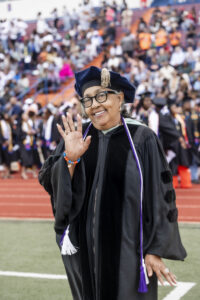
Dr. Harris will retire from Langston University after 44 years of service on June 30.
Langston University is excited to announce an allocation of $10,125,000 from the Oklahoma State Legislature to address deferred maintenance projects across the university in fiscal year 2026. This special allocation is a direct result of the recent Carnegie designation of Research or College University awarded to our institution. The funding will be used to address infrastructure needs at all three LU campuses with a particular focus on the needs of the university’s historic Langston campus.
The Legislature passed Senate Bill 1169, which increases the percentage of Oklahoma Capital Asset Management and Protection (OCAMP) deferred maintenance funding allocated to Langston University by the Oklahoma Legislature. With this funding, the university plans to pursue a number of high-impact projects which are aimed at enhancing the experience for students, faculty, and staff including select HVAC upgrades, plumbing modernizations, and addressing various infrastructure priorities that will improve campus safety, accessibility and operational efficiency.
“The funding will help us make prioritized improvements which are essential to providing our students, faculty and staff with the quality learning, working and living environments they deserve,” President Ruth Ray Jackson said.
Langston University has continually made strategic investments through federal grants and other funding sources to address critical infrastructure needs at the Langston, Tulsa and Oklahoma City campuses. However, many of these necessary improvements take months of planning, must be competitively bid, and the scope of required improvements has consistently exceeded available resources. This increased funding will greatly aid the university as it prepares to take on these high-priority projects.
Last year, the university received $3.5 million to address deferred maintenance projects, $2.5 million of which is earmarked to replace the roof at the LU-Oklahoma City campus.
Langston University appreciates the leadership of the Oklahoma Legislature, Gov. Kevin Stitt, the Oklahoma State Regents for Higher Education and the Oklahoma A&M Board of Regents for their continued support of higher education infrastructure.
The university is especially grateful to Sen. Chuck Hall, who represents the Langston campus, for his leadership in advancing this legislation. The university also recognizes the broad, bipartisan support from legislators across the state who understand the critical importance of this investment in Oklahoma’s public institutions.
“Langston University is committed to responsibly stewarding these resources to advance our mission and continue serving our students and communities with excellence,” Dr. Jackson said.
LANGSTON, Okla.––The Langston University Rehabilitation Counseling Program has been named one of the top 20 graduate rehabilitation counseling programs in the nation by U.S. News and World Report.
“This national ranking speaks to the quality of our faculty members’ and RRTC staff’s teaching, research and service impacts,” said Dr. Corey Moore, Chair of the Department of Rehabilitation and Disability Studies and Executive Director of the Rehabilitation Research and Training Center (RRTC). “Our nationally recognized faculty are indeed enhancing the academic acumen and brand of our programs and department through their strong commitment to the mission. This is truly a team effort.”
Langston University’s Rehabilitation Counseling Program was ranked 18th in the nation, a tie with Kent State University, Northern Illinois University, the University of Alabama, the University of South Florida and Winston Salem State University.
The rehabilitation counseling program was ranked above programs from the University of Arkansas, Mississippi State University, Florida Atlantic University and others.
“I am incredibly proud that Langston University’s Rehabilitation Counseling Program continues to be recognized among the top 20 in the nation and leads as one of the highest-ranked programs among HBCUs,” said Langston University President Ruth Ray Jackson. “This prestigious ranking is a testament to the unwavering dedication, expertise, and passion of Dr. Moore, our outstanding faculty, and the entire RRTC team.”
For more information about the Rehabilitation Counseling Program, please visit langston.edu/rehab.
It’s always a special moment to watch a loved one walk across the stage at graduation, but for the Barnett family, this year’s Langston University commencement ceremony was doubly special.
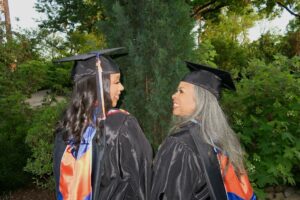
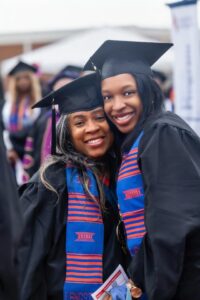
Mother-Daughter duo Cerita and Alexis Barnett both graduated with their master’s degrees in rehabilitation counseling this May, and their family and friends cheered loudly from near and afar as the two walked across the stage together as proud members of the Class of 2024.
“We laughed a lot, we studied a lot,” Alexis said. “We learned how to work as a team to grow.”
Alexis and Cerita didn’t always plan to go to school together.
A 1992 graduate of Langston University, Cerita wanted to work in a public school system, particularly with at risk students, to help provide guidance to young people as they navigate their next steps in life. After earning her bachelor’s in sociology, she intended to earn a master’s degree in pursuit of this goal. But life had other plans for her.
Certia Barnett graduated from Langston University in 1992 with her bachelor’s in sociology. Thirty-two years later, she graduated from LU again with her master’s in rehabilitation counseling.
Cerita got married, found a job and had kids. Her family became her priority, but she never gave up the idea of pursuing her master’s.
“I decided, okay, I’ll wait ‘til [the kids] get a little older so that it would be easier for me to actually do a program and do the homework, read the chapters, everything that was required of me,” Cerita said. “So, I was content working as a substitute teacher so that I can help still teach and guide my own children.”
As a substitute teacher in the Tulsa Public School system, Cerita had the opportunity to work with kids like she wanted, and she also had the flexibility to take an active role in her own children’s lives. That included taking an active role in their education.
In the classroom, she always tried to impress upon students the importance of taking their education seriously, and she did the same at home. She would volunteer in her kids’ classrooms, volunteer with their extracurriculars, help them with homework and do whatever she needed to help them succeed in school. And succeed they have.
Alexis graduated from the University of Oklahoma with a double major in psychology and sociology in 2021. Like her mother, Alexis knew she wanted to pursue a master’s degree.
After graduating with her bachelor’s from the University of Oklahoma, Alexis Barnett encouraged her mother to pursue their master’s degrees together.
“I know that education can open doors,” Alexis said. “So, I had my mind set on [a master’s degree]. I knew that’s something I wanted to challenge myself to do, and I’m glad I did.”
After Alexis graduated from OU, Cerita began to think it might finally be time to return to school herself. Her family, including Alexis, encouraged her. Alexis and Cerita were both interested in counseling, so they began looking to see what programs were available in the Tulsa area.
Cerita, confident in the quality educational experience she would receive at Langston University thanks to her experience as an undergraduate student, began looking into the rehabilitation counseling program at LU-Tulsa. Alexis followed suit and decided to apply, but Cerita was still hesitant about whether she was ready to return to school yet.
“I was able to encourage her to go ahead and apply after I had applied,” Alexis said. “We were able to apply around the same time, and we both got accepted to the Spring ‘22 cohort.”
Cerita smiled and nodded as she remembered how excited their family was when the two announced their decision to go to school together.
“My family was excited for me because they knew at some point, I wanted to go back to school,” Cerita said. “And they thought it was neat, ‘Mama and Alexis is going to school together!’ And actually, at one point, I was not going to tell anybody just in case I changed my mind. But my husband, Harvel…”
“He started telling people,” Alexis laughed. “He was excited.”
With the support of their family–Harvel, Alexandria, Albany and Arnetta–and friends behind them, Cerita and Alexis began their graduate school journey together.
Cerita (left) and Alexis helped and supported each other throughout the two-year rehabilitation counseling program and graduated together in May.
Thanks to the way the two-year rehabilitation counseling program is structured, Cerita and Alexis took all their classes together. While some of their classes reinforced things they had learned in their undergraduate courses, others introduced new concepts and encouraged them to look at things from new perspectives. With a built-in study-buddy, the Mother-Daughter duo tackled all their coursework head on.
After 30 years on the other side of the classroom, Cerita had to adjust to being a student again. Thankfully, Alexis was there to help.
Alexis introduced her mother to some new studying techniques, helped her relearn APA Style–which had experienced a few updates since Cerita had last used it–and helped her navigate the technology they needed to use. In return, Cerita helped Alexis talk through and simplify concepts, helped her manage her time efficiently and always provided encouragement when she needed it.
“Our relationship as students helped to reinforce what we were learning in the class,” Alexis said. “We were able to provide one another with output. And when you put two brains together, then you have a strengthened perspective.”
“It’s like old school with new school,” Cerita agreed.
They helped and supported each other through the whole program, taking turns being each other’s shoulder to lean on when needed. After two years of hard work, they graduated this spring.
With her new degree, Cerita still plans to assist people in the counseling area. Alexis would like to give back and help people. Cerita and Alexis both expressed gratitude to God for this joyous, momentous opportunity.
“We are especially grateful that our mother/grandmother Marilyn is alive and celebrating our accomplishment with us,” Alexis said.
“It felt so special to be hooded,” Cerita said. “Our experience will remain in our hearts. I knew it was going to be a challenge to get back into the regimen of studying while wearing different hats. This was one of the most challenging things I’ve ever done in my life, but God helped me through.
“What was rewarding for me was, this is something I’ve been wanting to do for a long time. And now it’s happening, I’m walking in it. It’s a reality. And whatever challenges came, we were able to work with it. Better together.”
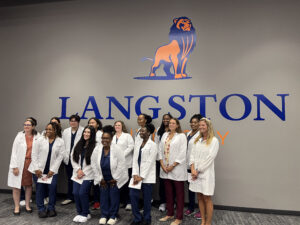
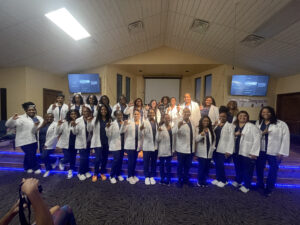
Students in the Langston University School of Nursing and Health Professions participated in white coat ceremonies at the university’s Tulsa and Langston campuses last week, officially completing an honored rite of passage for medical professionals.
The School of Nursing and Health Professions held two white coat ceremonies, one in Tulsa on Tuesday evening and one in Langston on Thursday evening. The students’ families and friends came from all over Oklahoma, the United States, and even from as far as the Bahamas to attend the ceremonies.
“The white coat ceremony is an important rite of passage for these students,” Dr. Teressa Hunter, dean of the School of Nursing and Health Professions, said during Thursday’s ceremony. “They are entering into a profession––this is not a career, it is a profession––and the goal is, in two years, we will all be back here to celebrate their pinning.”
Students from the Langston University – Langston Campus received their white coats Thursday, Sept. 19, 2024.
A white coat ceremony is a rite of passage for students entering medical professions, such as nursing. The School of Nursing and Health Professions holds white coat ceremonies when students begin their clinical studies in their junior year. Students recite an oath to acknowledge medicine’s central obligation of caring for patients and are given their white coats. White coat ceremonies are common practice throughout the United States and in 19 countries.
Thirteen students received their white coats at the LU-Tulsa ceremony on Tuesday, and 25 students received their white coats at the Langston campus ceremony on Thursday.
The School of Nursing and Health Professions offers an accredited Bachelor of Science in Nursing (BSN) at the Langston and Tulsa campuses as well as the Ardmore Site. Additionally, the School offers an online RN to BSN program. LU’s nursing programs are accredited by the Accreditation Commission for Education in Nursing, and the nursing program has been accredited since 1987.
The online RN to BSN program is accepting applications for the fall semester through Sept. 30. The Tulsa and Ardmore sites will accept applications for Spring 2025 admission to the BSN program until Oct. 15. For more information, visit langston.edu.
Langston University alumnus Sherman Lewis was elected as Chair of the Langston University Board of Trustees for Urban Campuses during its meeting Friday, Aug. 2, 2024.
Lewis was unanimously elected to the position by a vote of 6-0, with two members of the board absent.
“It was very humbling for me to be elected by the members of the Langston University Board of Trustees to be chairman,” Lewis said. “It speaks to the desire for the board to be more active and productive in providing advice and counsel to the Oklahoma A&M Board of Regents and the President of Langston University for the future of the institution and its primary function of providing a premier education for its students.
“Together, we will be successful in working toward the betterment of Langston University.”
Lewis has proven himself a stalwart supporter of Langston University throughout the years. Lewis was appointed to the Board of Trustees in 2013 and is the most prolific individual donor in Dear Langston’s history.
In 2022 and for the first time in institutional history, an academic school at Langston University was named in honor of Lewis, establishing the Sherman Lewis School of Agriculture and Applied Sciences.
The Langston University Board of Trustees for the Urban Campuses serves in an advisory capacity to the president, providing insight and guidance concerning its Oklahoma City and Tulsa campuses. At the meeting, administrative representatives of Langston University presented reports from their respective areas, including the site administrators from both urban campuses.
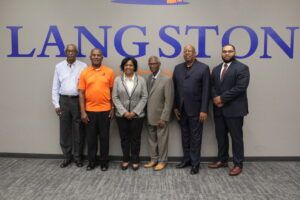
Langston University Board of Trustee members during its Aug. 2 meeting.
According to Lewis, the Board of Trustees plans to work closely with the administration on topics such as buildings and facilities, faculty and staff recruitment, and long-range planning.
“Our goal is to make LU a premier HBCU here in Oklahoma and beyond,” Lewis said.
Additionally, Gayle Maxwell and Avilla Williams will remain as the board’s Vice Chair and Secretary, respectively.
Trustees Rita Combs, Dr. Claud Evans, Colonel Stan Evans, Melvin Latham and Darrell Strong were present during Friday’s meeting held at Langston University – Tulsa.
TULSA, Okla. – Langston University held a dedication ceremony for the naming of the Jack Henderson Allied Health Building at the Langston University – Tulsa Campus Aug. 2, 2024, in honor of former Tulsa City Councilman for District 1, Jack Henderson
Jack Henderson served on the Tulsa City Council from 2004-2016 and, as an alumnus of Langston University, is a staunch ally for Langston University and its extension opportunities in Tulsa.
The original proposal for the Jack Henderson Allied Health Building was submitted in 2015. The expansion was funded through Vision Tulsa. Henderson assisted Langston University in learning about the opportunity and securing the economic development project.
Former Tulsa City Councilman Jack Henderson was honored on Aug. 2, 2024.
“I don’t do things for people to name buildings after me,” Henderson said. “I was trying to help Langston because Langston deserves it, and the community deserves to have Langston at the highest level it can go.”
Members of the Langston University Board of Trustees for Urban Campuses were in attendance during the dedication, in addition to Langston University faculty, staff, and community members.
The Jack Henderson Allied Health Building held its grand opening in March 2023. The state-of-the-art facility includes simulation labs with mannikins powered by artificial intelligence, spacious classrooms, a lecture hall, conference and meeting rooms, and department and administrative office spaces. About 80 students enrolled in nursing and healthcare related programs get to utilize and learn in this facility.
This project began because of the leadership at LU – Tulsa and the Associate Vice President of the campus at the time, Dr. Bruce McGowan. His work, along with former President Dr. Kent J. Smith, Jr., brought this dream to life.
Former Executive Director for LU – Tulsa Dr. Dytisha Davis oversaw the development of the Jack Henderson Allied Health Building from the groundbreaking until the lights turned on for the very first time.
“After the pandemic, you really see the significant role health care plays in our way of life,” Dr. Davis said. “Our nursing students are in the best position to have what they need to prepare them for the field. I really love that building because it has everything we need to prepare our students for the future and to be the best in the state.”
Henderson helped keep Langston University involved in and aware of opportunities for expansion and extension through his role as a Tulsa City Councilman.
President Ruth Ray Jackson speaks during the naming dedication ceremony for the Jack Henderson Allied Health Building at LU – Tulsa.
Langston University President Dr. Ruth Ray Jackson said Henderson’s advocacy on behalf of his alma mater is inspiring, and every alumni and friend of Langston University can assist not just through their monetary donations, but sometimes even more so through their advocacy and relationships.
“You don’t always get to sit under the shade of the trees you plant,” President Jackson said. “But Mr. Henderson, a two-time alumnus of Langston University, gets to see the fruits of his influence each time he drives past this building for years to come.”
In addition to achieving its goals of enhancing access to education in Tulsa, meeting the needs of the healthcare workforce and reducing health disparities in North Tulsa, the Jack Henderson Allied Health Building is significant because of what it represents for a Historically Black College or University in the Greenwood District in North Tulsa.
Executive Director of LU-Tulsa and Associate Vice President for Clinical Affairs Dr. Sherri Smith-Keys said that this project being funded through Vision Tulsa speaks to the City of Tulsa’s commitment to Langston University.
“Langston University is a staple within North Tulsa and the Greenwood District,” Dr. Smith-Keys said. “This place being here allows the community to say, ‘this is my building as well.’”
OKLAHOMA CITY––Langston University, Oklahoma’s only historically Black college or university, has been awarded a $1.25 million grant from the U.S. Department of Education’s Office of Special Education and Rehabilitation Servies (OSERS) to establish a new specialized course of study to prepare personnel to serve school-age children with mental disabilities.
The grant, which will total $1.25 million over five years, will be used to establish the “School-to-Work: Preparing Personnel to Serve School-Age Children with Mental Disabilities (STW-SACMD)” track within the university’s existing CACREP accredited Master’s of Science Degree in Rehabilitation Counseling Program. Dr. Corey L. Moore, a professor in and the founding chair of the Department of Rehabilitation and Disability Studies, will serve as Project Director for this grant.
Moore is also the Principal Investigator at the National Institute on Disability, Independent Living, and Rehabilitation Research (NIDILRR)-funded Rehabilitation Research and Training Center on Research and Capacity Building for Minority Entities (LU-RRTC) and Rehabilitation Research and Training Center on Advancing Employment Equity for Multiply Marginalized People with Disabilities (LU-2ERRTC).
“This initiative is important to the field of disability and employment as it affords our program the opportunity to train and prepare our students for rehabilitation positions that serve school-age children with mental disabilities from minority backgrounds to achieve a smoother transition from the secondary grade school system to the world of work,” Moore said.
The STW-SACMD project presents an exceptional approach to student development through LU’s partnership with the Oklahoma Department of Rehabilitation Services, Tulsa Public Schools and other local education agencies in Oklahoma.
Significant attention will be devoted to cross-fertilizing STW-SACMD and on-going LU-RRTC and LU-2ERRTC trainings, including with webinars and community of practices, to increase students’ knowledge about the delivery of transition and mental health services to school-age children with mental disabilities from minority backgrounds. The goal is to increase the supply of fully credentialed rehabilitation and mental health professionals from diverse racial and ethnic backgrounds available for employment in local educational and/or rehabilitation agencies.
The grant will pay for tuition and fees and will provide a living stipend for 36 students in the Rehabilitation Counseling Program, which was ranked #19 and highest across all HBCUs by the U.S. News & World Report in the publication’s 2023 rankings of Rehabilitation Counseling Programs in America.
“I am immensely proud of the continued success of Dr. Moore and scholars within Langston University’s Department of Rehabilitation and Disability Studies,” said Dr. Ruth Ray Jackson, President of Langston University. “This $1.25 million grant from the U.S. Department of Education is further evidence of the impact of their work in preparing our students for success and addressing needs across underserved communities.
“This significant investment supports our institutional priorities of offering quality academic programs, engaging in purposeful partnerships, and ensuring access to education for all.”
This OSERS priority (ALN 84.325M) focuses on personnel preparation of special education, early intervention, and related services personnel at HBCUs, Tribally controlled colleges and universities, and other minority-serving Institutions under focus area (B)- preparing personnel to serve school-age children with disabilities.
The funded STW-SACMD initiative at LU is in direct response to identified needs related to personnel development issues and demands and the improvement of services and results for school-age children with mental disabilities, especially those from racially and ethnically diverse backgrounds, including those who are multilingual.
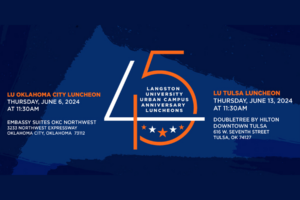
The Langston University urban campuses located in Oklahoma City and Tulsa will commemorate their 45-year anniversaries this June with celebratory luncheons.
These celebrations will honor the hard work done by the faculty, staff and site administrators at these campuses to provide quality educational opportunities for students in Oklahoma City and Tulsa since 1979. They will also serve as fundraisers to support the campuses as they continue to promote excellence in higher education and research in Oklahoma.
In January 2023, Griffin Media made the largest corporate donation in Langston University history when it gifted the university its KWTV News 9 building located at 7401 N. Kelley Ave. in Oklahoma City. The building has become the new home of the LU-OKC campus and a focal point for the Broadcast Journalism program.
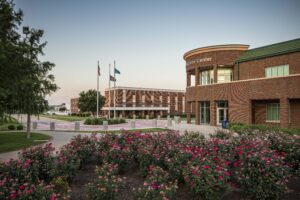
In March 2023, the LU-Tulsa campus held the grand opening for the new Tulsa Allied Health Facility. The 17,000-square-foot building, home to the School of Nursing and Health Professions in Tulsa, includes simulation labs with mannikins powered by artificial intelligence, spacious classrooms, a lecture hall, conference and meeting rooms, and department and administrative office spaces.
These recent additions to each of the LU urban campuses reflect the university’s efforts to expand its footprint and impact in Oklahoma City, Tulsa, and the state as a whole.
LU-OKC will celebrate its 45-year anniversary with a luncheon in the Embassy Suites OKC Northwest on June 6. The deadline to purchase tickets is May 30. Tickets can be purchased for $45 at bit.ly/LUOKC45.
LU-Tulsa will celebrate its 45-year anniversary with a luncheon in the Doubletree by Hilton in Downtown Tulsa on June 13. The deadline to purchase tickets is June 6. Tickets can be purchased for $45 at bit.ly/LUTulsa45.