For many years, Dr. Ryan Johnson and the Langston University Department of Chemistry have worked diligently to create service-learning and confidence-building programs in STEM fields for high school students.
Dr. Johnson’s goal has always been to expand this work statewide, but he’s learned an important lesson during his endeavors.
“Externally funded programs are powerful but temporary,” Dr. Johnson said. “When grants end, students lose access to support.”
That’s why the Chemistry Department has shifted its focus to sustainability by embedding this work directly into Langston University’s curriculum, building permanent pipelines that connect LU students to Oklahoma communities.
The Thomas E. English Chemistry Leadership Initiative is a curriculum-embedded service learning program named after Langston University’s 12th president, who emphasized education for community engagement and service.
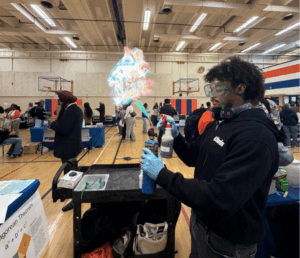
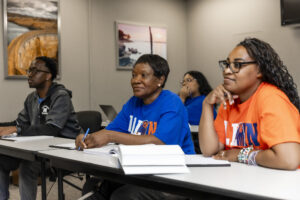
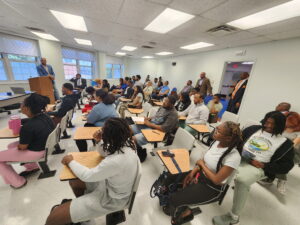
Langston University General Chemistry I students develop and deliver interactive chemistry demonstrations to local high school students, positioning themselves as experts and leaders. During the Fall 2025 semester, more than 25 LU students presented demonstrations at Frederick A. Douglass High School in Oklahoma City on Nov. 11 and 18.
For some of LU’s chemistry students, this was the first time they felt confident calling themselves “scientists.” That change in mindset doesn’t just help students pass chemistry; it shapes their entire STEM journey and career trajectory, according to Dr. Johnson.
General Chemistry I students designed demonstrations on topics like acids and bases, chemical reactions and states of matter. They practiced extensively, then taught 40-minute sessions to Douglass High School chemistry classes.
“This opportunity was encouraging for me because I got a glimpse of how well I can do in the education field as an instructor,” said Oliviya Greenhoward, a General Chemistry I student last semester. “I was so surprised, appreciative of and humbled by the experience.”
The department of chemistry is expanding the Thomas E. English Chemistry Leadership Initiative this semester and has submitted a research proposal to determine whether this type of teaching experience helps students build confidence in STEM fields.
“The goal is to create a replicable model that can scale across Oklahoma and beyond,” Dr. Johnson said. “A sustainable approach to STEM pipeline development that doesn’t depend on external funding cycles.”
Computer science is often ranked among the best college degrees in the United States, and U.S. News & World Report cites diverse career opportunities as one of the many benefits. Among STEM majors, a degree in computer science prepares students to thrive in technology-driven careers. These positions are often in high demand with leading companies who are focused on innovation and growth.
For those interested in computer science, Langston University is an excellent place to earn your degree.
Since spring 2021, the Langston University Computer Science program has boasted a 100% job placement rate. LU’s computer science graduates have all received jobs in their chosen industry, often solidifying their new jobs prior to graduation. In the past five years, Langston University has also realized a 95.5% enrollment growth in computer science.
Reginald Archibald II, Emoree Coley and Jathaniel Wakefield are just three of Dear Langston’s successful computer science graduates. Their preparation in mastering programming, algorithm design, data structures and developing software applications has paid dividends. In 2024, they earned their Bachelor of Science degrees in computer science. Today, they are living their dream with goals of achieving even more.
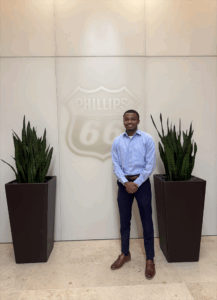
Reginald Archibald II accepted a job as an advisor and developer in commercial analytics for Phillips 66.
Reginald Archibald II
As an advisor and developer in commercial analytics for Phillips 66 in Houston, Texas, Reginald Archibald II is off to a great start. In this position, Archibald leverages his technical skills and tools in helping Phillips 66’s commercial business unit make more informed decisions to provide energy and improve lives.
Prior to graduation, he completed two summer internships as a software engineer with Boeing. Archibald also served as the lead computer scientist for NASA Rock On, where he contributed to the integration of a payload into a two-stage terrier Orion Rocket, and specialized in using a minicomputer to collect atmosphere data.
What Archibald appreciates most about his job is the “great work life balance” and the opportunity to network with fellow professionals.
The most challenging part of his job, Archibald said, is becoming comfortable with the uncomfortable.
”Just using problem-solving skills and networking that I learned from Langston helps me navigate through these real-world scenarios,” Archibald said. “We had conversations amongst peers and professors about scenarios and circumstances we may face in our careers and in the world. These deep conversations not only made me feel prepared in my technical skills and knowledge, but more importantly, my soft skills.”
Ralph Grayson, chair of the computer science department, was instrumental in Archibald’s choice of major. Grayson’s influence continued throughout Archibald’s matriculation, guiding him through internships, projects and coursework.
“I saw how passionate he was about his students’ success,” Archibald said. “He allowed me into his classes my freshman year as a business management major to observe and ask questions of the upperclassmen about their experiences. I was able to witness students who came before me and land amazing careers, and I told myself, that could be me if I buckle down and hit my studies hard.”
Archibald was awarded an Edwin P. McCabe Honors scholarship in addition to becoming an OK-LSAMP scholar. He was also chosen to attend the Thurgood Marshall College Fund Leadership Institute. His other achievements include being named the most outstanding computer science student and the Dr. In Hai Ro awardee for excellence in computer science, and becoming a member of Kappa Alpha Psi Fraternity, Inc.
Grateful for his faith, his family, and LU faculty and professors, Archibald encourages those seeking to pursue their computer science degree to choose Langston University.
“It’s more than a program,” Archibald said. “It is a family – from professors to the students. We uplift one another, hold each other accountable and recognize our peers’ successes.”
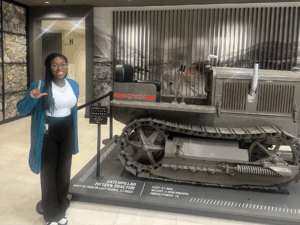
Emoree Coley accepted a job as an Information Technology Analyst with Caterpillar Financial Services Corporation after earning her bachelor’s in computer science at LU.
Emoree Coley
Emoree Coley grew up in Broken Bow, Oklahoma. Today, she is an Information Technology Analyst with Caterpillar Financial Services Corporation in Nashville, Tennessee. She is a part of the Cat Financials program, a two-and-a-half-year rotational program that will allow her to gain experience in different areas of the company before being placed with a permanent team.
Currently, Coley is working with the Cat Vantage Rewards team where she spends most of her time developing and working on tickets in the Salesforce platform. She has also been given the title of Co-Chair for the rotational program, which is a leadership role.
“I have the opportunity to organize events, support recruitment and intern efforts, and represent my fellow members to influence the evolution of the program,” Coley said.
Coley said she loves meeting new people, learning new things, and getting different experiences. The work is different than anything she’s done before, but she said her team makes it easy to figure things out, and she loves the work environment and company culture.
Coley transferred to Langston University from North Carolina Agricultural and Technical State University because of LU’s computer science program and the opportunities she knew she would have.
”(LU) just felt like the right fit for me, and it definitely was!” Coley said. “The classes covered a wide range of topics and taught me how to think critically and solve problems in different ways. The professors were always willing to help and pushed me to be my best.
“Even though what I’m working on now is new to me, the preparation I received at Langston University has made it easier to adjust and keep moving forward.”
Following in her father’s footsteps, Coley says she couldn’t ask for a better example to look up to. Growing up, she watched her father solve problems, build solutions and love his work. That passion made her want to pursue a career where she could feel the same way. He encouraged Coley to explore computers and technology from an early age. From there, her interest kept growing until she realized this was the path she wanted to follow.
She also credits her mom, grandmother, brother, boyfriend, closest friends and Grayson in helping her down this path.
During her LU journey, Coley achieved many awards and recognitions. Some of these accomplishments include being a USDA 1890 Scholar, a two-time Folds of Honor Scholarship recipient, making the Dean’s List every semester, and a triple scholar recipient (OK-LSAMP, TMCF, ITSMF).
Coley served as a member for several student organizations including Women of Purpose, the Computer Science Club, and LU NAACP. A spring 2025 initiate of the Apha Zeta Chapter of Alpha Kappa Alpha Sorority, Incorporated, she is also proud that as a transfer she completed her bachelor’s degree in three years, and received a full-time job offer before her final semester.
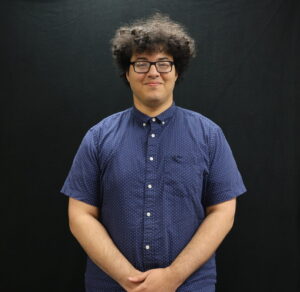
Jathaniel Wakefield secured a job at Paycom in Oklahoma City as a Level 2 Developer and received his first promotion a few months later.
Jathaniel Wakefield
As Oklahoma’s HBCU, Langston University has a legacy of generational enrollment. Jathaniel Wakefield and his family are part of that legacy. His parents, Misty and Jay, met on the Langston Campus while pursuing their education. Two decades later, their son followed in their footsteps.
“I am legacy,” Wakefield said. “On top of being a McCabe Scholar and not having to incur any debt for my education, it made for very persuasive reasons to attend.”
The younger Wakefield represented the family name well. Graduating summa cum laude, he quickly secured a job at Paycom in Oklahoma City as a Level 2 Developer and received his first promotion a few months later. Now as a Software Developer, Wakefield is responsible for the software development of new projects and applications. His duties involve testing and verifying functionality and then working with products to ensure their vision is properly applied.
Wakefield says the most enjoyable part of his job is the opportunity to solve complex problems by leveraging the tools and languages developed at Paycom, and to create a product that heavily impacts small and large businesses alike.”
His connection to Dear Langston allowed Wakefield to meet Grayson. He helped Wakefield understand what computer science is as well as how to apply basic concepts to real world scenarios and in industry use cases.
“(Grayson was) very influential and helped me by providing opportunities and challenges to grow and develop my understanding of computer science and how to apply it,” Wakefield said.
For those considering computer science, Wakefield recommends starting early and being responsible for your own development.
“When you start early, it gives you time to understand and work with complex topics like data structures and algorithms, which are used heavily throughout the industry to solve problems dealing with large amounts of data and information,” Wakefield said. “Being responsible helps your drive to continue learning. Computer science is not a career that allows you to quit learning as more and more things are discovered and leveraged to improve performance and understanding.”
Dry air fills Gloire Houmba Mayindou’s lungs as he runs, his worn shoes beating the concrete surface of the park’s basketball court.
The “Diablo Rouge,” Mayindou’s club team, practice on the outdoor court nearly every day in The Republic of the Congo, his home country. Dribble, stop, shoot, rebound, pass… the 5-on-5 drills of the day were as normal and intense as any other day.
The 11-year-old watches as a shot soars overhead, the ball bouncing wildly between the backboard and rim. Realizing the ball isn’t going in the basket, Mayindou jumps to secure the rebound. He suddenly feels hands, followed by a shoulder, hit him in the back as his feet leave the ground, causing them to swing out from under him. He lands shoulder first on the unforgiving concrete. A teammate falls on top of him.
The impact dislocates his right shoulder.
Young Gloire Houmba Mayindou poses for a photo in the Republic of the Congo.
“I couldn’t shower, couldn’t dress myself, couldn’t eat, couldn’t move,” Mayindou said. “So, dealing with that pain and then knowing that you cannot go to the hospital to get help, man, it’s mentally challenging.”
Access to healthcare, much less physical therapy, is limited in the Republic of the Congo. Even if you can get to a hospital or other healthcare provider, services are so expensive that most people don’t even consider it an option when they are hurt.
This experience, along with his observations of how many people are living with chronic pain without the assistance they need, drove Mayindou to come to the United States and eventually Langston University to earn his doctorate in physical therapy.
Now Mayindou, a first-year physical therapy student, can not only learn his trade in a program that boasts a 92% National Physical Therapy Exam pass rate and a 100% job placement rate, but he can soon get hands-on experience much more quickly than the average physical therapy student when Langston University completes construction on a physical therapy clinic being built right on the Langston Campus.
Construction has already begun on this Physical Therapy Clinic, which is being funded through Title III grants.
Dr. Elicia Pollard, Dean of the School of Physical Therapy, said this clinic will not only have an impact on students at LU, but on the community as well.
“There’s no physical therapy clinic here (in Langston),” Dr. Pollard said. “If locals want services, they’ll either drive or do without. So, we are going to fill that need there. We are going to be offering this clinic to people who are uninsured or under insured or low-income families. We are going to eliminate potential barriers such as transportation and cost.”
The closest clinics to the town of Langston are in Guthrie, which forces those who seek assistance to drive upward of 20 minutes for care.
The clinic is not designed like a typical medical facility with a labyrinth of halls and little rooms. The Langston University Physical Therapy Clinic will have an open concept with only a few rooms with doors for private needs. This allows for the area to be reconfigured for different patient populations and research needs.
Dr. Anthony Sylvester, Director of Clinical Services at Langston University, has been instrumental in the development and design of this clinic since its inception. As a two-time Langston University graduate with experience running small, rural health clinics in addition to 25 years of experience as a clinical instructor, he understands the importance of ensuring the space is being used to its fullest potential to optimize client and student outcomes.
Because of his experiences, Dr. Sylvester understands how unique this clinic is to Langston University.
“This isn’t typical of other physical therapy schools,” Dr. Sylvester said. “I think we’re going to be pretty unique in reference to what most schools, a lot of PT schools, will have. We’ll have that daily experience here. Students will see a patient they’ve worked with progress through their care.”
The Physical Therapy Clinic will also offer opportunities for students to participate in research, different forms of patient care, community events and much more.
This level of experience is why students like Mayindou come to Langston University to study physical therapy.
“The first time I learned that they were building a clinic, everyone, at least all my classmates, we are all so excited,” Mayindou said. “That’s kind of a dream come true. In our field, there’s nothing better than experience. To work with a patient one-on-one is a different thing.
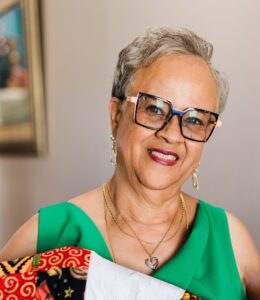
Beverly Huggins Kirk, a Langston University alumna, master quilter, educator and cultural historian, found her public voice later in life; now she urges seniors across America not to wait for certainty before stepping into purpose.
“Uncertainty has a way of making people pause, but I’ve learned that waiting for the ‘right time’ can quietly become a decision to stay silent,” Kirk said. “My message to seniors is simple: Today is the time to act.”
In 2026, with leadership priorities, economic pressures, and growing concern about aging, loneliness and relevance, many seniors have reassessed their place in a rapidly changing world. After decades in corporate America, Kirk discovered her creativity and calling had intensified.
At a stage where many have been encouraged to slow down, she leaned forward, transforming quilting into a powerful medium for faith, healing, history and legacy.
“Life didn’t become quieter for me at 72,” Kirk said. “It became clearer.”
That reassessment became a turning point.
Kirk is an LUSB alumna and the founder of Scissor Tales Guild, Oklahoma’s first African American quilt guild.
Kirk is the founder of Scissor Tales Guild–Oklahoma’s first African American quilt guild–and the creator of “A Maker of Quilts,” a limited-edition, 26-page, full-color booklet that weaves together quilt photography, personal reflection and cultural storytelling. Her quilts address themes that resonate deeply today, such as resilience across generations, healing after loss and grief, and faith in uncertain seasons.
“America is like a quilt,” Kirk wrote in the booklet’s opening pages. “Many patches. Many stories. Held together by something stronger than we can see.”
Although innovation, leadership and creativity can often be associated with youth, Kirk represents a growing but often overlooked truth: some voices are meant to rise later. Her message aligns with that of the mission of Langston University’s School of Business—to elevate purpose-driven leadership across the lifespan.
“Beverly Kirk embodies what so many seniors need to see right now,” said Dr. Daryl Green, dean of LUSB. “In a time when uncertainty can paralyze people, she chose expression over fear. Her work reminds us that our later chapters can be our most influential.”
Kirk’s work speaks to a generation navigating transition in an era defined by disruption, reminding people they can reinvent, reengage and lead at any age.
For the second consecutive assessment cycle, Langston University School of Business (LUSB) seniors scored in the top 1% nationally on the rigorous Peregrine Outbound Business Exam.
LUSB’s graduating seniors performed nearly 20 percentage points above national Accreditation Council for Business Schools and Program (ACBSP) benchmarks on the Peregrine Outbound Business Exam for Fall 2025 in a fully proctored classroom setting and under stricter testing conditions than in the spring. This performance follows LUSB graduates’ success on the Peregrine exam in Spring 2025.
Dr. Daryl Green, Dean of LUSB, said the students’ success reflects the hard work of the faculty and the students’ remarkable resilience.
“For the Fall 2025 term, our business seniors once again ranked in the top tier nationally on the Peregrine Outbound Business Exam,” Dr. Green said. “This time, under fully proctored, in-class conditions. Their average score of approximately 78.6% closely aligns with our Spring 2025 results, which were taken online and unproctored. This consistency confirms the integrity and authenticity of our students’ learning outcomes.”
Every year, graduating business students take the Peregrine Outbound Business Exam, a rigorous assessment administered by over 500 colleges and universities around the world. The exam evaluates students’ mastery across core business disciplines such as finance, economics, management, marketing and business ethics.
LUSB graduates excelled in several core disciplinary areas.
In Information Management Systems, graduates averaged 84%, which is significantly higher than the national benchmark. In Economics, graduates averaged in the low-mid 80s, which is about 20 points above ACBSP norms. In Quantitative Research & Statistics, students averaged 81%. In Legal Environment, students scored in the low 80s, outperforming most of their regional peers. In Marketing & Finance, students scored in the high 70s.
Ashley Dillard, director of Client Solutions at Peregrine Global Services, commended LUSB’s performance over the past two semesters.
“Langston University demonstrates an exceptional commitment to the growth,” Dillard said. “At Peregrine, we partner with many institutions focused on continuous improvement, and it is gratifying to collaborate with leaders like Dean Green who are deeply dedicated to the advancement of their students and academic programs.”
LUSB has made several strides to improve student learning outcomes and increase educational opportunities in recent years. Some of their recent accomplishments include increasing LUSB enrollment by more than 20% since 2024; partnering with Oklahoma State University’s Spears School of Business to launch a 4+1 program for LU students to earn master’s degrees; and hosting national events such as the HUxPNC Entrepreneurship Summit.
Langston University remains committed to providing high-quality educational opportunities for Oklahoma and beyond. Anyone interested in applying for LUSB, or any other LU program, can apply online at langston.edu/apply-now.
Dr. Charles Mambula was one of four economics professionals chosen to speak at the Renewed Hope USA General Meeting at the end of October, providing him the exciting opportunity to contribute to the discussion and share insights about how to grow and develop the Federal Republic of Nigeria.
Renewed Hope USA is a group concerned about the economic, infrastructural and social development of Nigeria. It is a group of Nigerians in the Diaspora from the United States, and it seeks to promote Nigeria’s Renewed Hope AGENDA. This includes finding ways to reform the economy to deliver sustained inclusive growth; focusing on education, health and social investment as to development; enhancing infrastructure and transportation as enablers of growth; and strengthening national security for peace and prosperity.
Dr. Mambula, who’s originally from Nigeria, is an associate professor in the LU School of Business. Because of Dr. Mambula’s previous work with similar groups, including ones with special interest in poverty alleviation, social and infrastructural development, and education, Renewed Hope USA invited Dr. Mambula to share his thoughts on how Nigeria can grow through Foreign Direct Investment (FDI).
“The presentation was basically to identify some of the progressive Foreign Direct Investment that is currently being carried out by the administration of President Bola Ahmed Tinubu and his team, while showcasing opportunities within the USA space and other parts of the world that Nigeria can take advantage of to help with the AGENDA for a better country,” Dr. Mambula said.
Companies or businesses participate in FDI when they invest in a company or business based in another country. For example, when foreign auto manufacturers open plants in the United States, that’s a form of FDI.
In his presentation, Dr. Mambula explained the benefits of FDI and shared his ideas for how Nigeria could promote FDI. As an expert on the topic, he was excited for a chance to present on FDI to an international audience. The General Meeting also offered an opportunity for Nigerian government officials and people close to government to have an opportunity to learn about his work.
Most importantly, he was excited for an opportunity to potentially contribute to the continued development and growth of his home country.
“I believe the global village idea for such a gathering will positively foster public engagement, showcase capacities and capabilities, and more importantly, promote opportunities for more collaborations,” Dr. Mambula said.
Standing at the front of the classroom on a Wednesday evening, Dr. Ruben Herron knows he’s exactly where he’s supposed to be.
As he leads the room of graduate students in an energetic discussion about client-provider dynamics in rehabilitation counseling, it’s hard to imagine there was a time when he felt like he didn’t have a calling. But for most of his early adulthood, Dr. Herron struggled to find his place in the world.
Throughout his 20s and 30s, Dr. Herron tried his hand at several careers, but he could never find a job where he felt truly fulfilled. Years of trial and error in various fields eventually brought him to Langston University to study rehabilitation counseling, and a chance opportunity years later brought him back to LU to teach. Now, he knows there was always a perfect career out there for him.
He just had to find it.
A Rough Beginning
Ruben Herron moved around a lot when he was a kid.
His family was from El Paso, Texas, but his dad was in the Army. As they accompanied him to each new duty station, the Herrons lived in places like Germany and England before eventually making their way to Wichita Falls, Texas.
Herron moved back to Wichita Falls after his time in the Marine Corps, but he had a hard time finding a job. Photo Credit: Craig Taylor Photo/AdobeStock
When Herron graduated high school, his father offered to pay for him to attend the local community college, but Herron didn’t want to go to school. He decided to enlist in the Marine Corps instead, and he spent a year in California at Camp Pendleton before he got out and moved back to Wichita Falls.
He returned to Texas during the 1980s “oil glut,” and work was hard to find. He took his dad up on his offer to pay for school, but Herron wasn’t a good student and soon dropped out. He got a job doing manual labor at a pipe yard until one Monday, he came to work to find out he’d been laid off.
“Suddenly, we all got pink slips,” Herron said. “And then there were no jobs in Wichita Falls because the big factory shut down. I mean, everybody was getting laid off.”
Herron and his wife decided it was time to leave Texas, so they moved to Tulsa, where his wife’s aunt lived. They arrived in two cars with three kids and a dog, and they were disappointed to find the job market wasn’t much better than it had been in Wichita Falls. Regardless, Herron was determined to provide for his family, and he finally found a part-time job as a sanitation worker.
It was hard, dirty and exhausting work, but Herron persevered. Eventually, he left the trash company for a job at Climate Control. He did his best to provide for his wife and kids, and he was grateful to receive government assistance during those days.
In the late ‘80s, Herron finally felt like he had a breakthrough. He found a new job as a maintenance man for an apartment complex, and he and his family moved out of government housing. For the first time in a while, they even had some money left over after their bills.
Herron and his wife began taking classes at TCC whenever they could afford it.
“They paid part of our rent at the apartment complex we was working at, and I was able to pick up a lot of overtime,” Herron said. “And so, we started to move up the ladder a little bit.”
During this time, Herron felt like he was starting to understand the importance of school. A better education could lead to a better job, and Herron wanted a better job. He and his wife decided to start taking classes at Tulsa Community College (TCC) together in bits and pieces as they could afford it.
Despite their improved circumstances, Herron’s success was short lived.
He felt dissatisfied with his life, and he began facing mental health issues. He sought out unhealthy coping mechanisms, and he ended up getting fired from the apartment complex. His marriage suffered because of it, and his wife left him.
Herron fell into a depression. He felt angry, hurt and frustrated, and he didn’t know what to do. He found himself involved in illegal activities, which led him to spend two and a half years in a correctional facility.
“Because of my own stubbornness, my own ignorance, my own selfishness, I chose the path I chose,” Herron said regretfully.
He felt like he had hit rock bottom, and he still has a lot of emotions to process when he thinks about that time. But he soon discovered the only thing to do was keep moving forward.
Never Too Late
When he was released from the correctional facility, Herron was determined not to go back.
He began working at Bennett Steel Inc. as a sandblaster, a job he thoroughly enjoyed because of how peaceful and almost meditative it was. He earned good money, and he felt like he was starting to move up in the world again. Most importantly, Herron met a man who would help him change his life: the company’s owner, Dave Bennett.
Seeing a counselor changed Dr. Herron’s life for the better.
Bennett was a great boss. He cared about his employees’ wellbeing, and he became a mentor for Herron. It meant a lot to Herron to have someone looking out for him. But as time went on, he found himself becoming restless again.
He liked his job and his boss, but he was still dealing with mental health issues. He still felt dissatisfied with his life. He began acting out in small ways, and Bennett noticed immediately.
Bennett wasn’t about to let Herron slip into old habits, so he convinced Herron to see a counselor.
“Through Dave Bennett’s help, I went and started seeing a counselor, which was really, really, really transformative,” Herron said. “She made me go there with myself, but she sort of held my hand. Like, ‘You know this is what you want. You know you want to let it out. Let it out. Trust yourself.’ And that was the biggest process.”
Counseling changed Herron’s life, and he found a kinder, softer version of himself. He learned how to take care of his mental health and how to cope with negative thoughts. He became someone he liked to be.
He continued to see the counselor while he worked at Bennett Steel, but the feelings of restlessness and dissatisfaction never went away completely. Once, he was having a particularly bad day when Bennett walked in, and he realized what he needed to do.
“Dave Bennett walks in, and I said, ‘Dave, will you loan me $375 bucks so I can go back to TCC?’” Herron said. “And he reached in his pocket and said, ‘Yeah.’ So that’s how I started back at TCC.”
In 2001, Herron went back to school. It was hard to study while working full time, and he faced some unexpected challenges, such as rapidly changing technology, but he was determined to see it through.
In 2004, he left Bennett Steel for a job at 12&12 as part of their substance abuse group counseling team, and he finally felt like he had found a calling. This motivated him as he continued his classes at TCC, especially when he worked two jobs in 2006 to buy his first house. In 2009, Herron graduated from TCC.
“I earned my associates after 28 years,” Herron said. “I earned my associates, and I didn’t know what to do. Then, a classmate of mine suggested I come up here (to Langston University), and I met Dr. (John) Sassin, and within five minutes of walking through his door, I was enrolled in the bachelor’s program.”
After earning his associate’s degree at TCC, Dr. Herron enrolled at Langston University and earned his bachelor’s degree in Rehabilitation Services before going on to earn his master’s degree in Rehabilitation Counseling.
Keeping the Momentum
Herron had learned he could be a good student, and he wanted to keep his momentum going as he pursued a career in counseling. He enrolled at LU-Tulsa in the rehabilitation services bachelor’s degree program in 2009, and he had a better college experience than he could have imagined.
A generous scholarship relieved him of the financial burden of his degree, and he felt like the doors to an untold wealth of knowledge had been opened. His professors became cherished mentors, and he truly understood what it meant to be part of the LU family.
In 2011, Herron had the great honor to walk across the stage at Langston University’s graduation ceremony with his daughter. A couple of months later, he was back in the classroom again as a student in LU’s rehabilitation counseling master’s program.
He continued to work at 12&12, and he continued to enjoy school. One day, Dr. Mary Ramey, an adjunct professor in the rehabilitation counseling program, kicked her shoes off in the middle of class and sat on a table. That behavior baffled Herron, who had always thought of academics as more formal and aloof. But Dr. Ramey seemed normal.
“It just sounds so strange, but that’s what it was to me,” Herron said. “And she looked right at me on that table and said, ‘You could be (a doctor) if you want to.’ And that’s the night it started. She inspired me.”
After that class, Herron contemplated pursuing his doctorate for weeks until one night, he realized that if he wanted to do it, he couldn’t wait.
The day after making that decision, he told Dr. Sassin about his new goal. Having taught and advised Herron for almost four years, Dr. Sassin was supportive of his plan. He helped Herron connect with faculty at the University of Arkansas, and after graduating with his master’s from LU in 2013, Herron enrolled in the University of Arkansas’ doctoral program in counselor education and supervision.
Dr. Herron returned to Langston University as a professor in the very program he graduated from, and he loves teaching and providing mentorship to students.
Herron went to school part time, making the two-hour drive to Fayetteville twice a week. It was difficult, and he even ended up sleeping in his car some nights, but he persevered. In 2017, he officially earned his professional counseling license and began working on his dissertation with Dr. Ramey as his dissertation committee chair.
Everyone Has a Place
Unbeknownst to Herron, other LU faculty had been keeping track of his progress throughout his doctoral program, too. In 2017, a faculty position opened in the LU-Tulsa rehabilitation counseling program, and Dr. Phillip Lewis reached out to Herron to invite him to apply.
“He had already gained his CRC and his LPC, which he is a Certified Rehabilitation Counselor and a Licensed Professional Counselor,” said Dr. Lewis, the graduate coordinator for the rehabilitation counseling program at LU-Tulsa. “So, it was a perfect fit for me to bring Dr. Herron in to fulfill that role, because I didn’t lose anything. I just kind of transitioned, and I didn’t have to worry about a person not having the credentials.”
Dr. Herron had never imagined he would become a teacher, but the opportunity to come back to Dear Langston was too good to pass up. He has thrived in the role since then.
Dr. Herron’s teaching style draws a lot on his own life experiences. As someone who has received counseling, administered counseling and studied counseling extensively, he brings invaluable insights into the classroom. His classes are often filled with lively discussions, and students walk away feeling like they’ve learned.
As both a friend and supervisor, Dr. Lewis loves working with Dr. Herron. According to Dr. Lewis, Dr. Herron’s unwavering positive attitude often lifts the spirits of the whole office.
“He’s been an excellent colleague, and to be honest with you, I don’t think I could’ve found better,” Dr. Lewis said. “Him working here, he’s a product of this program. He’s homegrown, you know. And I think it’s a blessing to kind of work your way back home sometimes.”
After so many years of struggling with feelings of dissatisfaction in his life, Dr. Herron is proud to say he loves his job. He has found a balance between work and his family, and all eight of his dimensions of wellness are being fulfilled.
When he was a young man, he never could have guessed where he’d be today. He loves teaching because it allows him to pass down the mentorship that he, too, received at LU, and he feels like he’s giving back to his community. Now that he has found his place in the world, he has no plans to slow down any time soon.
“I would say to young people, old people, it’s never too late,” Dr. Herron said. “If you look at all the possible jobs out there, there is a job for you that you can be passionate about, that you can enjoy doing. So don’t give up. Stay encouraged. Have some faith and trust yourself.”
Dr. Herron loves his job, and he knows that he has finally found his place in the world.
OKLAHOMA CITY–Langston University’s Department of Rehabilitation and Disability Studies earned $3.125 million in grants from the U.S. Department of Education to support the university’s rehabilitation programs, including funding 96 full-tuition scholarships over the next five years.
The department has been awarded three grants; one is from the Office of Special Education and Rehabilitation Services (OSERS), and two are from the Rehabilitation Services Administration (RSA).
The first grant, funded through the RSA and totaling $1 million over five years, will establish a specialized Pre-Employment Transition Services to Youth with Mental Disabilities track within the department’s master’s program for Rehabilitation Counseling. This will include funding the tuition, fees and a living stipend for 30 graduate students over five years.
The second grant, worth $1.25 million and funded by OSERS, will establish a new track within the undergraduate Rehabilitation Services bachelor’s degree program. The new track will be School-to-Work: Preparing Personnel to Serve School-Age Children with Intellectual and Developmental Disabilities, and the grant will fund the tuition, fees and a living stipend for 36 undergraduate students over the next five years.
The last grant is from the RSA and will pay out $875,000 over five years. This grant will establish another new track within the Rehabilitation Services program: Pre-Employment Transition Services to Youth with Intellectual and Developmental Disabilities (including Autism). It will fund 30 undergraduate scholarships over the next five years, which will include tuition, fees and a living stipend.
“Langston University is honored to receive this transformative investment from the U.S. Department of Education,” said President Ruth Ray Jackson. “These three grants reflect our unwavering commitment to preparing highly qualified professionals who will serve youth with mental, intellectual, and developmental disabilities.
“I commend Dr. Corey Moore and the Department of Rehabilitation and Disability Studies for their leadership in advancing inclusive education and workforce development. This funding strengthens our mission as a land-grant institution and expands access to high-impact academic programs that meet urgent national needs.”
Dr. Corey Moore is the Founding Chair of the Department of Rehabilitation and Disability Studies.
Undergraduate students interested in the Rehabilitation Services program who wish to apply for the scholarships within either track must have completed at least 41 hours of general education courses prior to applying. Interested individuals should contact Professor Emanual Lewis, the Rehabilitation Services Program Coordinator at LU-Tulsa, via phone at 918-902-3184 or via email at emanual.lewis@langston.edu.
Graduate students interested in the new track within the Rehabilitation Counseling program should contact Dr. Andre Washington, the Rehabilitation Counseling Program Coordinator at LU-OKC, via phone at 405-530-7525 or via email at andre.washington@langston.edu to apply for scholarships.
“The awarding of these grants, especially three at the same time, speaks to the relevance and value of the work being done here at Langston University in the Department of Rehabilitation and Disability Studies,” said Dr. Elizabeth Albright, Interim Dean of the School of Education and Behavioral Sciences. “These scholarships enhance what Langston University already does to support students through degree completion. By providing financial support, not only are students able to graduate without adding debt, but they will be stronger in their field because their primary focus can be school.”
These new grant projects present an exceptional approach to student development through LU’s partnership with the Oklahoma Department of Rehabilitation Services, Tulsa Public Schools and other local education agencies. Significant attention will be devoted to cross-fertilizing these academic initiatives and ongoing RRTC trainings to increase students’ knowledge of the delivery and transition of mental health and developmental disability support services to school-age children and youth.
The goal is to improve the supply of fully credentialed rehabilitation, mental health and disability professionals for employment in local educational and/or rehabilitation agencies.
“These innovative federally funded educational initiatives are critical for training and preparing our undergraduate and graduate students within the department to help meet the demands of human service systems addressing the current national youth mental health crisis as well as the pre-employment service support needs of school-age children and youth with intellectual and developmental disabilities” said Dr. Moore, the Founding Chair of the Department of Rehabilitation and Disability Studies and project director for all three grants.
The OSERS priority focuses on personnel preparation for special education, early intervention and related services personnel at Historically Black Colleges and Universities, Tribally controlled colleges and universities, and other minority-serving institutions. The RSA priorities are consistent with the purpose of the Rehabilitation Long-Term Training program, which is to provide financial assistance for academic training areas of personnel shortages in vocational rehabilitation.
These funded initiatives at Langston University are in direct response to identified needs in personnel development, as well as to improve services and outcomes for school-age children and youth with mental, intellectual and developmental disabilities.
It was a normal fall day in Oklahoma City, and Terrance Grayson was feeling restless. He had called in sick to work that morning, but he wasn’t physically ill. He was just sick of his job.
Grayson had been working for the same financial lending company since graduating college, and he was good at his job. He had risen quickly to a managerial position and was making good money, but he hated the work. He wanted to do something different with his life. He wanted a career that felt fulfilling and where he could help others. He just wasn’t sure what that career was.
That day, he told himself that because he hadn’t gone to work, he needed to find something productive to do. He decided to go for a walk. While strolling down the street, he saw a sign for Langston University and made an impulse decision to walk inside. At the front desk, Grayson asked what graduate programs they had available, and that’s when he learned about LU’s brand new master’s degree in Rehabilitation Counseling.
“I just walked up to Langston (University) and asked them if they had any programs,” Grayson said. “I literally walked in off the street and met with Dr. Moore, and I talked with him about it and filled out an application and just started down that path.”
Dr. Corey Moore is the Founding Chair of the Department of Rehabilitation and Disability Studies.
That was in 2000. Grayson was part of the inaugural class for the Rehabilitation Counseling master’s program. Now, he has been working for Rose State College in Midwest City, Oklahoma, for almost two decades, and he loves his job.
The Rehabilitation Counseling master’s program came together as the result of a partnership between LU and the Oklahoma Department of Rehabilitation Services. The two institutions collaborated on a grant proposal for the U.S. Department of Education’s Rehabilitation Services Administration and were awarded $500,000 to hire faculty, fund student scholarships and fund student conference travel.
Dr. Corey Moore was hired in October 2000 to create the program, and he became the Founding Director. Dr. Moore came from the University of Arkansas–Fayetteville’ Rehabilitation Research and Training Center on Persons who are Deaf and Hard-of-Hearing, where he served as a research assistant professor. His experience and expertise have shaped the LU program for the past 25 years.
“I saw the mission of the graduate program in rehabilitation counseling as to train rehabilitation and mental health professionals to meet the needs of people with disabilities,” Dr. Moore said. “Teaching, research and service.”
For months, Dr. Moore worked to recruit faculty and students while putting together a curriculum worthy of accreditation. In Spring 2001, the program officially launched at the LU-Oklahoma City campus with its first cohort of 18 students.
Alongside Grayson, Sharon Caldwell was a member of that inaugural class.
Caldwell was a graduating senior in LU’s Health, Physical Education and Recreation program when she first heard about vocational rehabilitation counseling. She had originally come to LU with the goal of becoming a physical therapist, but as she approached graduation, she was no longer sure that’s what she wanted. At her professor’s recommendation, she decided to attend an information session about the new Rehabilitation Counseling program.
“Initially, when I went to Langston, I felt like my passion was physical therapy because I knew I wanted to help people in some type of way,” Caldwell said. “When I heard about the rehab counseling program, those individuals work with individuals with disabilities to help them… to make them become more independent. The fact that the vocational rehab counselor was helping individuals achieve something, I think that kind of sparked my attention.”
Sharon Caldwell was a member of the first cohort for the Rehabilitation Counseling master’s program.
Grayson and Caldwell were excited about the program and the opportunities it offered them. With his scholarship, Grayson was able to quit the job he hated and focus on school full time. As she progressed through her classes, Caldwell discovered a clearer path to her future.
Their cohort became close friends during school. They joked they were “the guinea pig class” because the program was still trying to determine the best ways to do things, but the students knew they were still getting a quality education. They liked working with one another, they liked their professors and, even while working for hours on research papers, they were having fun learning.
“I’d say, educationally, it was the best experience I’ve ever had,” Grayson said. “They opened all these doors to me and provided me with all the support, and without that, I’m not sure I would’ve been able to do it… The environment was just so nurturing that it was everything I needed at the time.”
All 18 members of the first cohort graduated from the program on time and found work in the counseling industry. Grayson worked for the Oklahoma Department of Rehabilitation Services for almost three years before he began working at Rose State. He has held various positions there, and he is now the Director of Academic Outreach.
Caldwell completed an internship/practicum with one of her professors at PROS and Associates during school, and she accepted a full-time position there after graduation. She worked as a rehabilitation counselor for three institutions before accepting a position as a counselor with the U.S. Department of Veterans Affairs in 2012. Since then, she has worked in the Veterans Readiness & Employment Program in Oklahoma City, and she is now the Employment Coordinator.
The first few cohorts that went through the Rehabilitation Counseling program were so successful, the university decided to expand the program in 2004 and offer the master’s degree at the LU-Tulsa campus, too. In 2008, LU-Tulsa added a bachelor’s in Rehabilitation Services, and the School of Education and Behavioral Sciences officially created the Department of Rehabilitation and Disability Studies with Dr. Moore as the Founding Chair.
The Rehabilitation Counseling program earned its accreditation through the Council for Accreditation of Counselors and Related Educational Programs. In 2013 the Department of Rehabilitation and Disability Studies established LU’s first Rehabilitation and Research Training Center (RRTC) that conducts research on capacity building for minorities. A second RRTC has since been established that conducts research on advancing employment opportunities for people with disabilities with the greatest support needs.
Caldwell encourages current LU Rehabilitation Counseling students to apply to work for the VA.
The RRTCs are nationally recognized and funded by the National Institute on Disability, Independent Living and Rehabilitation Research. Through the RRTC, the Department of Rehabilitation and Disability Studies established a post-doctoral program for recent doctoral graduates to train in advanced research methodology and statistics. The RRTC has hosted seven doctoral fellows over the past eight years, all of whom have gone on to work at other universities, federal agencies or community-based rehabilitation service programs.
All of this grew from the master’s degree.
While they celebrate this milestone anniversary for the Rehabilitation Studies graduate program, Dr. Moore and the faculty in the Department of Rehabilitation and Disabilities Studies continue to look for ways to improve and grow the program. They are focused on workforce needs. They try to listen to their community and be responsive to the demands of employers. They have created an informed and research-based curriculum that prepares graduates for the demands of a career as a vocational rehabilitation counselor.
“It’s been 25 years of joy and of just a remarkable journey,” Dr. Moore said. “I’m excited about that, happy about that, thankful for it. We look forward to continuing to push the program forward in the future, and I think great things are beyond the horizon.”
Langston University’s School of Business and Oklahoma State University’s Spears School of Business have entered into a Memorandum of Understanding (MOU) establishing a new 4+1 Business Degree Pathway.
This agreement provides Langston University students majoring in Business the opportunity to complete both their bachelor’s and master’s degrees in just five years, streamlining their path toward advanced business leadership and analytics careers.
Through this partnership, qualified Langston University students can seamlessly transition into OSU’s Master of Business Administration (MBA), Master of Science in Business Analytics and Data Science (MS BAnDS), Master of Management Information Systems (MS MIS), Master of Quantitative Finance (MSQF), and Master of Hospitality and Tourism Management (MS HTM) programs. Students will have access to graduate-level coursework during their senior year, allowing them to accelerate their graduate degree completion while saving time and money.
“This partnership reflects our shared commitment to creating academic pathways that strengthen Oklahoma’s business and innovation ecosystem,” said Dr. Daryl Green, dean of the School of Business at Langston University. “It gives our students a competitive advantage in pursuing high-demand careers in business, analytics and leadership.”
The collaboration further aligns with Langston University’s mission to provide transformative educational opportunities and expand graduate pathways for underrepresented students in business and technology disciplines.
“We’re excited to partner with Langston University to create this 4+1 pathway for their business students,” said Dr. Jim Payne, dean of Spears Business. “Our campuses are just 20 miles apart, and this kind of collaboration strengthens Oklahoma’s workforce by providing more students with access to advanced business education. We look forward to welcoming Langston students into our graduate programs and helping them build successful careers in business.”
LU students wishing to take advantage of these new pathways must be juniors with at least 90 undergraduate hours completed at the time of applying. All students must take the GMAT exam and complete OSU’s standard graduate school application found at grad.okstate.edu/apply.
Interested participants will meet with their LU advisor to complete a general eligibility screening and discuss next steps. After meeting with their LU advisor, they will need to set up an appointment with a Spears advisor for their program of interest. Their advisors will help them navigate the process of applying to the master’s program early at OSU, and they will be equipped with timelines for the next available semester.
Langston University is Oklahoma’s HBCU. Made up of six academic schools, LU provides students with a world-class education that includes hands-on learning through impactful research and beneficial internships. The Langston University School of Business (LUSB) prides itself on producing change agents in the world of business. Nationally accredited by the Accreditation Council of Business Schools and Programs (ACBSP), LUSB offers more than 10 degree programs that prepare graduates to jumpstart their career goals. In 2025, LUSB graduates ranked in the top 1% nationally on the Peregrine Business Exam.
Emboldened by its motto “the Power of Personal,” Spears Business prepares students in an environment where human connections are paramount and academic excellence is strengthened by interpersonal prowess. The results speak for themselves, as U.S. News & World report ranked Spears Business No. 8 for its online bachelor’s programs and No. 11 for its online MBA, while Fortune listed its MS BAnDS program No. 2 in the country behind only Harvard University. With 6,744 students, Spears Business is the largest college on the OSU campus.
















 Langston University is Oklahoma’s HBCU. Made up of six academic schools, LU provides students with a world-class education that includes hands-on learning through impactful research and beneficial internships. The Langston University School of Business (LUSB) prides itself on producing change agents in the world of business. Nationally accredited by the Accreditation Council of Business Schools and Programs (ACBSP), LUSB offers more than 10 degree programs that prepare graduates to jumpstart their career goals. In 2025, LUSB graduates ranked in the top 1% nationally on the Peregrine Business Exam.